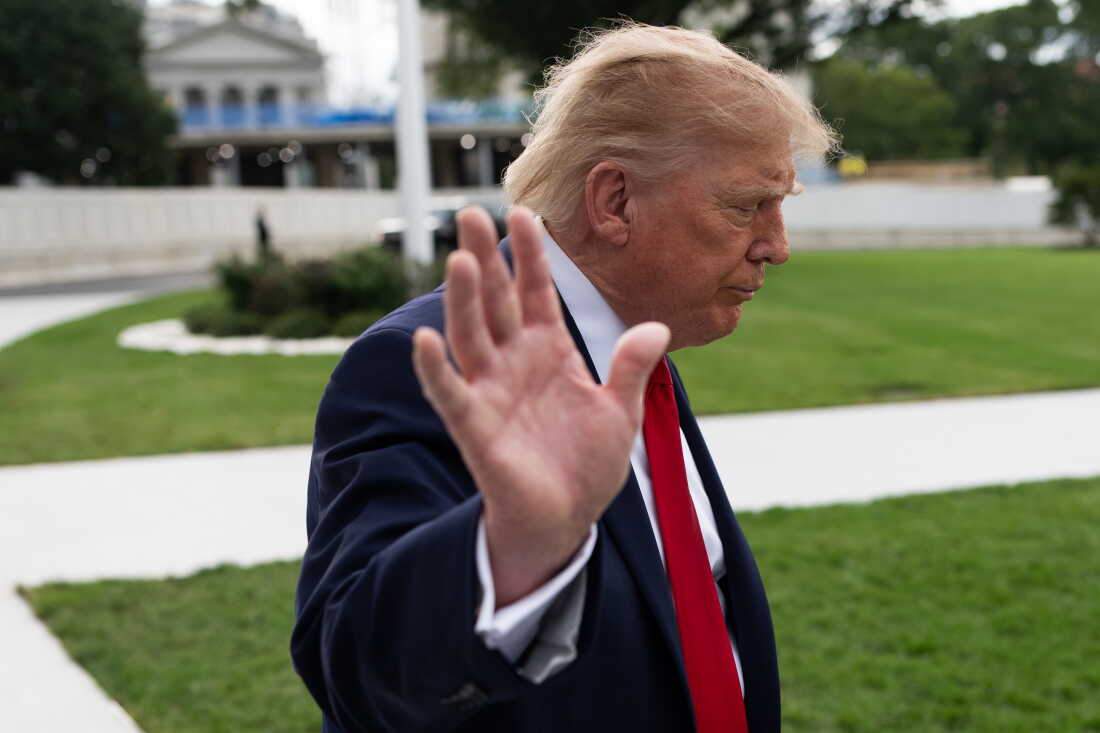
President Trump waved to the media on the South Lawn of the White House on September 26, 2026, before departing for Knoxville, Tennessee, where he would attend a college football game between the University of Tennessee and the University of Texas. As he left, he addressed reporters, mentioning the Iranian plan to reopen the Strait of Hormuz, which he rejected, stating the deal “would not be acceptable.” Trump did not elaborate but indicated a preference for different terms, saying, “I like making a deal too, but that deal would not be acceptable.”
The Iranian government proposed reopening the strait and resuming negotiations with the U.S. at the United Nations General Assembly in New York. Iranian Foreign Minister Abbas Araghchi detailed the offer to reporters, explaining that it included a “concrete seven-day plan” communicated through Qatar. Iran had initially closed the strait following an attack by the U.S. and Israel on February 28, leading to significant disruptions in the global oil supply. Araghchi stated, “If the necessary conditions are met, the strait can be reopened, and normal maritime passage restored within seven days. The choice now rests with the United States.”
The recent proposal mirrors a “memorandum of understanding” discussed between the U.S. and Iran in June. That agreement aimed to halt hostilities and restart ceasefire talks, offering Iran relief from a U.S. naval blockade. It also included sanction easing and the release of frozen Iranian assets, with Iran agreeing not to pursue nuclear weapons and to reopen the Strait of Hormuz. However, disputes over the vague wording, particularly regarding control of the strait, led to the collapse of the June agreement, and both nations resumed their military strikes.
Araghchi emphasized that the actions expected from the U.S. are not new and are outlined in the MoU, stating, “They are all already in the MoU. They are already under the commitments of the United States. So we don’t see any difficulty to implement them.”
In an interview set to air on CBS, Iranian President Masoud Pezeshkian expressed Iran’s willingness to honor its commitments, urging the U.S. to demonstrate no intentions to overthrow Iran’s government. He elaborated, “If the United States agrees to proceed in that way, everything will return to the way it was before. Because right now, it’s the United States that has blocked our way, and naturally, Iran has also blocked the way from its side. These are things that both sides need to open up first; then we can sit down at the negotiating table and discuss other issues at hand.” Pezeshkian also stated that if the U.S. accepts Iran’s proposal to reopen the strait and resume nuclear negotiations, Iran would permit U.N. nuclear inspectors to enter the country.
NPR’s Hadeel Al-Shalchi and Emily Feng contributed to this report.
Leave a Reply