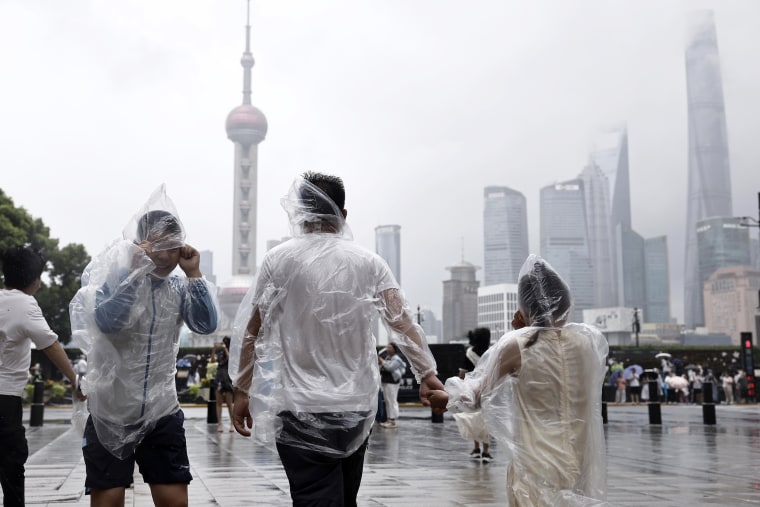
As Typhoon Dolphin approached China, meteorologists monitored its path using a blend of traditional and cutting-edge artificial intelligence weather models. This instance highlighted China’s growing influence in the push to enhance weather forecasting accuracy.
Prominent AI systems developed in China, such as the Fengwu by Shanghai AI Laboratory, Huawei’s Pangu, and Fuxi from Fudan University, are leading the charge. Researchers note that these models can generate forecasts quicker than conventional systems while maintaining or exceeding their accuracy.
Traditionally, weather prediction has depended on numerical models powered by supercomputers that simulate atmospheric physics. In contrast, AI models use extensive archives of historical weather data to learn patterns and deliver forecasts much faster. This technology is being increasingly tested during typhoon seasons in East Asia. Even minor advancements in track forecasts can aid authorities in better flood preparation, evacuation planning, and transportation management.
With more extreme weather, people need information to make decisions, both local governments, the national government, and the average person, farmers and fishermen,said Sun Zhi, CTO of Techwind, responsible for Fengwu’s applications.So we want to help provide better information so people can make decisions.
The rise of AI weather forecasting is fostering competition among tech companies, research institutes, and meteorological agencies. China is emerging as a key player. Among well-known global AI systems are Google’s GraphCast and GenCast, Nvidia’s FourCastNet, and the European Centre for Medium-Range Weather Forecasts’ AI System, AIFS.
Fengwu gained attention after surpassing GraphCast in performance across roughly 80% of weather variables, extending capable global medium-range forecasts past ten days.
While AI systems offer significant speed and reduced computing costs, they are unlikely to replace traditional models soon. Techwind’s Sun explained that AI models can predict typhoon paths and timings accurately but lag in forecasting storm intensity and are untested in major climate predictions.
For instance, Fengwu forecasted Typhoon Dolphin’s landfall within 30 minutes and 30 km (19 miles) five days in advance. However, predicting climate events like El Nino remains challenging due to the need for extensive scientific research to build trust.
As advancements continue improving AI systems, the dual use of traditional and modern methods is likely to persist for now.
Leave a Reply