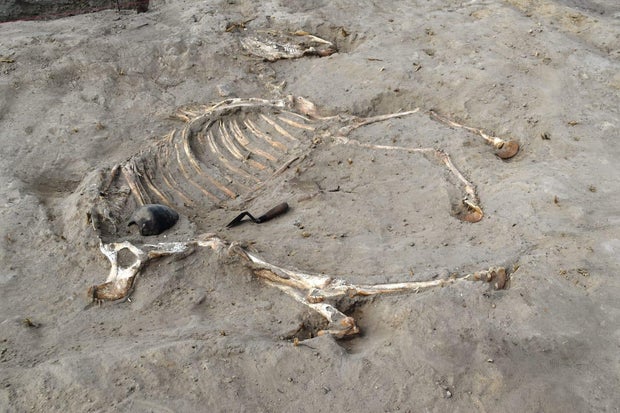
Archaeologists have uncovered a remarkable discovery at Tell Al-Abqain in Egypt’s northern Beheira province. The remains of a horse given an honorific burial more than 3,000 years ago were found. This site, established during the New Kingdom (1570-1069 B.C.), served as a military fort to protect Egypt from Libyan tribes.
The Ministry of Tourism and Antiquities revealed the site includes structures and artifacts illuminating military and daily life inside ancient Egyptian fortresses. Among these findings is a mudbrick residential complex with planned streets and rooms containing grain-storage silos and cylindrical pottery ovens used for food preparation.
Dr. Hisham El-Leithy, secretary general of the Supreme Council of Antiquities, explained how these findings showcase precise urban planning and resource management within the fortress. The complete burial of a young male horse stands out as a significant discovery.
Photos shared by Egypt’s Ministry of Tourism and Antiquities show the full remains of the horse. Mohamed Abdel-Badie, head of the Egyptian Antiquities Sector, noted preliminary studies suggest the horse belonged to a medium-sized breed noted for speed and agility, likely used in military activities such as pulling war chariots during the New Kingdom.
The deliberate interment, marked by the horse’s body position, head direction, and systematic burial, indicates it received an honorific burial. Nearby, cylindrical pieces of alabaster and limestone, potentially part of a horse’s chariot harness, were found, further supporting the site’s military purpose.
In addition to the horse burial, archaeologists uncovered several limestone stelas, including one depicting a Libyan prisoner in a posture of submission with bound hands. His clothing confirmed Libyan origin. The team also discovered religious amulets related to protection, fertility, renewal, and strength.
The varied pottery vessels and ostraca shed light on storage, cooking, serving food, and preserving perfumes and oils. Tools, jewelry, and other artifacts offer further insights into the fort’s function and life within.
Leave a Reply