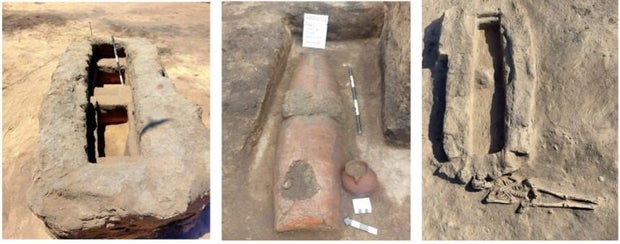
Excavations Reveal Ancient Burials
Archaeologists in Egypt have uncovered remains and numerous artifacts from a Greco-Roman cemetery dating back over 2,300 years. This discovery sheds light on the evolution of funerary practices over six centuries, highlighting the significance of the site.
The Tell Kom Aziza site, located in the Nile Delta in Beheira province near the Mediterranean coast, contains burials from around 332 B.C. to 395 A.D. The range of burial practices discovered there points to the transformation of the site from a settlement into a cemetery over its long period of use.
Burial Practices and Variations
At the Tell Kom Aziza site, burials range from simple pits to graves lined with mudbricks and painted plaster coffins. Dr. Hisham El-Leithy, Secretary General of the Supreme Council of Antiquities, notes the diversity in burials, which includes individual and collective graves oriented along both north-south and east-west axes.
The positioning of hands in the burials varies as well. Some individuals were buried with hands folded or crossed over the pelvic region, while others were placed in the ‘Osirian pose,’ with arms crossed over the chest, or with arms extended and aligned alongside the thighs.
Interpreting Burial Diversity
The diversity in burial practices could reflect social differences, variations in rituals, or limited developments within the same funerary tradition, according to Khaled Abdel Ghany Farhat, head of the excavation team.
A significant find includes the skeletal remains of two wild boars, a rare occurrence at ancient Egyptian funerary sites. Boars are associated with Seth, a deity linked to chaos and violence in ancient Egyptian mythology. Although uncertain if these remains indicate intentional animal burials or economic activity, their presence could have ritual significance.
Artifacts Spanning Millennia
Pottery fragments found at the site date from the Egyptian Old Kingdom, the era of the great pyramids, to the Greco-Roman period roughly 2,000 years later. These domestic items, such as amphorae, burial jars, and bread molds, indicate ongoing or repeated use of the site over centuries.
Continued excavation work aims to uncover more secrets and understand the site’s historical development to piece together patterns of human activity in the area.
Leave a Reply