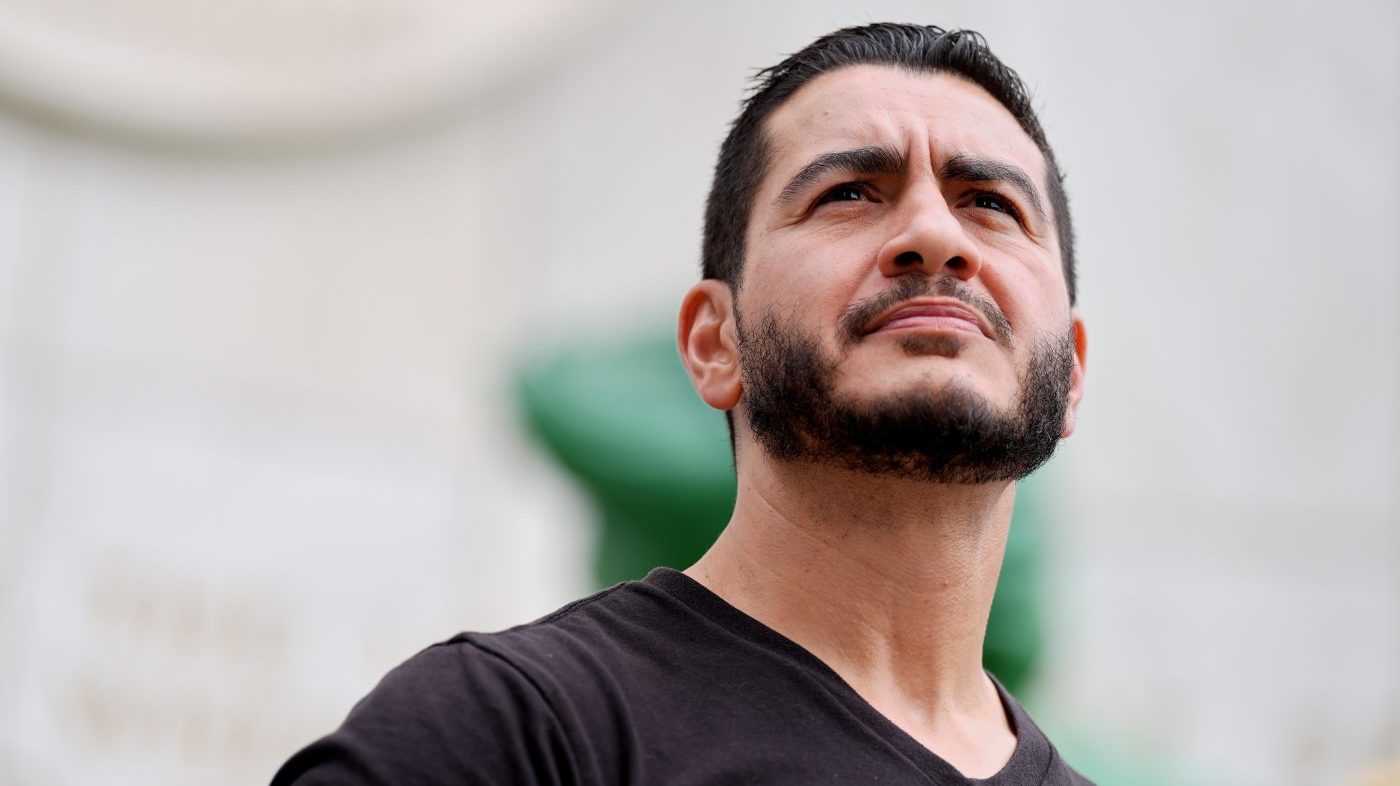
Abdul El-Sayed, a progressive contender in Michigan’s Democratic primary for the U.S. Senate, spoke with the press after participating in the March of the Many in Detroit on August 2, 2026. These developments come at a time when the Democratic Party faces significant challenges. Polls indicate 53% of Americans view the party unfavorably, with only 38% expressing a favorable opinion. Many criticize congressional Democrats’ leadership as uninspiring, contributing to a low approval rating of 24% for their performance.
Looking toward the 2028 presidential election, there’s a distinct generational divide among likely Democratic primary voters. Younger voters under 30 show preference for Rep. Alexandria Ocasio-Cortez (D-N.Y.), while voters over 65 lean towards California Governor Gavin Newsom (D). Despite President Trump’s waning popularity, his unpopularity hasn’t benefitted the Democrats. Instead, enthusiasm stems mainly from democratic socialists, comprising about a third of the party’s base. However, this enthusiasm does not guarantee success, as less than half of all Americans are open to voting for a democratic socialist presidential candidate.
A survey by the Washington Post highlights that while three-quarters of Democrats may support a democratic socialist, 54% of independents dismiss such candidates entirely.
Michael Greenberg from the New York Review of Books points out moderate Democrats fear abandonment, not from passive responses to far-right dominance, but due to potential socialist influence after progressive victories in primaries. The Democratic Party cannot afford ideological splits with democracy’s future at stake. Historical examples show long-standing ideological clashes within U.S. political parties. The Whig and the early Democratic and Republican parties experienced profound internal disagreements, leading to significant changes or collapse.
In the early 1960s, Goldwater conservatism deeply divided the Republican Party, favoring ideological purity over moderate stances, culminating in a major electoral defeat in 1964. Similarly, the Tea Party movement transformed the Republican Party during 2009-2010, highlighting that insurgent elements can sometimes succeed electorally and, at other times, create discord.
The current circumstances suggest that should democratic socialists increasingly influence the Democratic Party, they’ll need to clearly define their ideology to the electorate. The Washington Post emphasizes that confusion surrounds the meaning of democratic socialism, with only 13% of the public familiar with any singular view of it. Many equate democratic socialism with communism, providing ammunition for opponents to use the term “communist” against democratic socialist candidates and, by extension, the Democratic Party as a whole.
Benjamin Wallace-Wells observes that the Democratic Party’s core challenge lies in balancing the populist appeal of democratic socialism’s generational momentum with principles not fully aligned with the party’s traditional stance.
The Democratic Party’s future, and potentially that of American democracy, hinge on resolving this delicate balance.
Written by Austin Sarat, who is the William Nelson Cromwell Professor of Jurisprudence and Political Science at Amherst College. © 2026 Nexstar Media Inc. All rights reserved. This material is not intended for redistribution or rewriting.
Leave a Reply