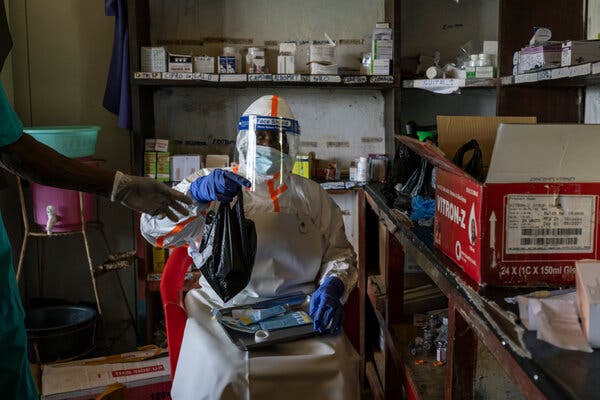
In the town of Mongbwalu, Democratic Republic of Congo, health workers are collecting medication for patients suspected of having the Bundibugyo virus. Trials are now starting on several drugs that showed promise in preliminary studies against the virus responsible for the current outbreak.
Dr. Papys Lame, along with his team, is working in a hastily assembled Ebola treatment center in Rwampara, Democratic Republic of Congo. They are rehydrating patients arriving with severe diarrhea and vomiting. They also provide transfusions for those bleeding from the nose and mouth and offer oxygen to those in respiratory distress. Continuous monitoring of heart rates and blood pressure is conducted, and intense pain is managed.
Dr. Lame, the Ebola response coordinator for the Alliance for International Medical Action, noted significant improvements in treatment options compared to five years ago. “Today, we have more options, and more people survive,” he stated. Despite advancements, a specific treatment for the Bundibugyo virus remains elusive, with 695 infections and 138 deaths reported so far.
Current Limitations in Treatment Options
The lack of specific treatments for the Bundibugyo virus stems from its evolutionary differences compared to more common Ebola virus species. Over the past five decades, most Ebola disease outbreaks were caused by the Ebola virus species. The World Health Organization recommends two drugs for Ebola virus infection based on clinical trials. However, the drugs that work against one virus may not work against another due to these differences.
Intense scientific research is ongoing to develop drugs specifically for the Bundibugyo virus. The urgency to find effective treatments remains high as the outbreak in East Africa continues to pose a significant health challenge.
A soldier was seen checking temperatures outside a hospital in Mongbwalu as part of precautionary measures. The search for viable treatments continues to be a top priority for health agencies and researchers working in the affected regions.
Leave a Reply