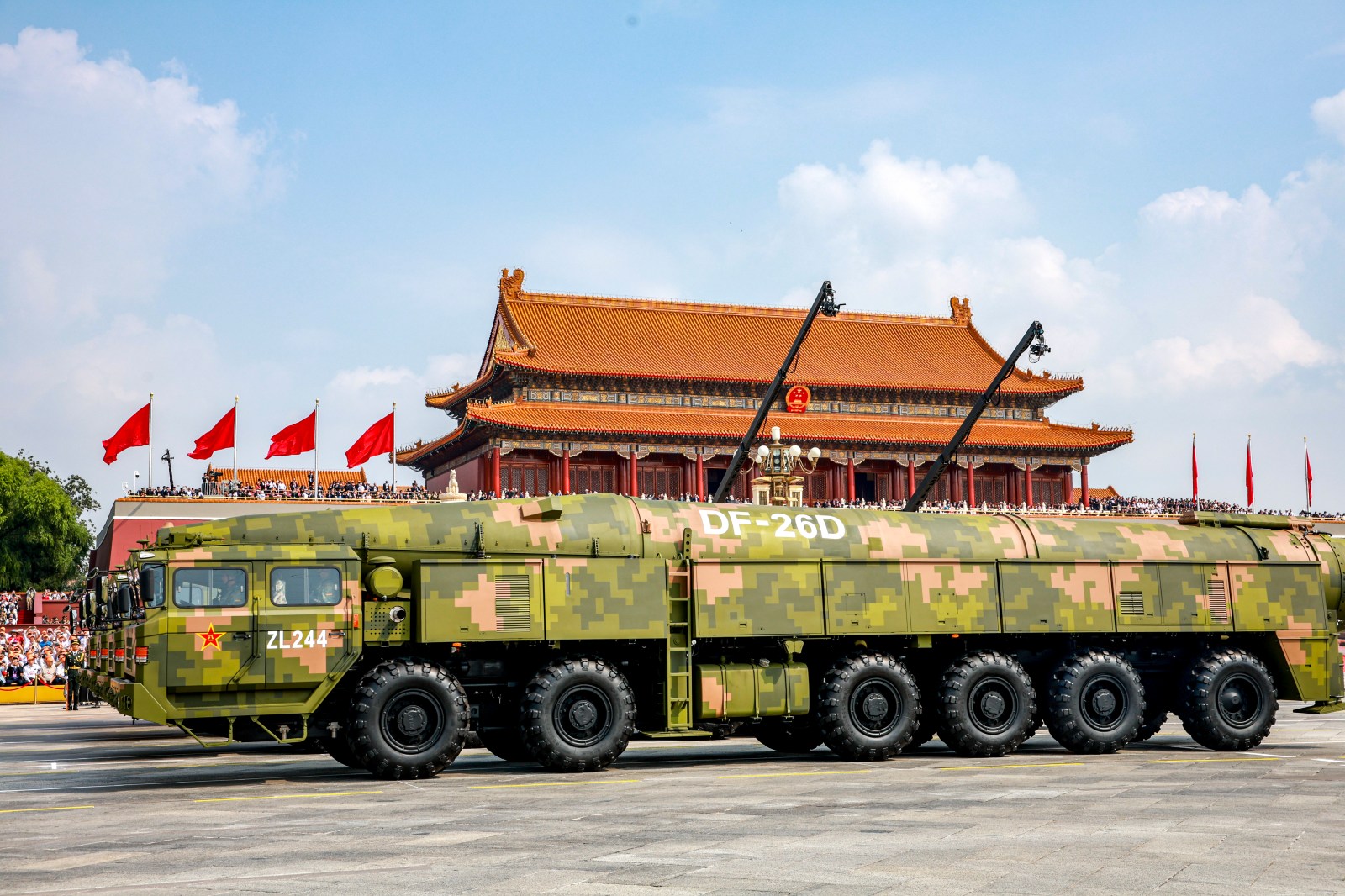
China is advancing in the development of long-range missiles that could target Australian territory. It already has the means to cause economic difficulties in the event of a regional conflict with the United States, according to a report by Australia’s Lowy Institute. The People’s Liberation Army (PLA) has rapidly expanded its military capabilities, challenging U.S. military dominance in the Indo-Pacific region. This expansion is pressuring regional states to align with Beijing’s preferences.
A potential conflict over Taiwan, a self-governed island that Beijing claims and the U.S. supports with security assurances, remains the PLA’s main focus. However, China also aims to project military power over long distances using missiles, aircraft, and ships capable of reaching Australia.
The assessment highlights the strategic shift due to China’s military rise, affecting Australia’s interests beyond the direct capability to strike Australian territory.
On Monday, a Chinese government spokesperson stated, “China is committed to peaceful development and strengthening defense capabilities to safeguard national sovereignty and security, without targeting any country.” This statement came in response to the report.
Missile Threat
Chinese missiles currently have the capability to strike Australian territory from sea or air. The DF-26 intermediate-range ballistic missile is presently the only conventional land-based weapon capable of reaching northern Australia from China’s artificial islands in the South China Sea. The DF-27 missile, with a range of up to 5,000 miles, could potentially cover the entire Australian landmass if launched from the Chinese mainland. The U.S. Defense Department believes this weapon may already be operational.
In a potential war scenario where Australia supports the U.S., China’s targets could vary based on its strategic goals. These could include warning strikes on offshore oil facilities, cyber or missile attacks on public infrastructure to pressure the Australian government, or direct attacks on government buildings to destabilize political leadership.
The report does not consider China’s nuclear capabilities, noting that the country’s arsenal, estimated at 620 warheads, could triple by 2035. China’s military modernization is financed by a defense budget possibly reaching $540.7 billion, which may be double the publicly stated figure.
Naval Threat
Australia’s vital maritime trade routes and subsea cables face risks of sabotage, the Lowy Institute report suggests. According to a Ports Australia industry group study, 99% of Australia’s international trade, totaling 1.6 billion tons or $460 billion, moved through seaports in 2024. Oil, gas, and fuel accounted for 50% of imports, followed by construction materials and chemicals.
“Maritime traffic could be restricted by a quarantine, a sinking ship demonstration, or blockades,” the report notes.
In March 2025, a Chinese naval flotilla from the South China Sea circled Australia and conducted live-fire exercises in the Tasman Sea. Neither Australia nor New Zealand received prior notification. Such deployments, including those involving aircraft carriers, may become more common over the next decade.
In response, Australia has increased its defense spending and strengthened ties with the U.S. by procuring nuclear-powered submarines under the AUKUS pact and hosting U.S. military forces.
Capability vs. Intent
Australian Defense Minister Richard Marles has called China’s military expansion the most significant since World War II. The U.S. also expresses concerns about China’s ambitions, citing its refusal to engage in arms control talks.
Senior American officials believe Chinese leader Xi Jinping has tasked the PLA with being capable of forcibly taking Taiwan by 2027. However, they do not believe an invasion is imminent. The Chinese government spokesperson labeled the Lowy report as a strategic miscalculation.
The report’s authors focused on China’s military capabilities, noting that intentions can shift rapidly. They stated governments need to plan based on what other countries are capable of, rather than intentions.
Leave a Reply