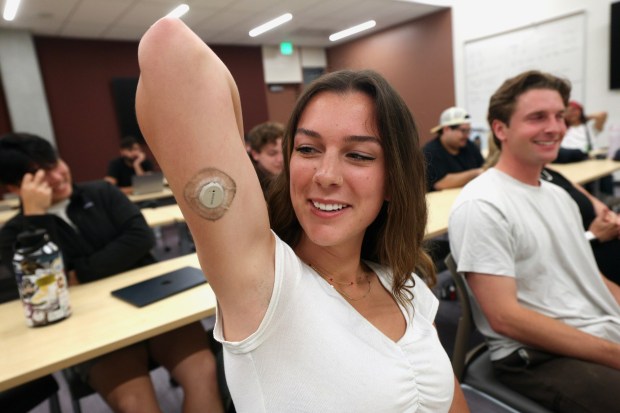
Adam Van Voorhees enjoyed orange chicken three times a week until a round white patch on his arm changed his routine. Like many 22-year-olds, he didn’t focus on his diet until his continuous glucose monitor alerted him. It signaled a spike into prediabetic blood sugar levels after dining at Panda Express. Now, he opts for packed lunches.
Van Voorhees doesn’t have diabetes, yet he wears a monitor typically used by people with Type 1 diabetes. It’s part of a class assignment at UC San Diego. These monitors previously required a prescription. However, Mary Boyle, a cognitive science professor at UCSD, believed the technology might help people understand their bodies better. When Dexcom, based in San Diego, introduced its retail monitor, Stelo, Boyle saw potential in researching its impact on forming healthier habits. She included her students in this investigation.
Students like Rylan Breneman showcased their Dexcom continuous glucose monitors as part of UCSD’s Metabolic Health Analytics class. These devices reveal how our bodies respond to our environment and choices. Real-time feedback, such as a sugar spike after a candy bar or a drop after a walk, provides valuable insights.
“Seeing how your body responds to choices encourages healthier decisions.” – Mary Boyle
This technology has proven effective for diabetics. With high stakes like lost limbs and shortened lifespans for them, behavior change becomes vital. Boyle’s class is gathering data to study this effect on healthy individuals. Surprisingly, some results show the long-term impacts of diet and lifestyle choices.
Boyle noted how Type 2 diabetes affects the brain. When brain cells resist insulin, neurons can’t absorb glucose. This leads to starving neurons and dying brain sections. Besides food, factors like sleep, exercise, and stress influence metabolism. While extensively studied in diabetics, these effects on healthy individuals are less understood.
Dr. Robert Thomas, an academic endocrinologist at UCSD, sees the value in studying these influences. Each student in Boyle’s class tested a personal hypothesis using three monitors. This individual focus method is known as an N-of-1 experiment. Unlike broad studies, these are tailored to personal data.
In a recent session, one student demonstrated applying a Stelo disk. Within minutes, she synced it to her phone to track her blood sugar for 14 days. Typically retailing at $99 for two monitors, students received them through a Dexcom grant arranged by Boyle.
During class discussions, students shared experiences. Many observed blood sugar shifts before they felt hungry. This supports the idea of ‘hangry’ being a biological response rather than just a feeling. Katie Lam, another student, monitored stress-related glucose changes. Anxiety one morning, due to an exam and an interview, showed her glucose levels rise on her monitor.
Boyle explained how hormones correlate with metabolism. Blood sugar usually increases in the morning as cortisol releases extra glucose. She also shared her interest in this with her rowing team, which includes perimenopausal and postmenopausal women.
“Understanding blood sugar mechanisms enhances self-awareness.” – Mary Boyle
Student Jaidy Leyva addressed dietary impacts through an experiment with chocolate cakes. Applebee’s cake caused a sugar spike, unlike other cakes. This class experiment, now in its second year, helps students form healthier habits. For instance, students view smoothies and late-night snacks differently after seeing negative impacts on the monitor.
However, some students, like Rithika Muttukuru, felt stress from constant feedback. Early morning alarms disrupted rest, highlighting what Dr. Thomas calls ‘device burden.’ He advises using technology wisely based on actionable insights rather than adding stress.
Thomas suggests periodic monitor trials for health-conscious or prediabetic individuals. On a different note, Leyva shared how the monitor influenced her lifestyle. Despite information from various sources, she only changed after directly seeing the effects of her choices.
Leave a Reply