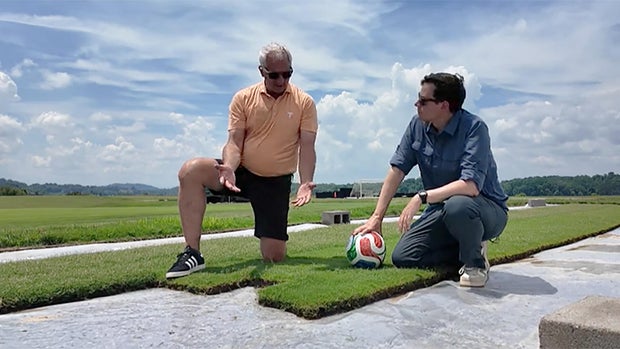
Broadcasting the World Cup has reached historical peaks in viewership this year as Americans exhibit unprecedented enthusiasm for the sport. The final match between Spain and Argentina is projected to set new records. However, for one man in Tennessee, the tournament’s allure lies in the pitches themselves.
“The number one thing is the pitches, right? We need to have a good surface, a good canvas for the players to play on,” stated Dr. John Sorochan, a distinguished professor in Turfgrass Science at the University of Tennessee, Knoxville. Sorochan is an esteemed expert in field preparation.
The previous men’s World Cup was watched by 1.8 billion viewers, yet most did not consider the field’s significance, Sorochan remarked. The preparation involved extensive efforts behind the scenes.
The University of Tennessee, collaborating with Michigan State University, has contributed to the FIFA Pitch Research Project for the past five years. This year’s tournament, spanning 104 matches and held across 16 stadiums in three countries, is the largest in history, with FIFA requiring the use of high-quality natural grass.
Due to varying elevations and climates, stadiums cannot use identical grass types. Specialized sod has been sourced from farms nationwide, often overlaying existing artificial fields. Remarkably, the grass installed at MetLife Stadium in New Jersey was cultivated in North Carolina.
Among the stadiums, five feature domes, requiring FIFA to establish an indoor growing facility at the University of Tennessee. This facility tests how grass responds to grow lights, used for 12-14 hours in dome environments to ensure adequate growth.
Sorochan explained that grow lights are crucial for extended usability of the pitch as ten to twelve weeks of growth are needed.
The resiliency of grass over years has been a major focus for Sorochan. A robot designed to mimic the force exerted by soccer players was co-developed by his team, measuring the pitch surface’s consistency.
Soccer ball interaction with grass has also undergone scrutiny. Sorochan highlighted the importance of managing grass so that the ball rolls smoothly and remains playable for maneuvering purposes.
Various grass types have been scrutinized, including Meyer Zoysia and drought-resistant TifTuf Bermuda, common in golf courses and sports fields.
Brad Jean, owner of Crossroads Sod Farm in Tennessee, values the expertise offered by nearby grass specialists when encountering issues.
“If it’s 90 degrees, AstroTurf is going to be really hot, and the grass is going to be really cool,” Jean stated, emphasizing the drawbacks of artificial surfaces.
Artificial turf has been correlated with higher injury rates compared to natural grass, though advances have reduced issues with newer turf variants. Sorochan considers the natural flow of play inherent to grass.
Grass used after the World Cup finds new homes as FIFA sells souvenir sod pieces. For $450, fans can own a piece from today’s match for their personal collection.
Further information can be found through Dr. John Sorochan, the FIFA Pitch Research Project, and Crossroads Sod Farm.
Leave a Reply