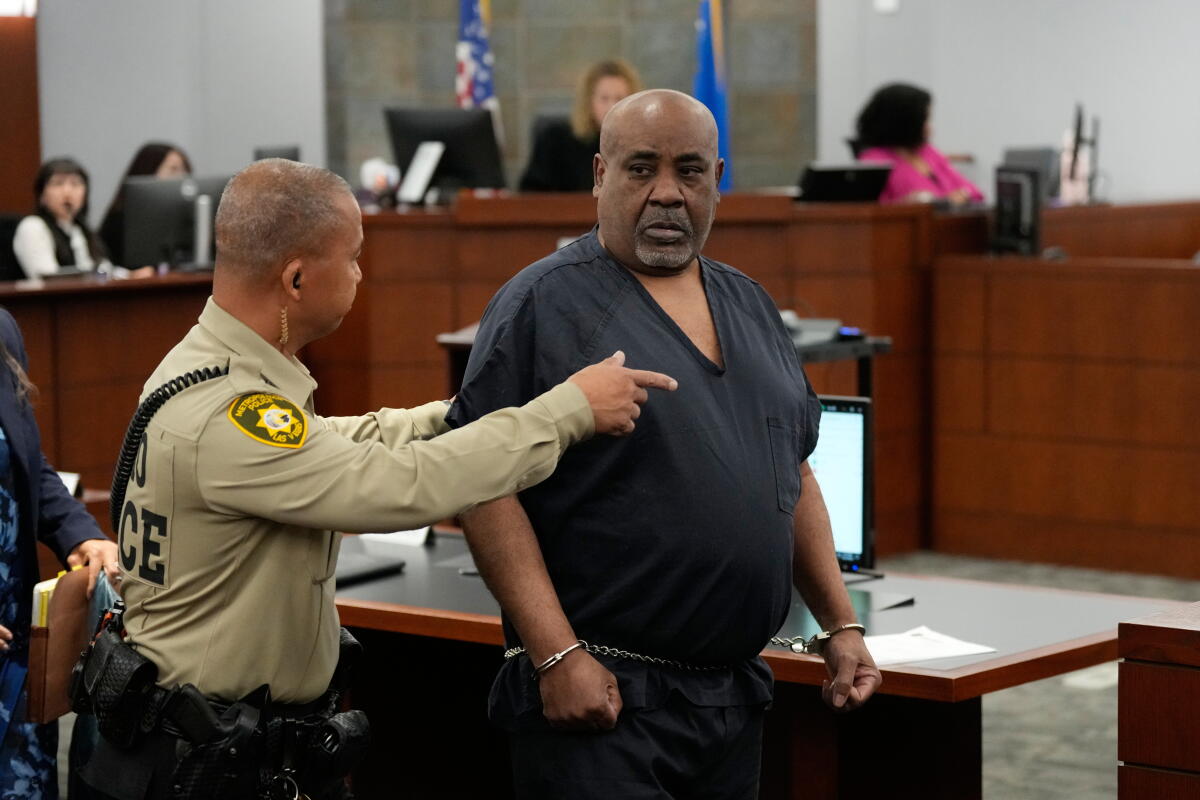
Duane “Keffe D” Davis has been sentenced to 40 years to life in prison for orchestrating the killing of rapper Tupac Shakur. This gang-related crime contributed to a bicoastal feud involving gang members and record executives.
During the sentencing, Clark County District Court Judge Carli Lynn Kierny told Davis, “You don’t get to take a man from his family and just walk away from it, especially Tupac Shakur. The world never forgot about him and his death, and neither did Las Vegas.” The jury convicted Davis on charges of murder and use of a deadly weapon, sentencing him to two consecutive terms of 20 years to life.
Prosecutors presented evidence during the two-week trial, highlighting Davis’s role as a gang leader. They demonstrated that he arranged Shakur’s murder by passing a .40-caliber handgun to fellow members of the Southside Crips-Burris Street gang. The evidence included interviews Davis gave to authorities, a documentary, and his 2019 memoir detailing the crime.
“I am going to appeal this case for sure,”
Davis told the judge before the sentencing. Davis’s involvement in Shakur’s murder occurred during a tumultuous time in the music industry, which was marked by a rivalry between Death Row Records and Bad Boy Records.
Shakur’s death led to conspiracy theories and reflections within the music community and sparked a 10-day gang war in Compton. For Shakur’s family, the loss was deeply personal. His sister, Sekyiwa Shakur, expressed the profound impact on her family, describing Tupac as a provider for many relatives and calling him “my shining star, my shining prince.” She described the emotional toll his death took on her, including depression and PTSD.
Prosecutor Marc DiGiacomo asserted that Davis profited from the rapper’s death, noting his memoir and arguing that he deserved the maximum sentence. During the trial, the prosecution contended that Shakur’s murder was a revenge plot. The incident stemmed from a beating Shakur, Suge Knight, and members of the Mob Piru gang gave to Davis’s nephew, Orlando Anderson, at the MGM Grand, caught on security footage.
The attack was triggered by an earlier incident where Anderson allegedly stole a Death Row chain at a mall. Davis reportedly handed a gun to a shooter who then targeted Shakur and Knight on the Las Vegas Strip. Shakur died six days later at 25 years old.
Los Angeles and Las Vegas police investigators, journalists, and Davis’s memoir served as evidence against him. Anthony Michael Sanft, Davis’s lawyer, argued the prosecution’s case was based on speculation, citing a lack of forensic evidence and eyewitnesses. He emphasized the difficulty of placing Davis at the crime scene.
The investigation into Christopher “Biggie Smalls” Wallace’s 1997 murder in Los Angeles helped to solve Shakur’s case. Davis had participated in a 2008 federal task force investigation, admitting knowledge of Wallace’s murder and implicating himself in Shakur’s murder during interviews.
Testifying in court, the prosecution played a task force interview recording where Davis described the events, naming Terrence Brown as the driver with Anderson and Deandrae “Big Dre” Smith in the back. According to Davis in the recording, Knight and Shakur became targets after women identified Shakur in a car.
Prosecutors stated that Davis’s memoir invalidated his 2008 proffer agreement, allowing his statements to be used as evidence. His attorney argued that the memoir was fictional, intended to sell books, and exaggerated his involvement in Shakur’s death.
Leave a Reply