Janet McCabe, who served as deputy administrator of the U.S. Environmental Protection Agency (EPA) during President Joe Biden’s tenure, was instrumental in formulating greenhouse gas regulations for power plants. Today, she observes the efforts of President Donald Trump’s administration to dismantle these regulations.
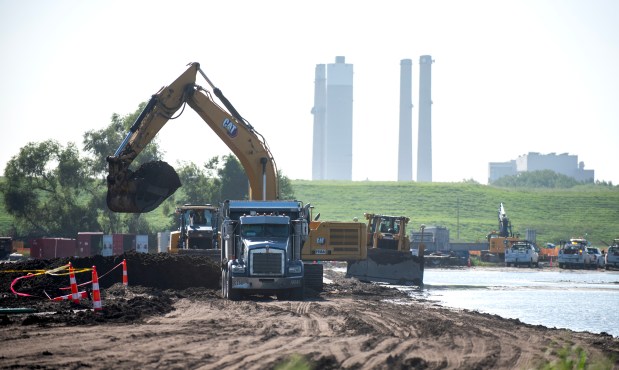
Construction progresses at a data center site in Wheatfield, Indiana, with NIPSCO’s R.M. Schahfer Generating Station visible in the background on August 20, 2026. McCabe, disheartened by the current administration’s focus on undermining environmental rules, conveyed concerns about weakening these rules to favor industry, ultimately hindering the government’s ability to tackle public health threats.
On September 14, EPA Administrator Lee Zeldin announced the rollback of numerous greenhouse emission standards established during Biden’s presidency for power plants. This move, following the repeal of the Greenhouse Gas Endangerment Finding earlier in February, has been consistent with the Trump administration’s actions since taking office.
Hana Vizcarra, deputy managing attorney for national climate at Earthjustice, stated that the latest EPA action was predictable, highlighting that Trump’s administration prioritized coal despite its higher costs. Vizcarra underscored the emphasis on rolling back regulations to benefit favored industries while disregarding clean energy alternatives, potentially increasing severe climate effects.
The EPA claims the policy changes will save $310 billion, proposing further rescission of existing greenhouse gas standards for the power sector to allegedly reduce compliance costs by $370 million. Lee Zeldin stressed the importance of protecting affordable energy, supporting the coal industry, and promising lower electricity prices alongside job creation and enhanced prosperity.
Despite promises of reduced utility bills, environmental and energy experts argue that coal prioritization results in higher costs for American ratepayers. Kerwin Olson, executive director of the Citizens Action Coalition, criticized the dependency on coal over cheaper alternatives like wind and solar, emphasizing the environmental and economic repercussions for communities.
Olson expressed deep concerns about the disregard for public health and the climate, noting the negative impact on utility bills and pollution levels as coal plants remain operational. Higher utility bills are particularly burdensome for those in Northwest Indiana, where the highest state bills are charged.
McCabe echoed these concerns, highlighting Northwest Indiana’s historically high pollution exposure, further exacerbated by prolonged coal plant operations. Efforts to roll back environmental regulations counteract goals set by the Clean Air and Water Acts to improve standards safeguarding health and the environment.
Ashley Williams, executive director of Just Transition Northwest Indiana, emphasized that EPA’s deregulation could increase premature deaths and asthma cases, underscoring the urgency as artificial intelligence data centers necessitate gas-fired power plants.
Indiana’s inability to adopt stricter environmental rules raises concerns, with deregulated standards affecting the state significantly. Williams mentioned ongoing legal challenges to the EPA’s repeal, urging public engagement during the commentary period for remaining rules.
State Rep. Earl Harris highlighted the disproportionate effect of such decisions on Black and low-income Hoosiers. Harris referred to reports showing that Black Americans are likelier to live near coal plants, stressing that utility rates can be lowered without endangering vulnerable communities.
Federal Court Ruling and Impact
The U.S. Department of Energy (DOE) required NIPSCO’s R.M. Schahfer Generating Station to remain operational beyond its retirement date under emergency orders. The orders, renewed repeatedly, face potential renewal challenges amidst court rulings.
Nick Wallace from the Environmental Law and Policy Center noted the high daily costs for running Schahfer and other plants, bringing financial strain to Midwest ratepayers. The U.S. Court of Appeals recently deemed similar actions for Michigan’s J.H. Campbell Coal Plant unlawful, citing overreach by the DOE.
Legal challenges initiated by environmental groups seek to invalidate emergency orders for Schahfer, Culley, and other plants. Wallace referenced the court’s clear stance against DOE actions in the Campbell case, expecting similar outcomes for Schahfer.
Kerwin Olson praised the court’s decision, seeing potential to nullify Indiana’s emergency orders. State Rep. Randy Novak encouraged legal challenges against federal orders, questioning bailout practices favoring utility companies while disregarding public health.
The DOE defended emergency actions, citing increased coal generation to prevent blackouts during severe winter storms. Despite the appeals court ruling, NIPSCO stated its focus remains on customer service alongside compliance with legal and regulatory requirements.
Leave a Reply