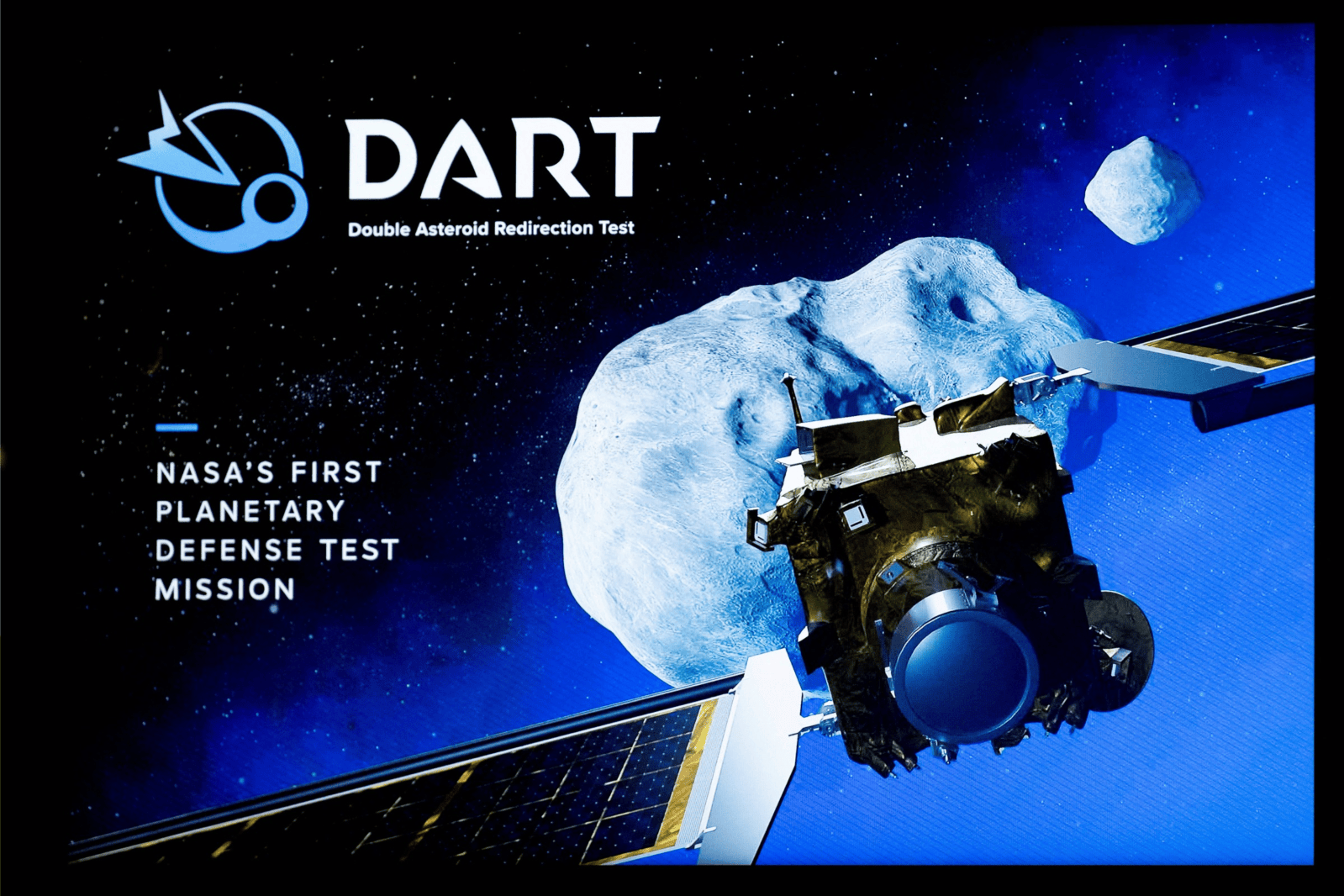
Humanity is poised for a major milestone in asteroid exploration with the European Space Agency’s (ESA) Hera spacecraft completing its journey to the Didymos asteroid system. After traveling for about two years, Hera is set to reveal its first close-up images of Dimorphos on Wednesday, November 25. This small asteroid was impacted by NASA’s Double Asteroid Redirection Test (DART) in 2022, which aimed to shift its path through space.
These images are crucial in analyzing the effects of NASA’s deliberate collision with Dimorphos and determining whether such a method could serve as a protective measure for Earth in the future.
The Purpose of Hera’s Mission
Hera launched on October 7, 2024, with a dedicated mission to study Dimorphos and its larger companion, Didymos. By analyzing the aftermath of the DART collision, ESA aims to transform this experiment into a repeatable technique that could be utilized if an Earth-threatening asteroid is identified.
Ian Carnelli, who leads ESA’s Hera mission, previously remarked, “DART and Hera were initially planned as part of a coordinated double-spacecraft initiative – one to execute the deflection and the other to perform precision measurements.” Didymos and Dimorphos form a binary asteroid system, in which the smaller Dimorphos orbits its larger counterpart.
Didymos is approximately 780 meters wide, similar in size to the Burj Khalifa, while Dimorphos measures about 151 meters across, comparable to the Eiffel Tower. Dimorphos orbits Didymos at roughly three-quarters of a mile from its surface. Before the DART collision, it took Dimorphos 11 hours and 55 minutes to complete one orbit around Didymos.
Why NASA Crashed into an Asteroid
On September 26, 2022, NASA targeted Dimorphos with the DART spacecraft at a speed of roughly 14,000 miles per hour. This marked the world’s first large-scale attempt to alter an asteroid’s trajectory. The principle behind this mission is straightforward: if an asteroid headed towards Earth is detected in advance, a spacecraft collision might divert its course enough over time to prevent a direct hit.
Although Didymos and Dimorphos posed no threat to Earth, NASA used them to test the viability of a collision strategy for changing an asteroid’s path. “This mission shows that NASA is trying to be ready for whatever the universe throws at us,” stated NASA Administrator Bill Nelson.
The experiment succeeded, with the collision shortening Dimorphos’ orbit around Didymos by approximately 33 minutes. This made Dimorphos the first object in our solar system to have its motion measurably influenced by humans.
Despite this success, scientists have yet to study the site directly. The DART impact ejected over two million pounds of dusty rock into space, significantly altering Dimorphos’ orbit more than expected. Hera’s investigation will help explore why the collision was so effective and assess any changes to the asteroid’s structure.
Scientists want to learn what lies beneath Dimorphos’ surface, how the impact altered its shape, and the efficiency of the energy transfer from DART. ESA predicts the collision might have created a crater around 20 meters wide, which Hera’s observations will confirm.
Upcoming Image Release
ESA plans to share the first close-up images of Dimorphos during a livestream on Wednesday, November 25. The public can view the event through ESA WebTV, ESA’s YouTube channel, and its website. While Hera has already sent close-up imagery of the larger Didymos, the upcoming images will provide an unprecedented detailed view of Dimorphos, unseen since DART captured its last moments before the 2022 collision.
Leave a Reply