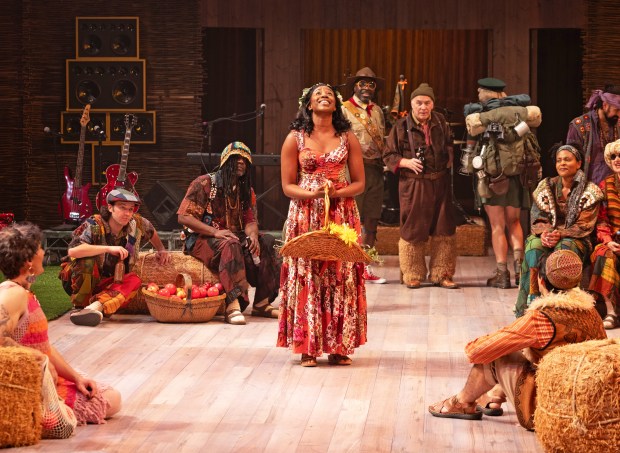
Edward Hall’s new production of “The Winter’s Tale” at the Chicago Shakespeare Theater signals a fresh venture: establishing a Chicago-based repertory company of actors performing multiple plays simultaneously. This initiative provides esteemed Chicago performers with extended work alongside trusted colleagues this fall and early winter. It aligns with Hall’s long-standing aim of centering Shakespearean productions around a consistent ensemble, reflecting how such plays were originally staged, with similar cast sizes and character types.
“The Winter’s Tale” premiered on a recent Sunday afternoon; the company spent the following week rehearsing “A Midsummer Night’s Dream,” which is set to open on November 15. The productions will alternate in what theater practitioners refer to as “rotating rep.” By late November, theatergoers can witness both plays on a single day, a strategy successfully employed by the Stratford Festival of Canada, often enriching the experience.
A definitive critique of Chicago Shakespeare’s fall programming should wait until both openings are evaluated. However, initial impressions of “The Winter’s Tale” suggest potential for a richer emotional depth than currently present, despite engaging performances and creative staging. The play is renowned for its emotional impact—its ability to touch the heart profoundly. Yet, this production lacks that degree of emotional resonance.
Similar to Shakespeare’s later romances, “The Winter’s Tale” proposes the possibility of redemption and recovery from grievous mistakes. The plot revolves around Leontes, King of Sicilia, temporarily portrayed by Demetrios Troy, whose unfounded accusation of infidelity against his wife Hermione leads to tragic consequences. Unlike “Othello,” it lacks an Iago-like figure manipulating events, yet results in widespread harm. Ultimately, the universe presents a repentant Leontes with a partial second chance, capturing the play’s bittersweet essence. Leontes struggles with jealousy over Hermione’s friendship with the King of Bohemia, a role by Chiké Johnson, resulting in the destruction of four lives, including his and Hermione’s daughter Perdita, superbly portrayed by Felicia Oduh, and son Mamillius, also played by Oduh.
The production complicates this further with dual casting choices that impact the story’s emotional complexity. Director Hall appears to resist portraying Leontes’ path to redemption fully. While the play doesn’t equate a second chance with forgiveness, it suggests that the mystic elements might ultimately redeem humanity’s mistakes.
The early scenes effectively depict Leontes launching baseless accusations while his sycophants, aware of his error, remain silent out of fear, unable to prevent Hermione’s downfall. Performers like Kevin Gudahl, Sean Fortunato, and Erik Hellman ably portray courtiers, drawing parallels to contemporary political scenarios where courage is rare, causing innocent casualties.
A standout character, Paulina, portrayed by Issy Van Randwyck, demonstrates unwavering conviction, and her portrayal is the production’s highlight. She drives the narrative with determination and focus, offering a compelling stage presence.
The play also intersperses amusing scenes, cleverly envisioned as a whimsical Bohemia with an ovine rock band called “Sheep Trick” and Fortunato playing a vibrant classic rocker. While entertaining, this sudden shift in tone may detract from the story’s ultimate miraculous developments.
The performance boasts several commendable elements—beautifully spoken dialogues, clear storytelling, elegant visual design courtesy of Michael Pavelka, and engaging costumes. Shakespeare’s noted stage direction, “Exit, pursued by a bear,” is well-utilized, ensuring that audiences are entertained throughout.
Ultimately, “The Winter’s Tale” explores profound themes of regret and redemption with high stakes. This emotional depth is not entirely realized within the repertory’s current landscape.
“The Winter’s Tale” continues at Chicago Shakespeare’s Courtyard Theater on Navy Pier through December 12. The performance runs for two hours and forty minutes, with tickets priced between $65 and $135, available at 312-595-5600 or chicagoshakes.com.
Leave a Reply