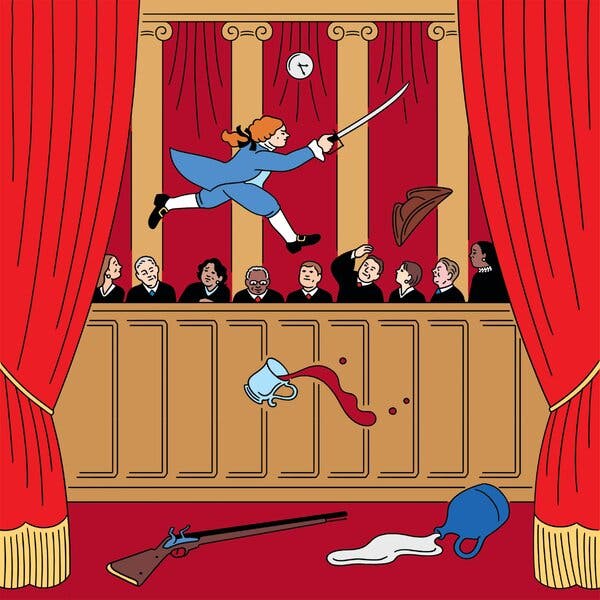
The recent Supreme Court term presented numerous perplexing developments, but one topic has not garnered enough attention— the court’s use of ‘originalism.’ This interpretive method, championed by conservatives since the Reagan era, aims to confine judges within historical contexts. Justice Brett Kavanaugh illustrated this concept when he stated, ‘History is far less subjective than policy,’ arguing that only ‘history and tradition,’ rather than contemporary issues, should justify limits on the Second Amendment right to own guns.
Assessing the Objectivity of History
Is history truly objective? Let’s consider its application. Take a scenario where a young man in Dallas, with a stable job and resident gun ownership, occasionally uses marijuana. A federal law, Section 922(g)(3), criminalizes firearm possession for ‘unlawful users’ of controlled substances, carrying up to 15 years imprisonment. When the government prosecutes, it must demonstrate ‘history and tradition’ as per Supreme Court precedent.
The Bruen decision in 2022 clarifies that ‘historical tradition’ doesn’t concern the time a regulation is enacted; instead, the government must find analogous regulations from the nation’s founding era or post-1868, when the 14th Amendment broadened the Bill of Rights to states. Given marijuana’s absence in 1791 and 1868, the government faces a challenge. Creative prosecutors reference ‘habitual drunkard’ laws from the 18th and 19th centuries, which placed visibly intoxicated individuals in jails or workhouses, away from firearms access.
Ultimately, this raises the question: are such analogues sufficient to legitimize modern firearm regulations?
Leave a Reply