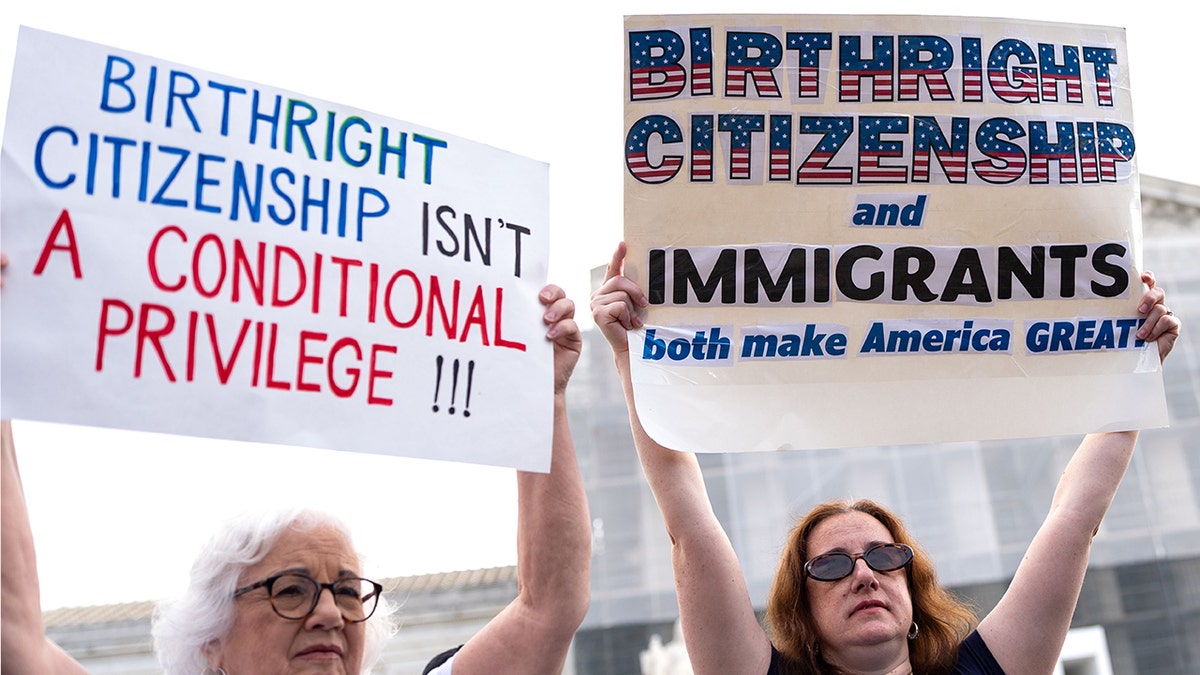
A federal judge has temporarily blocked President Donald Trump’s latest attempt to limit birthright citizenship. This move sets the stage for another significant legal battle regarding the 14th Amendment. U.S. District Judge Deborah Boardman issued a preliminary injunction against the President’s executive order from August 6. The decision comes a month after the Supreme Court upheld birthright citizenship in the case of Barbara v. Trump.
This injunction marks the first halt of Trump’s revised birthright citizenship order. The Supreme Court had previously affirmed birthright citizenship, making this an important legal development. Previously, the same judge blocked Trump’s original order before the Supreme Court’s intervention.
Trump’s executive order sought to limit birthright citizenship for several groups. These include children whose parents are designated as alien enemies and members of Foreign Terrorist Organizations. Additionally, the order targeted children whose foreign parents used a surrogate in the United States for birth. Court Appointed Special Advocates (CASA) filed a lawsuit against this executive order.
“The 2026 Executive Order is almost certainly unconstitutional for the certified class,” Judge Boardman stated in her ruling. “This Court must preliminarily enjoin enforcement of the President’s attempt to remove citizenship rights.”
The White House dismissed Boardman’s ruling, criticizing it as an action by a “Biden-appointed activist judge.” Lauren Bis, a White House spokesperson, insisted the executive order aligns with Supreme Court analysis.
The Supreme Court’s 5-4 decision, in the case of Barbara v. Trump, held children born in the U.S. to unlawfully or temporarily present parents are “citizens at birth” under the 14th Amendment. Although exceptions exist, such as for children of foreign diplomats, Boardman rejected Trump’s order targeting children born to alleged alien enemies. The plaintiffs argued the administration’s broad definition of ‘enemy’ could lead to errors, identifying people based on questionable criteria like tattoos or family ties.
Boardman referenced cases such as Andrea, a Mexican woman whose child’s father has links to a cartel, and Monica, a Venezuelan fearing wrongful connections to Tren de Aragua. In rejecting the order, Boardman indicated the executive order’s potential to leave children and families in a precarious state regarding citizenship.
Former Justice Department official Abhi Kambli remarked on the legal challenges, noting Boardman speculated on potential administrative errors, which lack a firm legal basis.
During the ruling, Boardman highlighted the First Circuit’s argument that denying birthright citizenship inflicts irreversible damage. “The loss of birthright citizenship, even temporarily, can have lasting negative effects,” the ruling stated.
Monica expressed relief over the ruling. “During my pregnancy, anxiety over my child possibly being stateless was overwhelming,” she said. “This battle isn’t over, but for now, children like mine are protected.”
Shana Khader, We Are CASA’s legal director, emphasized their stance. “The Trump administration has repeatedly failed to undermine birthright citizenship. We stand with families affected by fear and uncertainty, fighting to ensure their constitutional rights remain intact.”
Leave a Reply