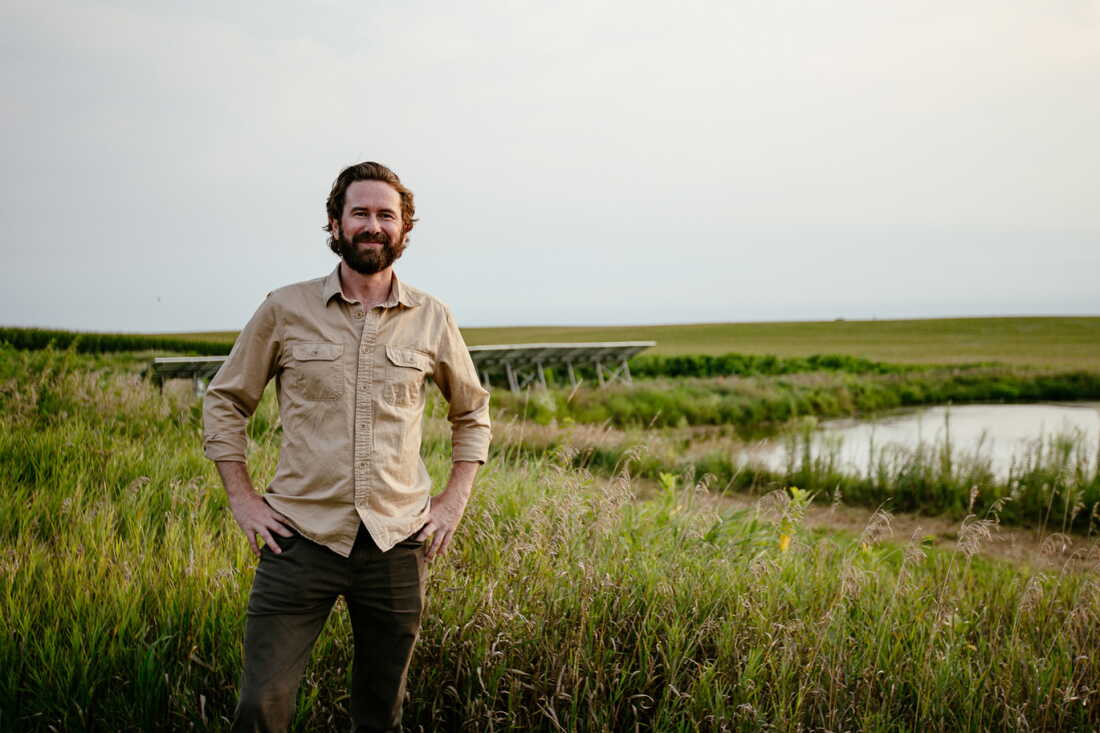
Tanner Faaborg poses for a photo at his farm in central Iowa. The Faaborg family now focuses on growing specialty mushrooms at 1100 Farm. Previously, the farm was dedicated to raising hogs. The Faaborg family recently transitioned their operation with the assistance of the Transfarmation Project, an initiative by Mercy for Animals.
“We primarily work with industrial animal farmers to help them transition to sustainable practices, such as growing mushrooms, diversified vegetables, or incorporating trees,” said Katherine Jernigan, director of the Transfarmation Project. “What’s unique about Transfarmation is repurposing existing farm infrastructure.”
This transformation involves growing mushrooms in a former hog barn. The family has retrofitted the space to accommodate their mushroom-growing operation. Tyler Faaborg explained that making their own mushroom blocks, a mix of 50% soy hull and 50% hardwood pellets, is a cost-effective choice. This method allows for more efficient production.
The Faaborg family converted half of a 200-foot-long hog barn. The retrofitted area now serves as a resource for other farmers, becoming the second demonstration hub in the U.S. established by Transfarmation. The first hub operates on a former chicken farm in North Carolina.
“Having this demonstration hub opens doors for people to visit, ask questions, and see the transition firsthand,” Jernigan said. “We also collect data on production, costs, and labor, sharing it to benefit other farmers.”
The Faaborgs receive $216,000 through a four-year contract for sharing their experiences with other farmers. This includes the lessons learned during the transition. The aim is to show that converting from industrial-scale animal farming to specialty crops can be profitable.
Tanner Faaborg, who brought the concept of 1100 Farm to his family, explained that the farm could demonstrate sustainable farming practices for others. Tanner’s passion grew from his involvement in promoting sustainability and climate change mitigation in Des Moines.
Before transitioning, the family’s primary focus was raising pigs through contract feeding agreements. This method involved a company supplying animals and feed, while the farmer provided labor and covered infrastructure costs. The Faaborgs ran a concentrated animal feeding operation (CAFO), initially retrofitting existing buildings to house thousands of pigs.
Raising hogs eventually became less profitable, prompting the family to explore other ventures. Tanner Faaborg saw a chance to repurpose their infrastructure for a healthier and more sustainable purpose. His brother Tyler needed some convincing, given his long history working in pig farming. However, the family decided to move forward with Tanner’s vision.
The Faaborgs began collaborating with Transfarmation in 2021, selling their last herd of hogs the following year. They received a grant to start a yearlong pilot project for growing mushrooms. The transition has included rewilding efforts, such as converting a manure pit into a freshwater pond with support from a USDA grant.
Beyond mushrooms, the Faaborgs have planted native grasses and flowers to support pollinators and improved water quality. They plan to expand their orchard and habitat for wildlife. Tanner Faaborg envisions turning an unused grain silo into a visitor space for enjoying the farm’s offerings. The goal is to create a meaningful impact that lasts for generations.
Leave a Reply