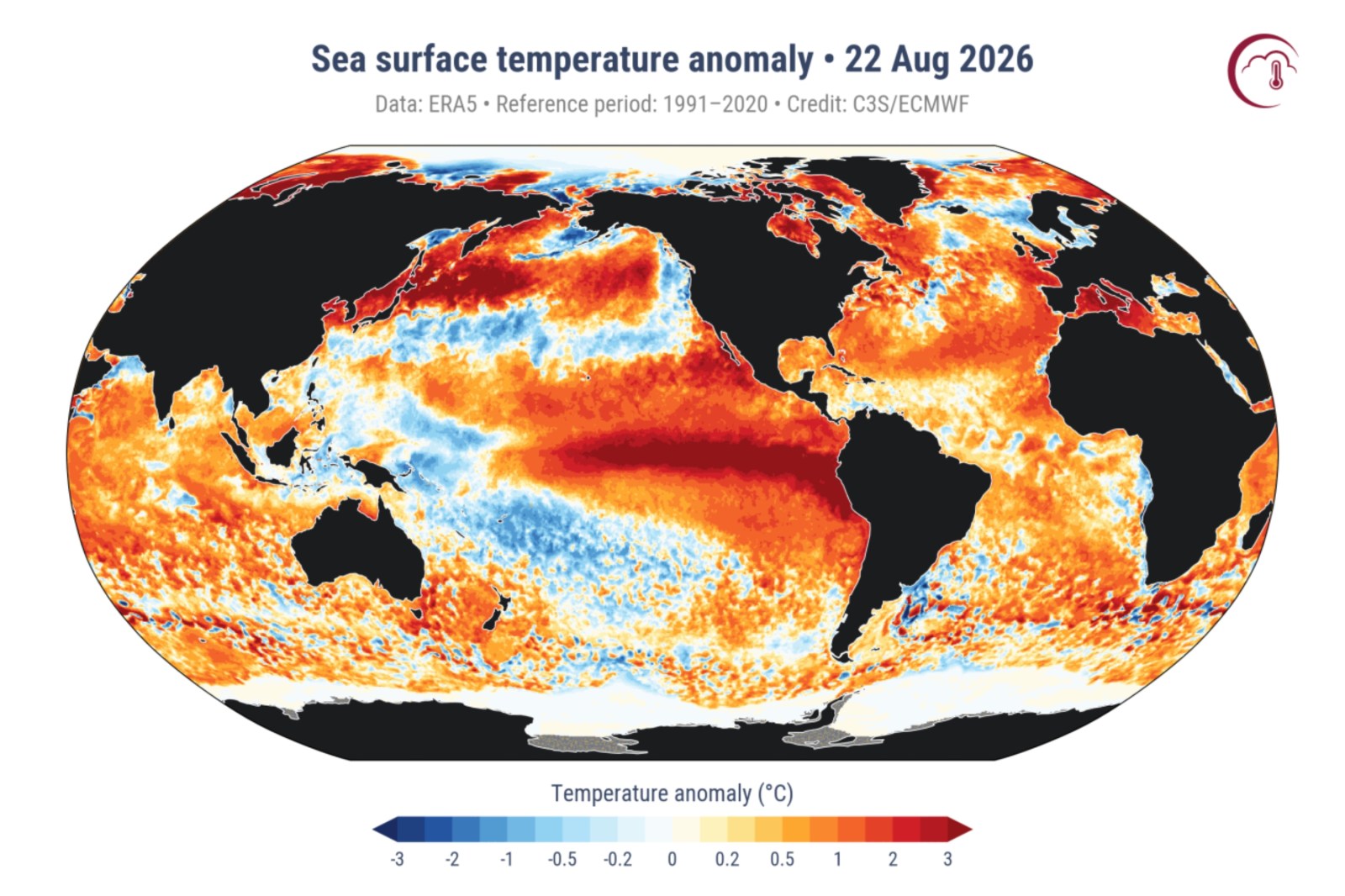
The average surface temperatures of the world’s oceans have reached unprecedented levels. The Copernicus Climate Change Service reported that the average sea-surface temperature was 21.1 degrees Celsius, or 70 degrees Fahrenheit, on a recent Saturday. This surpasses the previous daily high of 21.09 C, recorded in March 2024.
Copernicus noted the peculiarity of this record’s timing. Usually, global ocean temperatures peak in March and April, following the austral summer. Yet, this new record was observed in August.
Alex DaSilva, a meteorologist at AccuWeather, informed Newsweek that the record pertains to oceans outside the polar regions and indicates warmth across multiple ocean basins. “El Niño plays a significant role,” DaSilva stated. “It affects a large part of the Pacific Ocean, making record temperatures easier to attain. The Atlantic Ocean is quite warm too, contributing to the global record.”
For three consecutive years, Copernicus has recorded ocean temperatures outside the polar zones ranging between 0.35 C and 0.73 C above the long-term average. In June, these temperatures were already at record levels, aligned with the emergence of El Niño in the equatorial Pacific.
Understanding Ocean Temperature Records
The highest daily average temperature for the world’s oceans outside the polar regions is 21.1 C, or about 70 F, reached on August 22, 2026. This surpassed a March record of 21.09 C. Previously, in August 2023, the record was 20.98 C.
Samantha Burgess of the European Centre for Medium-Range Weather Forecasts highlighted the ocean’s stress. “El Niño adds heat, but it’s compounded on decades of human-driven warming,” Burgess said. “Rising ocean temperatures threaten marine ecosystems and coastal areas. Since the 1990s, marine heatwave days have more than tripled, increasingly stressing marine habitats and reliant communities.”
DaSilva noted that 2024 and 2023 occupy the subsequent positions in ocean temperature records. El Niño was present from late 2023 into early 2024 before shifting toward La Niña.
“Typically, the oceans are warmest in March and August,” DaSilva explained. “While temperatures might still rise within the coming week, setting new records in September seems unlikely.”
Exploring El Niño’s Influence and Potential Strength
El Niño describes the warm phase of the El Niño-Southern Oscillation (ENSO), a natural climate pattern in the tropical Pacific that fluctuates every two to seven years. During El Niño, waters in the central and eastern equatorial Pacific warm, trade winds diminish, and tropical rainfall patterns shift eastward. These changes can alter weather and climate globally according to the National Oceanic and Atmospheric Administration (NOAA).
On August 13, NOAA’s Climate Prediction Center indicated that El Niño was strengthening. It highlighted a greater than 90 percent chance of a significantly strong event during the Northern Hemisphere’s fall and winter into 2027. Moreover, during October-December 2026, there’s a 69 percent chance of a historic El Niño exceeding past events’ strength since 1950.
DaSilva predictively mentioned that another ocean record might follow when the seasonal peak returns. “Depending on El Niño’s intensity this fall, we might see another sea-surface temperature record next March,” he said, recalling 2024’s record in a similar period.
Leave a Reply