On a live concert stage, sound engineers constantly battle noise. Issues like a kick drum bleeding into a vocal mic, or a guitar amp interfering with a monitor feed, are common. When singers drop the mic to their chest mid-chorus, half the lyrics can vanish into the mix. Traditional tools to combat these problems have included equalization, compression, volume adjustments, and human judgment. This often involved manual adjustments by sound engineers making real-time decisions.
This summer at the Hollywood Bowl, a new approach is being introduced. A machine learning system, Source Intelligence, developed by L’Acoustics, a French audio company, is changing the game. It listens to every microphone on stage and isolates a vocalist’s voice from surrounding noise in real time. Engineers have noted its precision, claiming they haven’t encountered such a level of effectiveness before. The system offers about 40 decibels of rejection on unwanted noise, which L’Acoustics Chief Executive Laurent Vaissié asserts is 20 decibels better than its competitors.
Fred Vogler, the Bowl’s principal sound designer since 2003, described the practical effect as startling. He noted that the system allows for only the vocal capture without interference from guitar amps or drums.
The Source Intelligence is part of a larger audio overhaul at the Hollywood Bowl, the most significant upgrade in a generation. This also includes the introduction of a new flagship L Series line array system and an immersive surround installation, possibly the world’s largest of its kind.
The Physics of the Upgrade
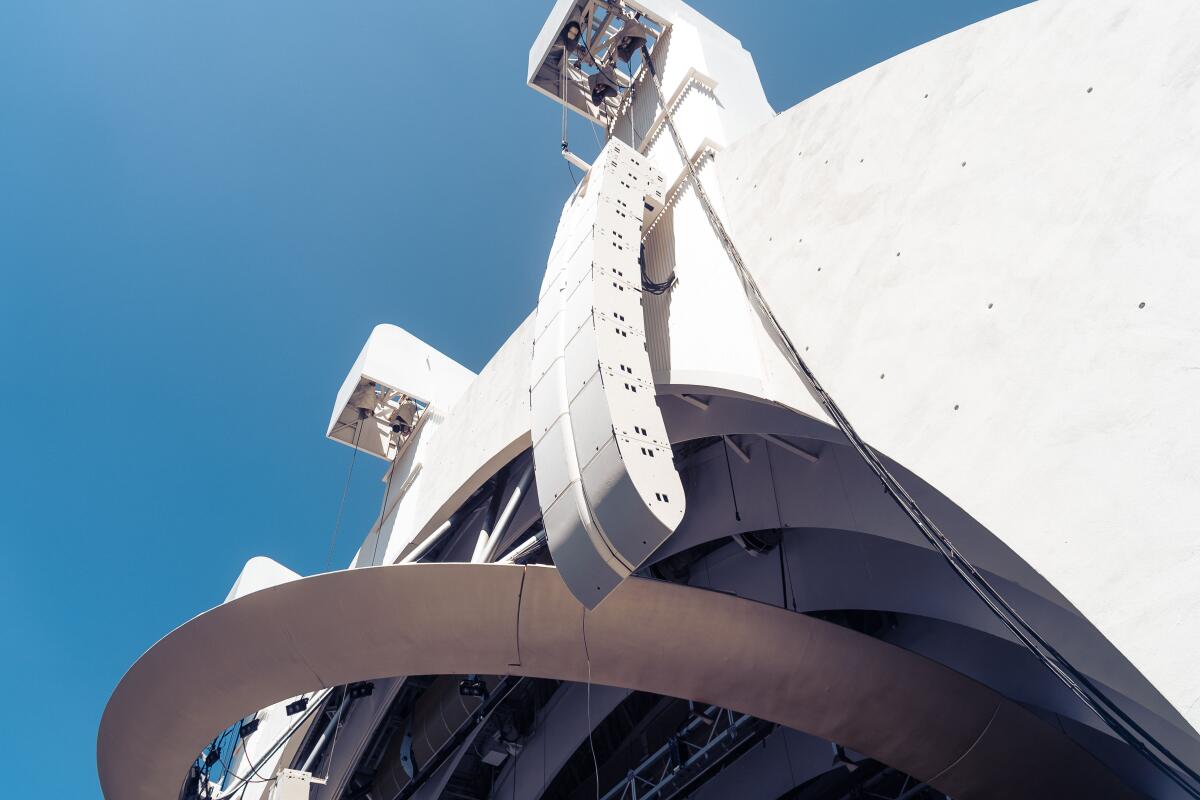
The upgrade centers around the L1, L’Acoustics’ new line array system, a major rethinking of the format since the company first created the modern line source array in 1993. Line arrays involve suspending multiple speaker cabinets in a vertical column, enabling sound engineers to direct audio across a space. The challenge has been the physical gaps between these cabinets.
Laurent Vaissié explained that when multiple boxes are attached, gaps are created, which affects coherence. The L1 system addresses this by integrating speakers into a reshaped cabinet with a built-in angle, reducing interfaces. This results in a system that is 30% smaller in footprint yet more powerful.
At the Hollywood Bowl, the stakes are high. The venue’s uppermost seats are approximately 400 feet from the stage. Surrounding neighborhoods make noise bleed an issue. Previously, there was a variance of six to nine decibels between the stage’s loudest and softest areas, which has now been reduced to about three decibels.
Laurent Vaissié noted that the reduction in variance makes it feel like you’re close to the stage regardless of the seating.
Fred Vogler remarked that the shift from the K Series to the L Series exceeded his expectations.
AI on the Mix
In addition to the new speakers, the AI components of the upgrade mark a significant development. Source Intelligence, the new vocal isolation system, utilizes machine learning to separate a singer’s voice from the accompanying live stage sounds.
This technology initially started as a tool for DJs, allowing them to split a stereo track into parts like vocals, bass, and drums, and spatialize them in real time. L’Acoustics engineers adapted it for live sound application.
For mixing engineers, this technology is transformative. It enables them to elevate vocals without raising other elements. Audiences benefit from enhanced intelligibility and a cleaner mix, as engineers expend less energy battling unwanted signals.
Source Intelligence has been used in major tours with artists like Harry Styles, the Weeknd, and Bruno Mars, whose engineers reported significant impacts.
The Immersive Frontier
The third component of the upgrade could be its most forward-looking. The Bowl has installed a full immersive surround sound system, L’Acoustics’ L-ISA platform. This system includes distributed speakers that envelop audiences in spatial audio across the 17,500-seat amphitheater.
Scott Sugden described it as potentially the largest immersive sound deployment worldwide. L-ISA operates in two modes: a room engine that simulates enclosed spaces through digital reverberation and a surround object mode that allows spatializing sounds across the seating area.
Vogler has cautiously experimented with it during performances, finding it can create a club atmosphere in the expansive space. He ensures its use remains subtle to enhance the experience without drawing attention.
A Century-Old Venue with Modern Enhancements
The Hollywood Bowl was founded in 1922. The current structure dates to a 2004 renovation, which established a partnership with L’Acoustics. The Bowl first installed the K1 system in 2013 and now the L1 this season.
To maintain its world-class status, acoustics and sound have been prioritized. More than 130 shows are scheduled this summer, all using the house system. This commitment reflects confidence in the infrastructure.
The L Series, Source Intelligence, and L-ISA signify the Bowl’s most ambitious technological advancement since amplified sound’s introduction. The future of live music promises smarter, more precise, and immersive experiences. Audiences simply need to arrive and enjoy the refined listening experience.
Leave a Reply