Intense heat and severe storms are sweeping across the United States this week, extending into the next as summer temperatures settle across the nation. Friday marks the last oppressively hot day for the East Coast, with numerous record highs anticipated in cities such as Baltimore, Washington, New York, Philadelphia, and Raleigh. On Thursday, Raleigh recorded a temperature of 101 degrees Fahrenheit. New York activated cooling centers on Thursday as temperatures climbed into the 90s.
Combining above-average warmth with high humidity, heat index values are expected to rise to between 95 and 105 degrees. However, temperatures should decline over the weekend. Conversely, the West will experience record heat on Sunday and Monday, with temperatures projected to reach the upper 90s to low 100s. Next week, Portland and Seattle are likely to set new high-temperature records.
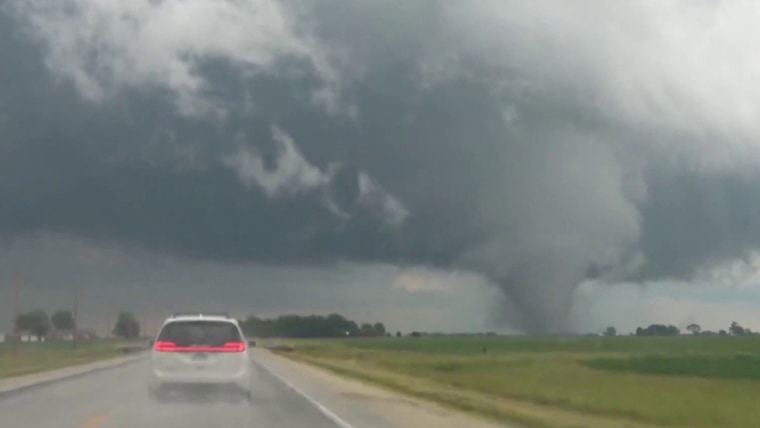
Meanwhile, severe storms persist throughout the weekend in various areas. On Thursday, there were 500 storm reports, marking it as the third-most active day of 2026 thus far. More than a dozen tornadoes were reported in Illinois, Indiana, and Wisconsin. In Illinois, extensive damage occurred, leaving homes destroyed and debris scattered. In Streator, a small city, a cul-de-sac suffered devastation from the twisters. Neighbors informed NBC News that a couple was trapped under rubble and required rescue.
NBC News witnessed another man trapped under debris, asserting he had a broken leg. Police later rescued him.
The storms also brought sizable hail across the central U.S., damaging cars in Iowa. Roads were flooded and rain reduced visibility from Wisconsin to Pennsylvania. By Friday morning, there were no reports of storm-related fatalities. Severe storms remain possible for 66 million people across two regions on Friday.
The larger region includes the mid-Atlantic, Appalachians, and Northeast, where damaging winds pose the primary threat. Cities advised to be cautious include New York, Philadelphia, Washington, Baltimore, Raleigh, and Charlotte. The second, smaller area covers western Oklahoma, the Texas Panhandle, and sections of New Mexico, Colorado, and Kansas, where hail, strong winds, and isolated tornadoes are threats.
Saturday’s severe storm risk targets the Midwest and Plains, impacting 14 million people from northern Oklahoma to Illinois and Iowa. Cities such as Wichita, Kansas City, St. Louis, Des Moines, and Peoria should remain vigilant. Primary hazards involve wind gusts exceeding 75 mph, hail larger than 2 inches in diameter, and several tornadoes. On Sunday, severe storms are expected to continue, threatening 23 million people in the mid-Atlantic with gusts surpassing 60 mph. This zone covers Richmond, Norfolk, Washington, Baltimore, and Philadelphia.
Leave a Reply