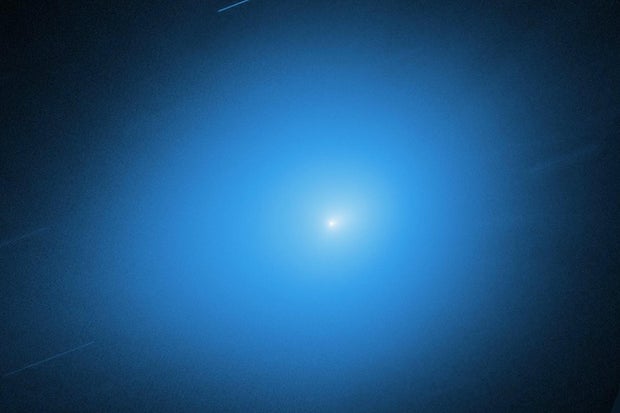
An interstellar comet, 3I/ATLAS, captivated astronomers with its passage near Earth last year, showcasing unique characteristics never seen in our cosmic region. The comet is estimated to be almost three times older than our solar system, offering unprecedented study opportunities.
Interstellar Visitors
3I/ATLAS is the third comet from outside our solar system observed by humanity. Previously, 1I/’Oumuamua and 2I/Borisov were detected, but lacked the brightness needed for detailed analysis. The unusual brightness of 3I/ATLAS enabled scientists to gather significant isotopic data using powerful telescopes.
Unique Chemical Composition
The study, published in Nature, reveals that 3I/ATLAS has a chemical composition unlike any celestial body previously identified. Observations from the James Webb Space Telescope and ALMA Observatory in Chile show it contains ten times more deuterium compared to solar system comets. This high heavy water content indicates its formation in a cold environment, likely around minus 243 degrees Celsius.
“Maybe it’s the oldest object to have been observed in our solar system.” — Martin Cordiner, NASA’s Goddard Space Flight Center
Cosmic Mystery and Origin
While its exact origin remains uncertain, experts speculate that it may be a relic from the ‘cosmic noon’ era, a period around 10 billion years ago marked by intense star formation. Similar to solar system comets, interstellar objects might have been expelled during new planet formation.
Scientists observed a lack of chemical enrichment, hinting at proximity to newly forming stars during its origin. Untethered by any star, 3I/ATLAS likely wandered around the galaxy for billions of years.
Spotlighting Future Discoveries
Despite the challenges of observing 3I/ATLAS as it exits the solar system, astronomers anticipate detecting more interstellar objects soon. The new Vera C. Rubin Observatory in Chile holds promise for future discoveries.
“This is just the beginning of an exciting new field, with much to discover about our galaxy.” — Martin Cordiner
NASA has dismissed theories of extraterrestrial technology on the comet. Images captured by the Mars orbiters and Hubble Space Telescope have provided visual documentation of its journey.
As astronomers delve into the study of these cosmic travelers, they unlock new insights into the history and formation of the galaxy.
Leave a Reply