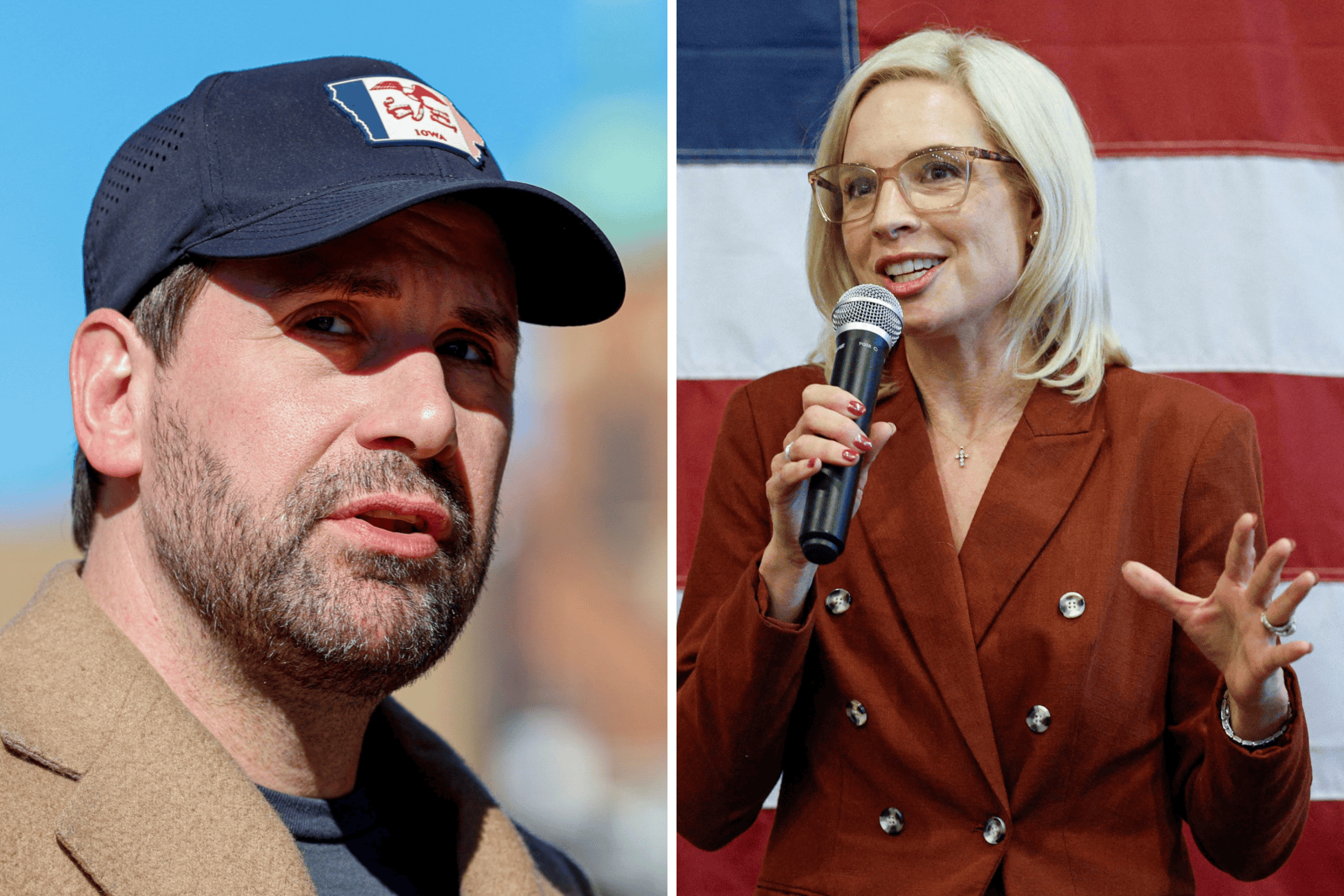
Undecided voters are gradually choosing sides in Iowa’s closely contested U.S. Senate race between Democrat Josh Turek and Republican Ashley Hinson. Despite more voters making decisions, the race remains extremely competitive.
This particular Senate race is critical as it fills the seat vacated by outgoing Republican Senator Joni Ernst. The competition between Turek and Hinson remains tight according to recent polls. The candidates tackled issues like tariffs, immigration, and voting records in their debate on October 7. A subsequent debate last week revisited these topics and added discussions on the Iran war.
Earlier in the campaign, a significant number of voters remained undecided, sometimes reaching double digits. Independent voters without specific party allegiance play a crucial role in Iowa’s elections. They are more inclined to vote across party lines on Election Day. Despite a decrease in undecided voters, the narrow margin between Turek and Hinson continues. Both candidates have led at different times based on various polls.
Latest Polling Insights
The Trafalgar Group, a conservative pollster, released a recent poll from October 13-15 involving 1,094 likely voters. In this survey, 46% supported Hinson, while 44% favored Turek. Over 6% remained undecided. The undecided percentage has decreased since a previous poll conducted September 16-18, where Hinson led 44% to 42% and over 10% were undecided.
Marist polls from September and October revealed similar trends. In September, 5% were undecided among 1,050 registered voters. By October, of 1,100 registered voters, the undecided percentage fell to 4%. The September poll showed Turek leading 50% to Hinson’s 42%. However, by October, his lead narrowed to 48% versus Hinson’s 45%.
YouGov’s October poll highlighted a notable drop in undecided voters. Surveying 2,245 likely voters from October 6-12 found 4% were undecided, with Turek at 47% and Hinson at 46%. In September’s results, which had 11% undecided, 44% supported Turek and 43% backed Hinson.
John Geer, a political science expert from Vanderbilt University, emphasized the unpredictable nature of the race. High turnout from either party could be the deciding factor. He noted that the polls lack the precision to provide certainty in such a close contest.
No Further Debates Planned
Hinson and Turek will not participate in additional debates. They concluded their debate schedule with the events on October 7 and October 13. President Donald Trump plans rallies in Iowa to support Hinson on October 22 and November 1.
Upcoming Election and Iowa’s Significance
Election Day is scheduled for Tuesday, November 3. Early voting in Iowa began and will continue until November 2. As of now, 2% of Iowa’s registered voters have already submitted early ballots.
The midterm elections carry the potential to change the Senate’s control. Voter concerns include economic issues, inflation, rising fuel costs, and foreign policy matters like the Iran war. Historically, Iowa has shifted between party preferences in presidential elections. Donald Trump won Iowa in the previous three elections but it was won by Barack Obama before Trump.
Timothy Hagle, an Iowa politics expert, noted the critical role of undecided voters. He explained that most of these voters are independents, not affiliated solely with Democrats or Republicans. Without an incumbent, the division amongst undecided voters might be more even.
In the past, Iowa independents divided their support in open-seat races, such as when Ernst ran in 2014. This election, Iowa joins states like Texas, Michigan, Ohio, and Alaska in hosting competitive Senate races.
Geer further speculated on the broader election trend, suggesting a partisan tide could swing most competitive seats to one party, similar to prior election outcomes.
Leave a Reply