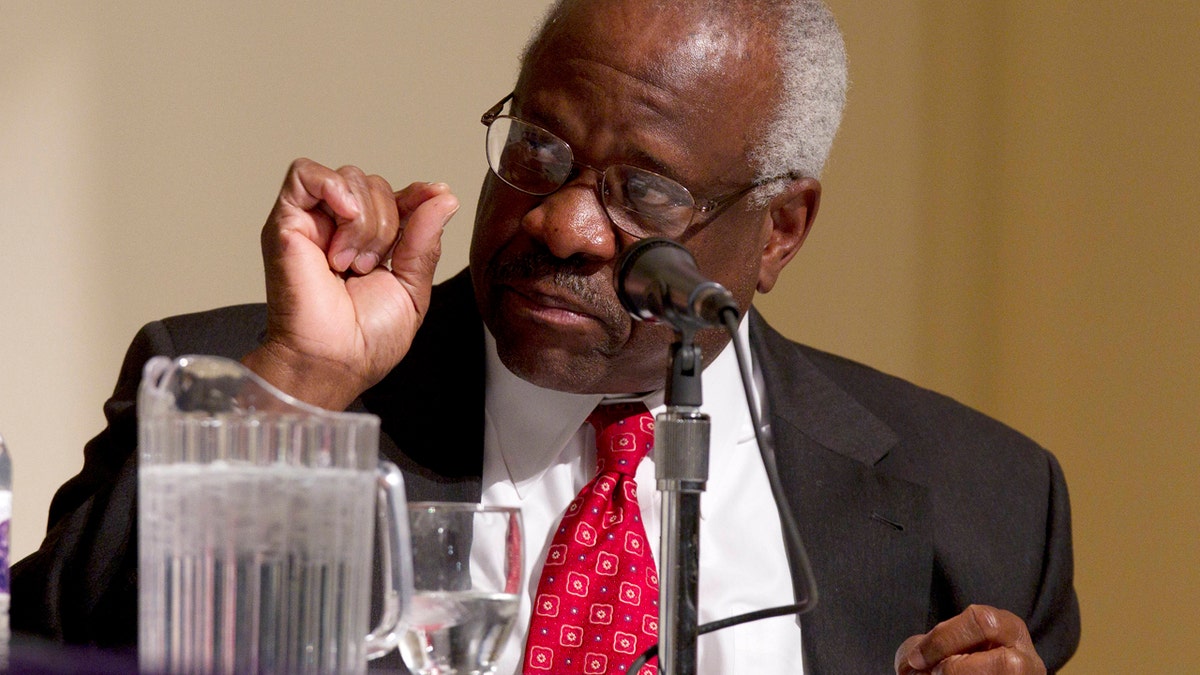
Supreme Court Justice Clarence Thomas has expressed strong opposition to the notion that Black Americans should be expected to adhere to specific political views based on their race. During a rare interview with Republican Texas Sen. Ted Cruz, Thomas spoke about individualism and the pressure placed on Black individuals.
“We had this saying [that there are] only two things I have to do: stay Black and die,” Thomas remarked, addressing Cruz’s comment regarding his individualist approach. He highlighted how expectations are often set upon people due to their skin color. “That was a retort to people who had these sort of requirements for us, these mandates for us because of our skin color. But at any rate, they think that here’s the way you’re supposed to think. Again, here’s your skin color. There’s this kind of deterministic view that you’re supposed to think this because we say so.”
Thomas stressed his refusal to accept such expectations and noted how this led to perceptions of him being a contradiction. Speaking on the “Verdict with Ted Cruz” podcast, he emphasized his deviation from what others believe he should think.
Justice Clarence Thomas, having experienced poverty during his childhood in segregated Georgia, initially lived in his parents’ wooden home in Pin Point before relocating to Savannah with his grandparents. Thomas was raised speaking Gullah, a creole language rooted in English, spoken by descendants of African slaves.
While attending the College of the Holy Cross, he initially supported left-wing Black nationalism, admired Malcolm X, and contributed to founding the Black Student Union. He shifted his political stance after participating in a violent protest in Cambridge, Massachusetts, in 1970. He later attributed his change of mind to the shame he felt from the episode, which led him to turn away from left-wing activism and adopt his grandfather’s message of self-reliance.
Thomas further explained the point by comparing modern pressures on Black Americans to historical racial segregation. He asked, “When I was a kid, the Savannah Public Library was segregated. Do you think it was right that the Savannah Public Library was segregated?” When the answer was no, he continued, “What if they allowed me in but said I couldn’t go to certain floors? That would be wrong.” Thomas illustrated how restricting ideas based on race is akin to limiting access within segregated spaces.
Justice Thomas challenged the notion that certain ideas or books are off-limits for Black individuals, underscoring his belief in the freedom to embrace a range of ideas without restriction.
Leave a Reply