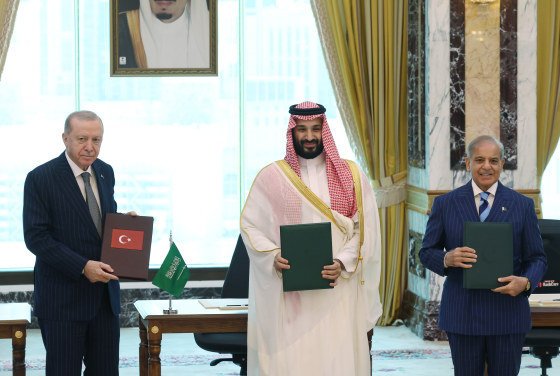
In Islamabad, defense analysts warned that the new defense agreement should not be considered equivalent to NATO, even with its collective-defense clause. Turkish President Recep Tayyip Erdogan, Saudi Crown Prince Mohammed bin Salman, and Pakistani Prime Minister Shehbaz Sharif signed a trilateral joint defense agreement in Mecca, Saudi Arabia, on August 7.
The agreement, known as the Mecca Joint Defense Agreement, aims to bolster security cooperation among the three nations amid rising tensions between the United States and Iran. The agreement was signed by Saudi Arabia, Turkey, and Pakistan at a time when security collaboration is paramount.
Pakistan’s Foreign Minister Ishaq Dar emphasized that the agreement is not directed against any particular country and remains open to other nations willing to adhere to its principles. He highlighted that the accord reflects a mutual desire to enhance strategic security cooperation.
Turkish Foreign Minister Hakan Fidan echoed similar sentiments, affirming that the agreement is not aimed at Iran or any other nation. The agreement states that an armed attack on any member shall be considered an attack on all, aligning with Article 51 of the U.N. Charter, which addresses the right of self-defense.
Dar assured that the agreement would not replace existing bilateral or multilateral agreements with other countries or organizations. His statements came after public celebrations marked the signing of the agreement, with landmarks in Islamabad and various Saudi cities illuminated with the countries’ flag colors.
“The agreement underscores our commitment to peace and stability,” Dar stated. “We will continue to work with nations across the region.”
Each country brings unique strengths to the agreement. Pakistan has significant military experience and is the only nuclear-armed country in the Muslim world. Saudi Arabia contributes substantial economic resources and regional influence. Turkey, a NATO member, offers a large military and developing domestic defense industry.
Analyst Abdullah Khan cautioned against seeing the agreement as a NATO equivalent despite its collective-defense provision. He noted that although it was signed during regional tensions, it should not be viewed as targeting Iran or any other country. Pakistan and Saudi Arabia have maintained strong military ties, having signed a mutual-defense agreement in September 2025. Additionally, Pakistan and Turkey have been expanding their defense cooperation in recent years.
Leave a Reply