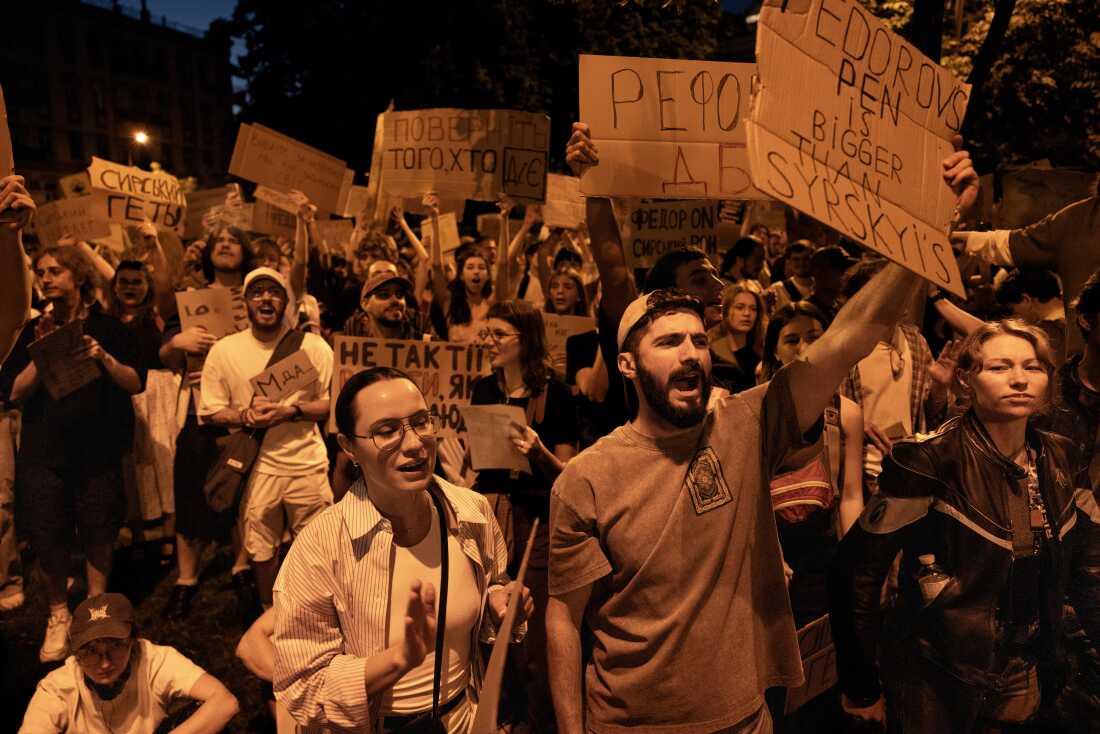
Protests erupted in Kyiv on Friday following President Volodymyr Zelenskyy’s decision to dismiss Mykhailo Fedorov as Ukraine’s defense minister. Fedorov had been credited with enhancing technology within Ukraine’s military. In a period of nationwide protests over military strategy, the Ukrainian military appointed Mykhailo Drapatyi as the new armed forces commander, replacing Gen. Oleksandr Syrskyi who was dismissed the previous Tuesday. “There is a difficult task ahead, so we are not making loud promises,” Drapatyi said in a post on Facebook following his appointment announcement.
The 43-year-old major general is recognized as a reformer and takes command during a significant political and military transition in the country. He represents a new generation of military leaders in Ukraine who quickly adapt to technology-driven combat strategies. Drapatyi has been instrumental in developing a “drone line” strategy, which creates a “kill zone” near front lines using drones for offensive and surveillance purposes.
Zelenskyy acknowledged Syrskyi for his contributions early in the Russian invasion. “We have come a long way,” Zelenskyy stated in a video address. “Ukraine’s defense continues, and every warrior must be treated with dignity.” The decision to dismiss Syrskyi followed the removal of Fedorov, which sparked protests across Ukraine. Protesters, including 42-year-old Mila Timchenko, noted that while Syrskyi’s experience was valuable at the onset of the conflict, the nature of warfare has evolved.
Fedorov, aged 35, had advocated for a drone-centric strategy that has effectively countered Russia’s larger resources over the ongoing four-year conflict. Ukraine has used long-range drones to strike Russian energy facilities, triggering fuel shortages. Mid-range drones have targeted Russian supply lines and sea vessels, while land drones increasingly replace infantry on battlefronts.
The clash between Fedorov and Syrskyi highlighted a generational divide between those embracing tech-driven strategies and traditional military doctrine. Military analyst Rob Lee, based in Kyiv, remarked on the oversimplification of the “drone-debate” narrative. “Fedorov wanted quicker reforms, while Syrskyi was more cautious,” Lee told NPR.
Fedorov noted in a press conference that Syrskyi’s supporters were resistant to tech-driven reforms. He stressed the need to eradicate cultures resistant to innovation, otherwise victory could remain unattainable. Syrskyi, whose appointment as military chief followed the dismissal of Valerii Zaluzhnyi in 2024, defended his leadership style on social media, emphasizing his focus was on Russia, not internal conflicts.
Newly appointed Drapatyi highlighted the importance of change, crediting Fedorov with rapid decision-making initiatives. “The military needs change but without justice, no change will make sense,” Drapatyi stated on Facebook.
Drapatyi gained recognition in 2014 countering Russian-backed forces in Mariupol and rose through military ranks. His commitment to accountability resonated deeply amongst troops, according to Lee. The Kremlin showed indifference towards these changes, issuing an arrest warrant for Drapatyi and predicting no shift in battle dynamics.
Since the 2022 Russian invasion, over 16,000 Ukrainian civilians have perished, per U.N. reports. Protests continue outside Zelenskyy’s office, with demonstrators demanding Fedorov’s reinstatement as defense minister. Fedorov, proposed another governmental role by Zelenskyy, insists on returning as defense minister. Reflecting on the developments, Fedorov described the moment as a “new era and new hope” in fighting for freedom and justice.
Leave a Reply