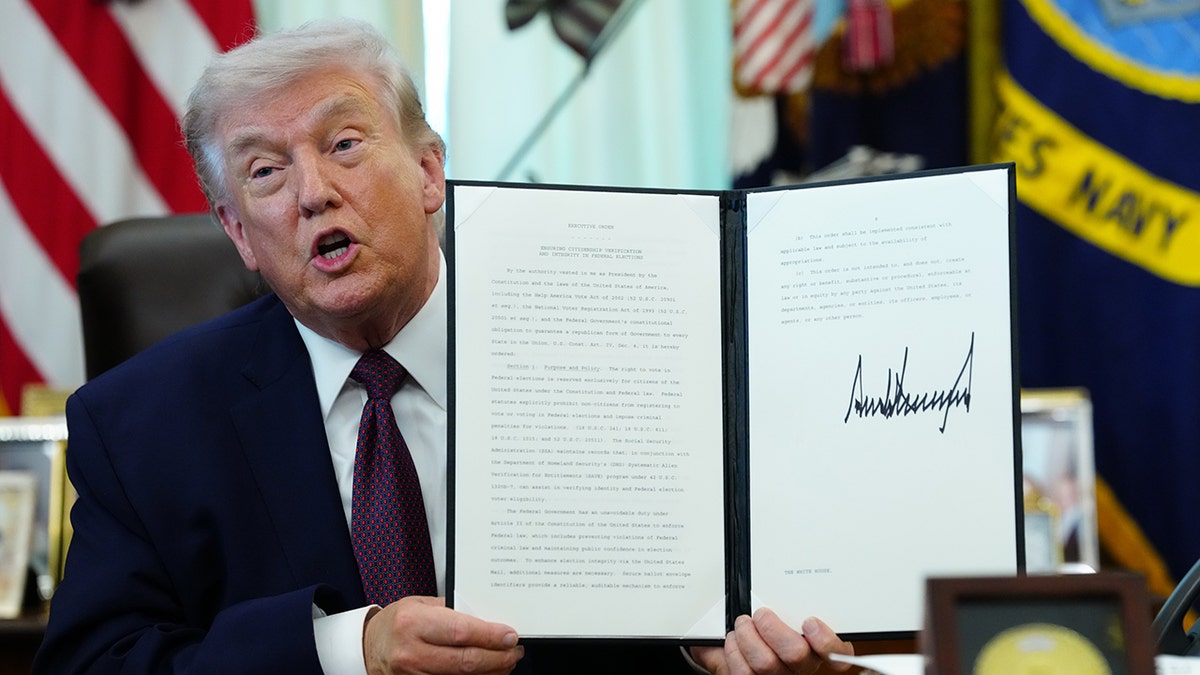
The possibility of implementing new mail-ballot regulations before the 2028 presidential election raises legal challenges and uncertainties for President Donald Trump’s administration. Legal experts shared insights with Fox News Digital regarding the president’s executive order, issued in March, which directed the Postal Service to develop new rules for federal mail ballots. These included standardized ballot envelopes displaying an Official Election Mail designation and machine-readable barcodes. The order would allow the Postal Service to reject ballots that do not meet these standards or belong to individuals not listed as eligible mail voters by states.
On September 14, the Supreme Court chose not to remove a preliminary injunction blocking these rules from being enforced ahead of the midterm elections in November. As a result, it remains uncertain if these changes can be enacted by 2028.
Experts explained the case heavily depends on the Supreme Court’s interpretation of the balance of power between the executive branch and states’ rights over election processes. Florida State University law professor Michael Morley explained to Fox News Digital, “If the Court views this primarily as an attempt by the President to regulate federal elections, the Court is likely to invalidate it.” Morley noted, “The President has no constitutional authority over federal elections, and Congress has not delegated him broad statutory authority over the field.”
Morley also suggested that if the Court approaches the rules as administrative requirements essential for the Postal Service’s operations, the rules might stand. From this angle, he suggests it would be unusual if the Court decided the Postal Service lacks authority in dealing with the delivery of election-related mail.
“Justice Brett Kavanaugh voted to uphold the injunction, noting that, though the Post Office may have the authority to implement such a regulation, forcing its new rule to be implemented so close to an election likely runs afoul of federal law.”
Stephen Richer from the Cato Institute opined that at least six justices believe the administration might lose on the constitutional grounds. He explained, “The Constitution doesn’t vest authority to regulate elections to the president, and I think that they would say that this effectively dictates how elections can be run.”
Some see the decision as procedural rather than a full rejection of the administration’s efforts. Chad Mizelle from the America First Policy Institute argued that Justice Kavanaugh believed in the Postal Service’s statutory rights but highlighted timing issues that could disrupt the implementation.
Regardless of outcomes, the injunction has been termed by President Trump as a significant setback. In his Truth Social account, Trump criticized the decision as contributing to a system he describes as “corrupt and out of control.”
Instances of election and mail-ballot fraud have been documented, although there is no evidence of widespread fraudulent activity in U.S. mail voting operations. The broader implications of the proposed rule leave uncertainties as Election Day nears. Ilya Shapiro from the Manhattan Institute highlighted the complexity: “It’s not about whether mail voting is good or bad. It’s about who gets to set the rule for it.”
Leave a Reply