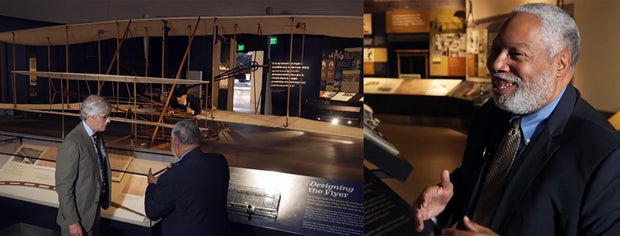
When Lonnie G. Bunch III strolls through the Smithsonian’s National Air and Space Museum, his enthusiasm for history is unmistakable. Among his cherished exhibits is the 1903 Wright Brothers’ flyer, the first powered airplane to achieve flight. Bunch fondly recalls visiting Kitty Hawk, North Carolina, where a replica stands, yet beams with pride knowing that the original resides in the Smithsonian.
As the Secretary of the Smithsonian Institution, Bunch oversees 20 museums and the National Zoo. His journey at the Smithsonian began nearly 50 years ago when Apollo 11 astronaut Michael Collins, then director, offered him a position. Bunch reflects on what Collins saw in his 25-year-old self, commenting that it was likely his passion for history that stood out.
In 2019, Bunch made history as the first African American and the first historian to become Secretary of the Smithsonian. At his installation, he spoke about the transformational changes within the institution, noting the symbolic significance of his position in a place where Frederick Douglass could not speak in the past.
Museums, in Bunch’s view, are America’s greatest storytellers. However, the Smithsonian itself has become part of the narrative recently. In 2025, an executive order from President Trump threatened funding due to concerns about the institution’s focus on race. Despite these challenges, Bunch’s decision to retire is not influenced by political pressures. He stresses the importance of defending the Smithsonian and history itself against misconceptions.
Reports have criticized the Smithsonian, particularly the National Museum of American History, suggesting inadequate representation of the founding fathers. Bunch refutes these claims, emphasizing that the love for the nation’s history is present, though he acknowledges room for more expansive storytelling where needed.
Personal attacks on his patriotism have not deterred Bunch. He shares his roots and the pride his family holds for the nation, stemming from his father’s World War II service and fond memories of Memorial Day parades. Bunch believes in embracing the totality of American history, asserting that one cannot avoid history’s realities.
His most significant contribution was as the founding director of the National Museum of African American History and Culture, which opened to widespread acclaim a decade ago. Bunch describes it as a testament to the shared national journey.
Bunch advises that his successor should value the institution’s historical significance, navigate the political landscape adeptly, and possess the courage to attribute challenges to him, the predecessor. Until his departure at year’s end, Bunch remains committed to portraying America’s complete story through the Smithsonian’s endeavors.
In his words, “The Smithsonian is America’s collective memory,” highlighting the importance of preserving the nation’s history to ensure it is never forgotten.
Leave a Reply