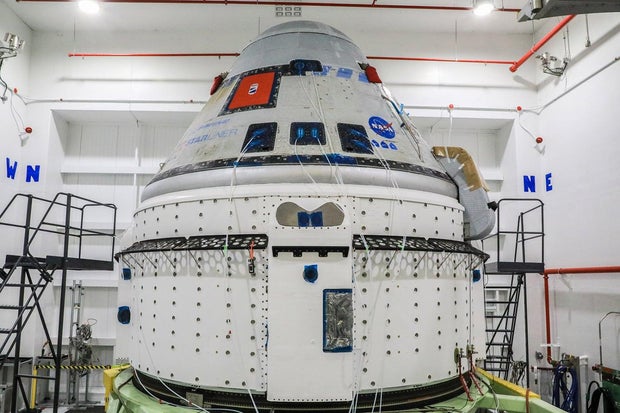
NASA, in collaboration with Boeing, plans to launch an uncrewed Starliner capsule between December and January. This test aims to evaluate recent upgrades following issues in a 2024 mission. Those failures left two astronauts stranded on the International Space Station (ISS) for over nine months due to propulsion system faults.
If this test proves successful, a manned Starliner flight could occur by mid-2028. Enhancements include redesigned propulsion system valves and improved subsystems. These changes are crucial after the setbacks of 2024, according to officials. Veteran astronaut Warren “Woody” Hoburg will lead the mission.
Currently, SpaceX’s Crew Dragon is the only operational U.S. vehicle for astronaut transport. NASA aims to quickly reintegrate Boeing to ensure a steady U.S. capability for transporting astronauts to the ISS, which is scheduled for retirement in 2030.
Besides ISS missions, NASA managers emphasize the need for an American spacecraft to support commercial space station flights in the 2030s. SpaceX plans to phase out its Falcon 9 rockets and Crew Dragon spacecraft. Dana Weigel, manager of NASA’s low-Earth orbit operations, stated that having two crew transportation providers ensures commercial access to low Earth orbit.
Boeing supports this collaboration, noting hardware enhancements and efforts for human spaceflight certification. These efforts align with their goal of being a long-term provider of manned missions to low Earth orbit.
Astronauts Barry “Butch” Wilmore and Sunita Williams launched on June 5, 2024, from a Starliner capsule. This was promoted as a 10-day ISS test flight but became a 286-day ordeal. The mission experienced multiple helium leaks and thruster failures, delaying their return.
“The propulsion mishaps were a close call,” an independent review board concluded after classifying the issues that put the astronauts at risk.
The Starliner returned to Earth without a crew after three months. Wilmore and Williams extended their ISS stay for six more months, returning on a Crew Dragon capsule in March 2025.
The independent review identified three critical Starliner issues, among other minor flaws. These included thruster failures, helium leaks, and insufficient redundancy for the orbital descent system.
Boeing responded by addressing these challenges. Upgraded components include new thruster valves, erosion prevention in service module poppets, a faster flight data recorder, better batteries, and enhanced parachutes.
The upcoming Starliner 1 mission will test these improvements, performing a docking maneuver with the ISS. NASA flight controllers will rigorously test propulsion systems throughout the mission.
“We aim to fly Starliner One once the vehicle and team are ready,” noted Weigel. Emphasizing the importance of thermal modification assessment, she described plans for extensive onboard demonstrations.
Long-term, the plan involves certifying the Starliner for commercial crew access to low-Earth orbit. As the Atlas 5 rockets used by Starliner dwindle, NASA intends to certify ULA’s Vulcan rocket for manned spaceflight.
ULA expressed commitment to the Starliner-1 mission, highlighting collaborations with Boeing and NASA on integrating the Vulcan rocket for human spaceflight capabilities.
Leave a Reply