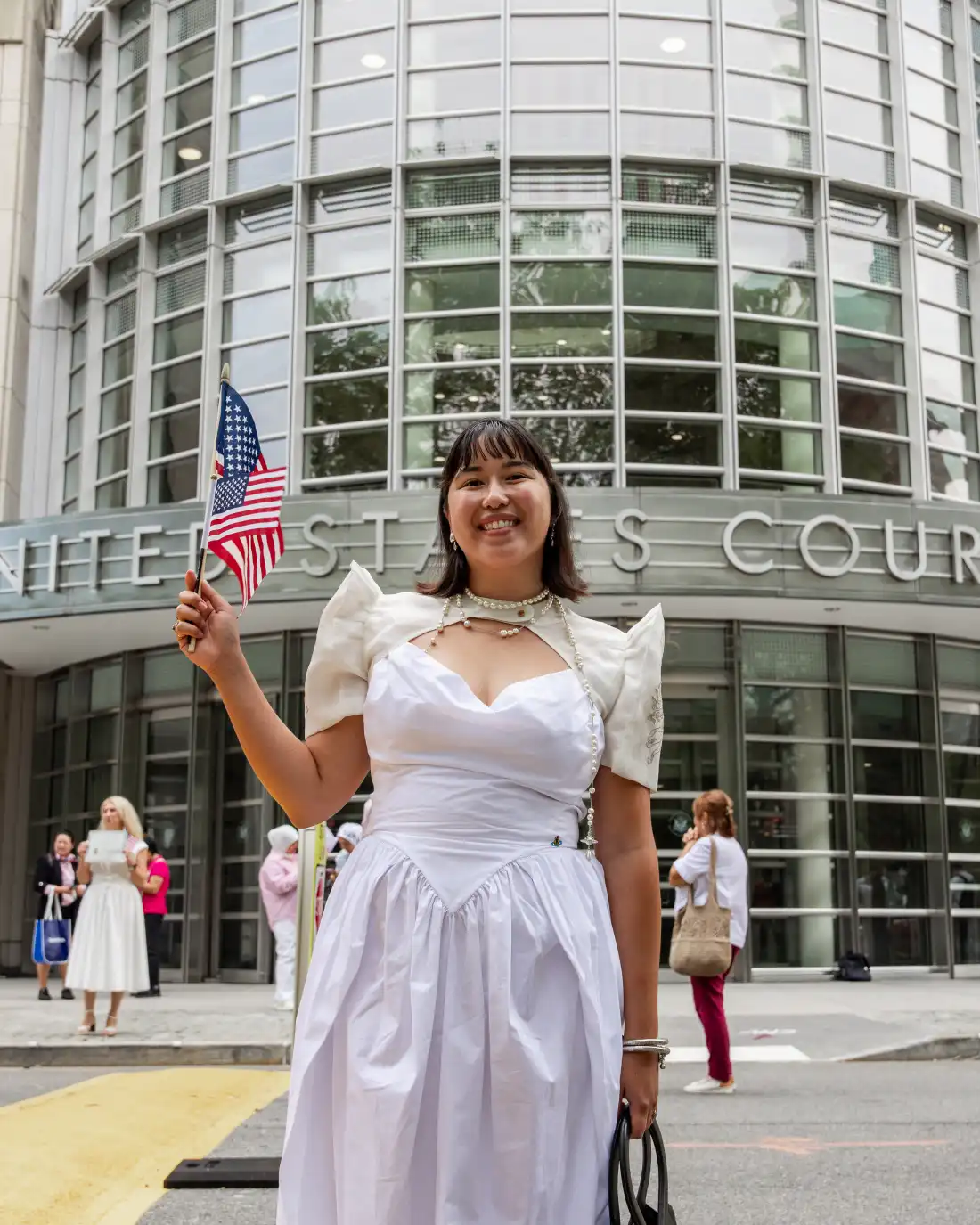
Nicole Solis-Sison arrived in the U.S. from the Philippines at the age of seven. Her family sought asylum due to political turmoil in their homeland. Initially, they expected their stay in Los Angeles to be brief, hoping to return once stability was restored. However, the Philippine government pursued their deportation internationally, complicating their situation.
An Immigration and Naturalization Services agent suggested they apply for asylum, leading them to secure legal residency. Now, after navigating the immigration system for over two decades, Solis-Sison has become an American citizen. At 34, she is voting for the first time in a New York City election, marking a significant milestone in her life.
Young voters, including Solis-Sison, often have concerns about their future, such as the ability to buy a home or pay off student loans. However, this election holds unique significance for young individuals from immigrant families and newly naturalized citizens. Solis-Sison feels lucky and responsible to protect others undergoing similar immigration processes.
“I’ve only gotten out of it with a sliver of hope,” Solis-Sison shares, reflecting on her family’s journey.
Juan Escalante, originally from Venezuela, was unaware of his undocumented status while growing up in Florida. His family faced difficulties due to poor legal guidance, but his status changed with the introduction of the Deferred Action for Childhood Arrivals (DACA) program under President Obama. This transformative moment allowed him to graduate college and eventually become the family’s first American citizen in 2025.
Escalante, now 37, is voting for the first time in California’s general election. He shares a deep appreciation for the power of voting, despite the ballot’s complexity. His determination stems from a desire to support his family and community.
“I understand the power of what a vote can do in service of the greater good,” Escalante emphasizes.
Escalante’s approach was meticulous as he researched every candidate and proposition, with immigration at the forefront of his considerations. His background and identity as an immigrant, American citizen, and Latino inform his voting choices.
Deisy España, from a mixed-status family in Wisconsin, grew up recognizing the risks faced by her undocumented parents. Despite her U.S. citizenship, España’s parents feared encounters with law enforcement. Her mother’s recent green card status provides some relief, yet concerns remain amid heightened immigration enforcement under former President Trump.
España continues encouraging young voters with immigrant families to cast votes not only for themselves but for their parents. Her upbringing shapes her political priorities.
“I’m voting for my parents. I have to do it for my parents who can’t vote,” España asserts.
Leydi Gonzalez of Texas shares a similar sentiment. At 21, her goal was to help her Salvadoran parents gain legal status. Thanks to her sponsorship, they are now legally authorized to remain in the U.S., but concerns about deportation persist.
Gonzalez describes the difficult conversations her family had about contingency plans if her parents were detained. Recent incidents, such as the death of Lorenzo Salgado Araujo, underscore the stakes for her community.
Gonzalez sees hope for change in Texas’s high-stakes U.S. Senate race, with Democrat James Talarico polling ahead of Republican Ken Paxton. Her vote represents both her family’s security and her broader community’s future.
“It definitely feels like I’m voting for my family,” Gonzalez explains.
Leave a Reply