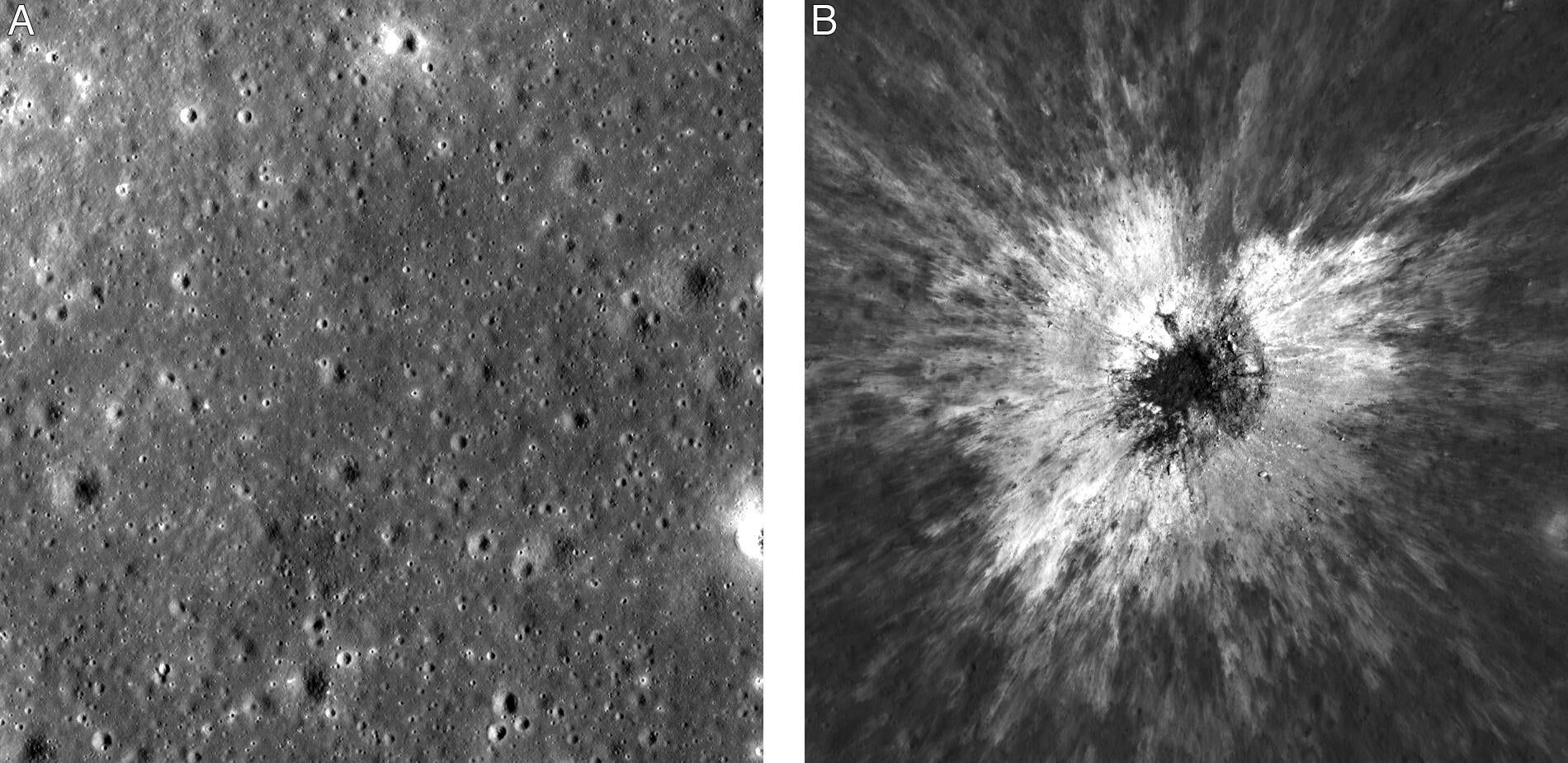
Scientists recently identified a massive crater on the moon, larger than the Roman Colosseum, that resulted from a forceful impact two years ago. Initially unnoticed, the crater spans approximately 728 feet in diameter, akin to the length of two football fields, and reaches depths of up to 141 feet. According to NASA, it’s the most substantial impact crater in the solar system detected in recent times.
Researchers estimate such significant events happen only once every 132 years, providing valuable insights as NASA plans a lunar base for astronauts. “This event represents a statistically rare, essentially once-in-a-lifetime observation,” scientists noted in one of two studies published in Science Advances this week.
NASA’s Lunar Reconnaissance Orbiter (LRO) captured images showing the moon’s surface before and after the discovery of the crater in May 2024. These images were later acknowledged in August 2025. The LRO spotted the crater on the moon’s near side between April 11 and May 22, 2024, after an asteroid or comet fragment impacted the surface.
The crater, named after the late Thomas McGetchin, a former director of Houston’s Lunar and Planetary Institute, is three times larger than the previous record set by the LRO a decade ago. The moon, with impact craters dating back centuries, hosts some of the solar system’s largest, including one over 1,500 miles wide. This new impact disturbed the lunar surface over more than 66 miles, with dust and rocky debris ejected at higher angles than expected.
Mark Robinson, the chief scientist for LRO’s cameras at Intuitive Machines, was the lead author of one study. Another study found a 4-mile-wide cold spot surrounding the new crater, indicating a disruption of the moon’s topsoil. David Paige from the University of California, Los Angeles, describes this process as similar to “gardening the regolith”—turning over sediments and revealing deeper materials.
The LRO has been orbiting the moon since 2009, providing detailed views as NASA gears up for future astronaut missions. The orbiter’s discoveries show the moon’s topsoil undergoes ejection roughly every 80,000 years, faster than earlier estimates. This finding contradicts the belief that the Apollo lunar footprints will last forever, according to Robinson.
Robinson emphasized the next step: calculating the risk posed by ejected debris to planned lunar bases. This information will aid engineers in fortifying structures to minimize damage risk. “That information will help engineers harden structures so one won’t have to worry about damage, or maybe worry less,” he stated.
Leave a Reply