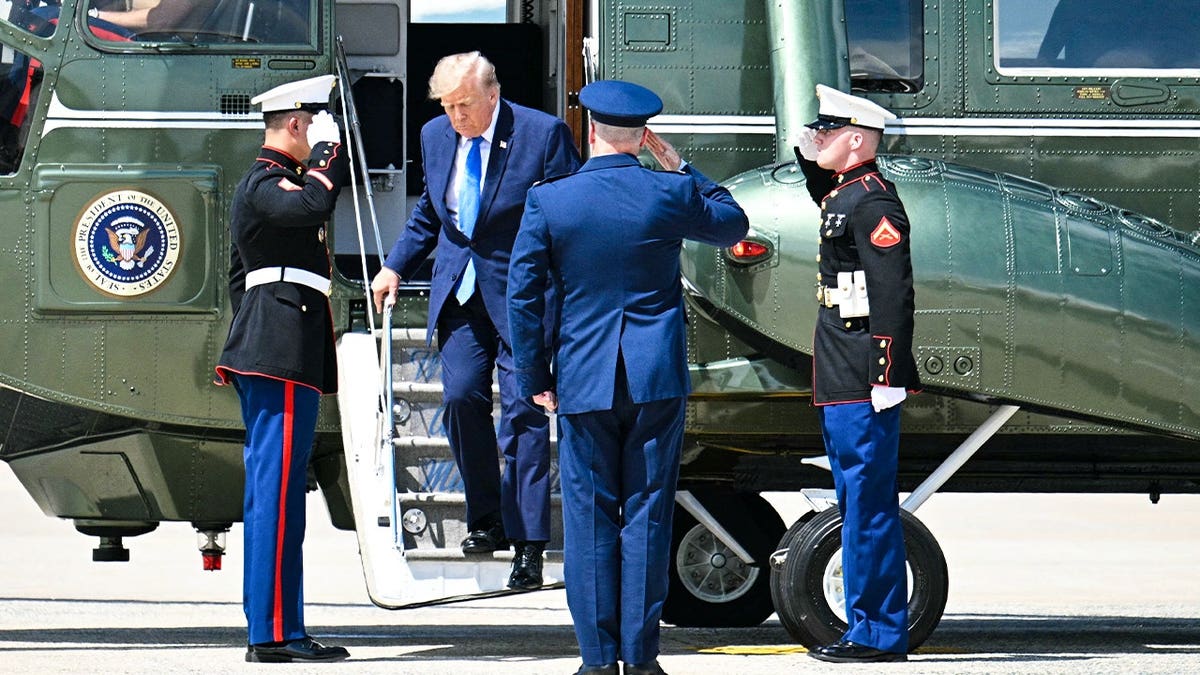
The National Transportation Safety Board (NTSB) has released a preliminary report highlighting communication failures involving Marine One, President Donald Trump’s helicopter, during its departure on August 4. The crew made multiple attempts to notify Reagan National Airport that the helicopter was preparing to leave, but these efforts were unsuccessful.
Initially, Marine One’s crew attempted to contact Reagan National’s helicopter-control frequency before departing from the Ellipse. However, the first call was not received, and a second transmission was too broken to be understood. When direct communication failed, the crew attempted to relay the necessary three-minute notification through the Joint Base Anacostia-Bolling facility, but this also did not succeed.
Due to the missed warning, Reagan National controllers did not receive notice to halt departures before Marine One lifted off. Consequently, Envoy Air Flight 3742, an Embraer E-170 headed to Pensacola, Florida, was cleared for takeoff from Runway 1 as Marine One departed for a trip to Los Angeles. The NTSB stated that the passenger jet was starting its ascent while Marine One left the Ellipse, located approximately two miles north of the airport.
The Federal Aviation Administration (FAA) estimated that the aircraft came within about 0.82 nautical miles laterally and about 700 feet vertically. Importantly, no injuries or damages occurred, and both flights proceeded without further incident.
During the Envoy flight, the crew reported that their traffic-collision system announced “Traffic, Traffic,” upon climbing and speeding up after takeoff. Though the pilots did not visually identify Marine One, the helicopter appeared to the right and below the jet on the cockpit’s display. The traffic-collision system did not issue a resolution advisory, as per the NTSB report.
Marine One’s crew eventually managed to contact the tower after climbing to a sufficient altitude for reliable communications. Reagan National controllers then emitted a traffic advisory, and the Marine One crew promptly reported spotting the Envoy jet.
A communication issue was raised days prior, on July 30, when Marine Helicopter Squadron One (HMX-1) met with Reagan National tower staff. HMX-1 stated that communication had been “spotty,” a concern echoed by the controllers. An agreement was made for helicopter crews to use alternative methods to relay notifications if direct communication faltered, including using another aircraft for relay.
FAA technicians later identified inadequate line-of-sight coverage between the radio transmitter-receiver site and the Ellipse. As a solution, the FAA moved the radios used for helicopter-control frequencies to the top of Reagan National’s control tower from a nearby residential area.
Subsequent radio checks conducted by the FAA with two HMX-1 aircraft near the Ellipse showed no deficiencies after relocating the equipment. The FAA and NTSB began reviewing the incident, initially labelling it a “momentary loss of separation.” According to the FAA, the incident involved a brief loss of separation during which controllers maintained contact with both the commercial and Marine One pilots.
While the reported horizontal separation was less than 1.5 nautical miles, the vertical separation estimate of 700 feet met the applicable FAA standard in Class B airspace, which requires either 1.5 nautical miles of lateral separation or 500 feet of vertical separation.
The NTSB continues to assess surveillance data to confirm the closest point between the two aircraft. The White House has assured that President Trump was not endangered. White House spokesperson Kush Desai stated that Marine One flights are piloted by elite aviators, assuring no threat to the president at any time.
The NTSB specified that the preliminary report presents the factual data gathered thus far but does not include analysis or conclusions about the probable cause. The investigation is ongoing, with any safety recommendations, findings, and further reports announced in public disclosures.
Leave a Reply