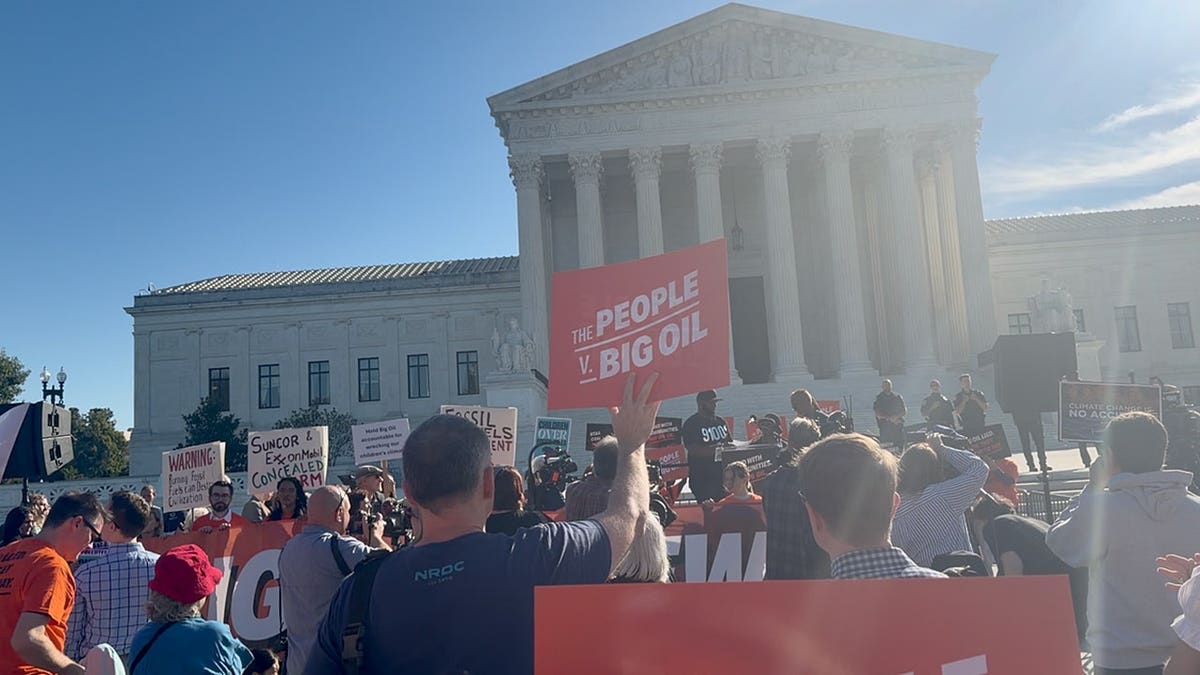
The Supreme Court heard arguments in a critical case that could impact oil companies, gas stations, and American consumers. This case, Suncor v. Boulder, examines whether federal law blocks cities and states from suing oil companies for climate change-related damages.
Potential Consequences
Energy policy experts express concern about the potential outcomes. Jason Isaac, CEO of American Energy Institute, highlighted the risk, stating, “You would see mass exodus and that would create more scarcity with fuel, more so than we’re seeing already today, higher prices.” This case concerns controlling oil companies and curbing the use of hydrocarbons.
Debate Over Legal Implications
During Monday’s arguments, Justice Clarence Thomas questioned whether the legal theory used by Boulder might also apply to other businesses beyond oil producers. Kevin Russell, Boulder’s attorney, acknowledged that nothing in their theory prevents this but pointed out state tort law limits.
Justice Brett Kavanaugh voiced concerns over the financial consequences of extensive litigation, warning about the possibility of “bankruptcy” for defendants. He questioned if virtually any business might face similar claims.
Lawsuit Background
The city and county of Boulder sued ExxonMobil and Suncor Energy in 2018 for allegedly contributing to climate change while misleading the public. Boulder seeks damages to cover climate-related harm costs. Similar lawsuits, about 30 in total, are ongoing across various jurisdictions, including Portland and Baltimore.
Boulder’s lawsuit claims ExxonMobil and Suncor were aware of the climate risks associated with fossil fuels for decades. A 1977 ExxonMobil memo stated, “current scientific opinion overwhelmingly favors” the idea that fossil fuels increase CO2 emissions.
Broader Concerns
David Bookbinder, a former counsel for Boulder, viewed the lawsuit as a means for an “indirect carbon tax.” Boulder disputes this view, asserting Colorado’s right to hold companies accountable under its state law for local harms.
OH Skinner, executive director of the Alliance for Consumers, argued these lawsuits attempt what climate advocates couldn’t achieve through Congress, such as a carbon tax or bankrupting the energy industry.
Justice Samuel Alito recused himself from the case without explanation.
Impact of a Potential Ruling
Isaac warned a ruling in favor of Boulder might lead to numerous jurisdictions filing similar lawsuits, increasing consumer costs. “There are over 90,000 levels of government — government entities just in the United States alone — that could also begin lawsuits against energy companies,” Isaac noted.
Skinner raised issues about who could be sued, extending beyond oil producers to involve businesses in the energy supply chain. “From Boulder’s perspective, anybody who’s contributed to climate change would be liable,” Skinner stated.
Isaac contrasted this to tobacco or opioid lawsuits, emphasizing greenhouse gas emissions as a global phenomenon, making it difficult to pinpoint responsibility for climate damage. “Emissions are a global phenomenon,” Isaac remarked.
Arguments from ExonMobil and Suncor
ExxonMobil and Suncor argue that because emissions are global, Colorado shouldn’t use state law to hold them accountable. They believe federal law should govern such disputes.
Some states, like Utah, have already barred these state tort lawsuits. “If the energy companies were to lose and Colorado were to win, this would in effect drive up the prices of gas all across the country,” said Utah Attorney General Derek Brown. He believes such decisions belong to Congress.
Elaine Mallon reports on national politics for Fox News Digital and Fox Business.
Leave a Reply