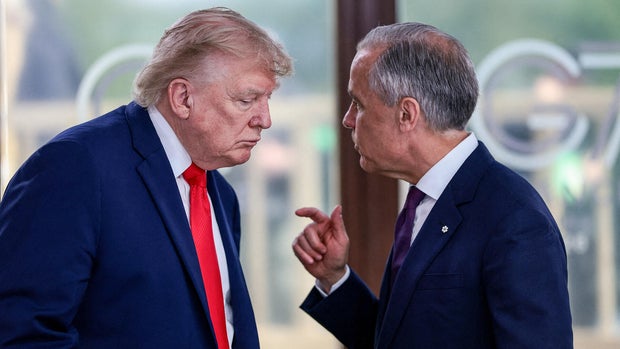
The trade relations between the United States and Canada have reached a new level of tension following the U.S. decision to prohibit nearly $1 billion worth of Canadian imports. This includes products like alcoholic beverages, dairy items, and motorcycles. Although the ban represents a minor fraction of the $880 billion annual trade between the two countries, it signifies a further intensification of President Trump’s trade war with Canada.
Trade attorney Patrick Childress, a partner at Holland & Knight, highlighted that the ban might worsen trade tensions rather than mending them. Earlier, President Trump enforced 50% tariffs on approximately $20 billion worth of Canadian products, accusing Canada of unfair practices against U.S. dairy, auto, and alcoholic beverage industries. Canada retaliated with equivalent tariffs of 15%, 25%, or 50% on U.S. imports, matching dollar for dollar.
In response to Canada’s counteractions, President Trump imposed a ban on certain Canadian products, effective from 12:01 a.m. Eastern time Tuesday. The economic impact of this ban is expected to be minimal. Childress pointed out that products on the banned list were already facing high tariffs, effectively making them uneconomical for importation into the United States.
Jacob Jensen from the American Action Forum estimated that the ban covered $967 million worth of imports, with alcoholic beverages making up 87% of this total. Some Canadian provinces have reacted to Trump’s measures by banning U.S. alcohol from their stores.
Dairy products such as whey are also included in the ban. Long-standing issues have existed between both countries over Canada’s protective tariffs imposed on dairy imports. Furthermore, motorcycles, specifically the three-wheel Can-Am Spyder and Canyon motorcycles from Bombardier Recreational Products, are restricted from entering the U.S.
Jensen warns of further retaliatory actions by Canada. Both Canadian exporters and U.S. importers impacted by these bans are likely to push their respective governments toward resolving the trade dispute.
“This marks yet another escalation in the trade war,” Jensen said.
The stalled trade relations threaten the renewal of the U.S.-Mexico-Canada Agreement. This trade deal, strongly advocated by Trump in his first term, aimed to allow free movement of goods across North American borders.
Upon re-election, President Trump has announced new tariffs complicating the trade future within the region. His focus has been predominantly on Canada, tactically striving to shift Canadian manufacturing to the U.S. His remarks suggesting Canada’s potential as a U.S. state have further strained diplomatic relations.
Canadian Prime Minister Mark Carney, committed to confronting Trump, has retaliated with tariffs similar to China’s counteractions against Trump. He also aims to reduce Canada’s dependence on U.S. trade, with the U.S. previously accounting for 70% of Canadian exports.
Carney’s strategy includes expanding Canadian trade partnerships. Canada is considering becoming the European Union’s first associate member and is progressing towards a trade agreement with India.
“There is now a price to be paid for access to the United States market,” Carney stated, indicating a shift towards diversified global trade.
Earlier this year, Carney negotiated with China to ease tariffs on certain products. Gabriel Brunet, spokesperson for Canada-U.S. Trade Minister Dominic LeBlanc, emphasized Canada’s focus on protecting workers and diversifying trade.
President Trump anticipates a resolution, expressing confidence that Canada will eventually comply.
“I think a deal will be made, but it’s gonna be fair,” he remarked.
Trade attorney Childress foresees the trade impasse persisting for months, as the current measures may not significantly pressure either side into negotiations.
For more information on tariffs and their implications, explore further expertise from professionals like Patrick Childress.
Leave a Reply