Theodore Roosevelt’s Legacy Honored
Theodore Roosevelt consistently ranks among the nation’s most popular presidents. Though he passed away 107 years ago, this July 4 marks the opening of his presidential library in an unexpected location: the North Dakota Badlands. This 96,000-square-foot tribute mirrors Roosevelt’s grandeur, akin to his likeness on Mt. Rushmore, but designed to be more subtle.
A Unique Architectural Vision
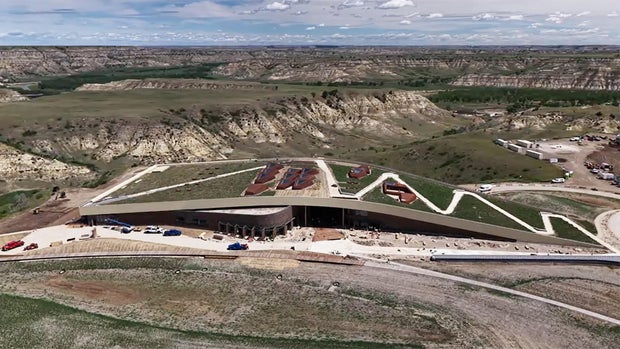
Architect Craig Dykers highlights the transformative nature of the Badlands, which is intricately woven into the library’s design. The gently sloping roof mimics the surrounding buttes and is covered in native grasses. Walking paths on the roof offer visitors commanding views of the Theodore Roosevelt National Park nearby. Dykers remarked, “This form emerging from the Earth felt like it just arrived from the Earth.” Inside, skylights using natural illumination pair with walls made of compressed earth.
Theodore Roosevelt Presidential Library’s unique connection to the surrounding landscape and its architectural approach.
Significance of Location
The library’s placement in North Dakota instead of Roosevelt’s native New York underscores a pivotal part of his life. Edward O’Keefe, CEO of the library and author of “The Loves of Theodore Roosevelt,” emphasized Roosevelt’s transformation during his time in the Badlands. Following the tragic loss of his mother and wife in 1884, Roosevelt sought solace in the land’s rugged beauty. After settling his affairs, he moved to the Dakota Territory where his resilience was tested but ultimately thrived.
A Journey of Personal Growth
Roosevelt’s time in the Badlands was marked by healing and adventure. O’Keefe described his visit as the embodiment of a ‘life wish,’ remarking on the uncertainty of life’s journey despite wealth and privilege. The library aims to offer visitors an experience, not merely a historical overview.
“Library and museum are the two worst descriptions of what the TR Library actually is,” according to O’Keefe.
Modern Technology and Reflection on Legacy
The library incorporates artificial intelligence, allowing visitors to converse with an avatar of Roosevelt. This interaction implements modern technology and encourages visitors to engage with Roosevelt’s spirit of adventure and resilience.
Roosevelt’s great-great-grandson, Theodore Roosevelt V, explained that the library doesn’t serve as a typical legacy project. Rather, it offers reflection on his lasting impacts, including addressing his complicated views on race. Efforts have been made to include indigenous voices in the land blessing ceremony for the library project.
Understanding Roosevelt’s legacy, including his views and contributions.
Preserving and Contextualizing History
The library possesses a statue of Roosevelt removed from the American Museum of Natural History after criticisms of its racially insensitive symbolism. The library aims to appropriately contextualize Roosevelt’s life and legacy, emphasizing his belief in personal courage and strength derived from adversity. As O’Keefe highlights, Roosevelt valued action over critique, urging future generations to become sources of change.
For more information, visit the Theodore Roosevelt Presidential Library or Theodore Roosevelt National Park, both located in Medora, N.D.
To explore Roosevelt’s impact further, the book “The Loves of Theodore Roosevelt” by O’Keefe is available in multiple formats via Amazon, Barnes & Noble, and Bookshop.org.
Story produced by Aria Shavelson and edited by George Pozderec.
Leave a Reply