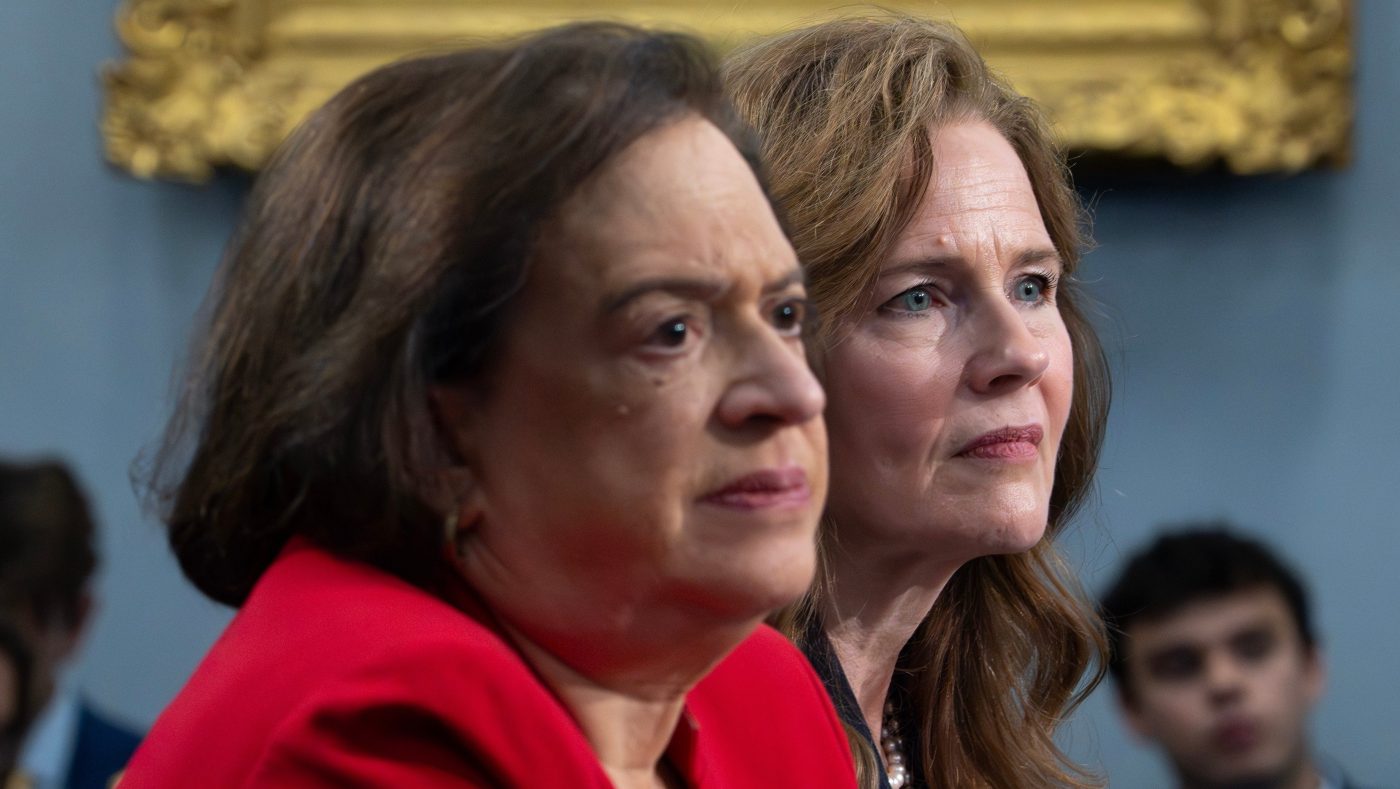
Supreme Court Justices Amy Coney Barrett and Elena Kagan testified during a House Appropriations subcommittee hearing on July 14, 2026, at Capitol Hill in Washington. Drawing attention to the Supreme Court’s dual nature, political scientist Robert Dahl argued nearly 50 years ago that viewing the Court purely as a legal entity underestimates its importance in American politics. He contended that the Court serves as both a legal and a political institution, highlighting a unique characteristic: Americans struggle to acknowledge its political aspect while simultaneously denying it.
Recent data underscores a shift in public perception. A new poll indicates that over half of Americans disapprove of the Court’s performance, with 46% believing it favors Trump’s policies based on ideology over law. The Supreme Court faces growing discontentment, likened to the Taney Court (1836-1864) known for the Dred Scott decision and the 1930s Court that opposed FDR’s New Deal, sparking a constitutional crisis.
On June 29, after the Court enhanced presidential power over independent regulatory agencies, Paul Krugman of Princeton remarked that the Court was undermining U.S. democracy. Krugman criticized the Court for empowering a controversial leader, calling it a dire scenario. This inclination to support political agendas is not a temporary trend. Seven years ago, Senator Sheldon Whitehouse analyzed the Supreme Court’s 2017-2018 term, concluding that essential conservative principles like modesty and federalism were set aside for partisan wins.
This behavior troubles citizens, especially when justices avoid acknowledging it publicly. Their statements to the public often lack transparency; decisions reflect deep political rifts, as seen in contentious exchanges between justices. Justice Ketanji Brown Jackson highlighted a “strong political undercurrent” in a voting rights decision, suggesting it was driven by political motivations, not principle. Justice Samuel Alito countered her dissent as groundless and trivial.
The Court’s rulings on major issues often align predictably with justices’ ideological leanings, raising public skepticism. Despite Chief Justice John Roberts’s claim that the judiciary has no “Obama judges or Trump judges,” and Justice Neil Gorsuch’s assertion that they are not “politicians in robes,” skepticism lingers. Justice Amy Coney Barrett’s reassurance on nonpartisanship fails to convince the public that politics play no role whatsoever in their decisions.
Denials of political influence seem implausible, eroding public trust in the Supreme Court. To restore confidence, the Court needs to reposition itself openly so Americans can understand its unique political role. This clarity is essential for the nation’s acceptance of the Court’s distinct nature.
Austin Sarat is the William Nelson Cromwell Professor of Jurisprudence and Political Science at Amherst College.
Leave a Reply