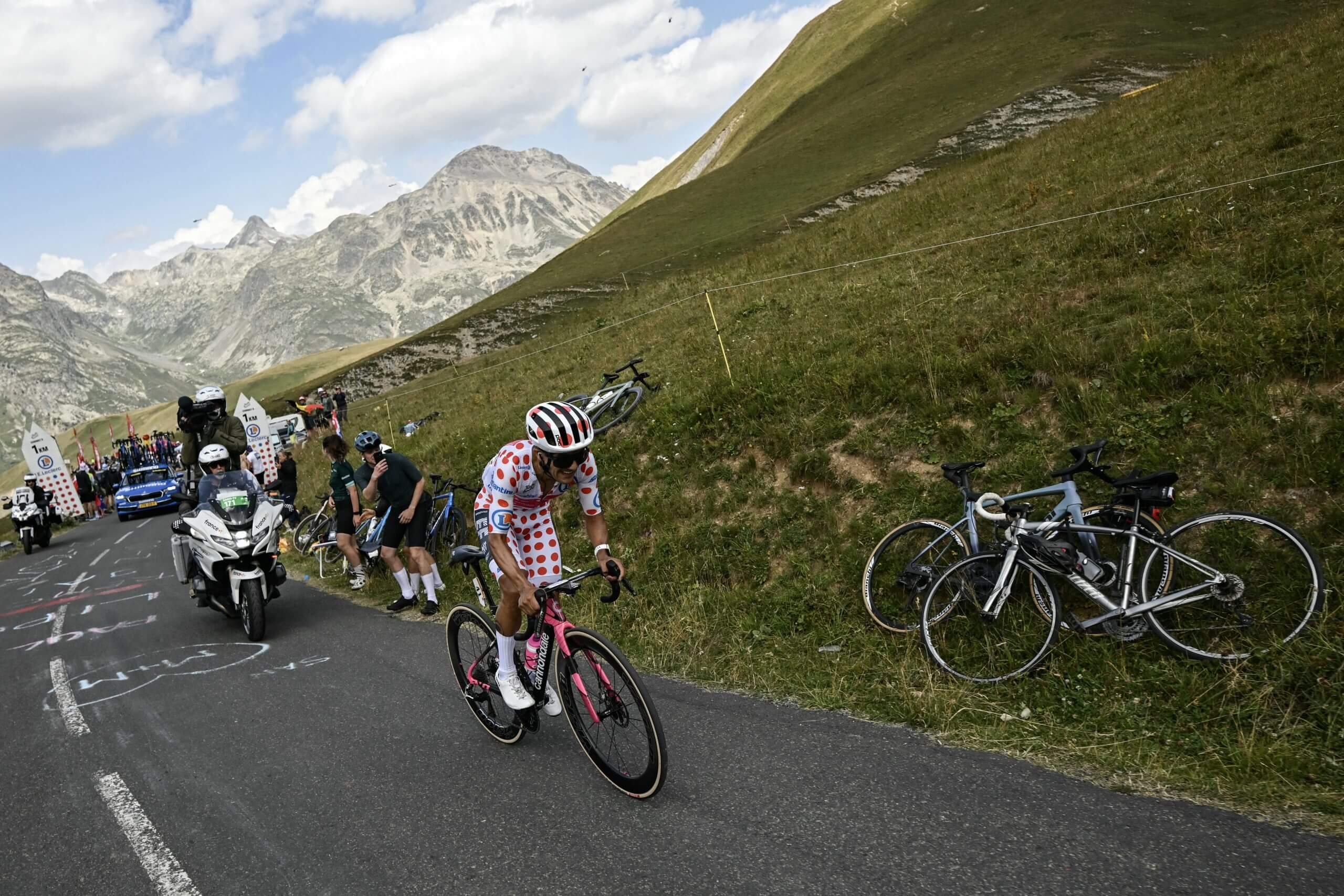
The sobering image of Valentin Paret-Peintre, despondently leaning against the summit barriers at Alpe d’Huez, marked a poignant moment in this year’s Tour de France. He lost the coveted polka-dot jersey, a rare opportunity for France to achieve stage glory after a prolonged dry spell.
Traditionally, the mountains classification didn’t receive much attention. It was popular among fans but often seen as secondary in significance, a filler in broadcasts during early mountain stages. Recent years have seen the ultimate winner frequently claim this award. Tadej Pogačar succeeded thrice in 2020, 2021, and 2025, while Jonas Vingegaard triumphed in 2022.
This year, 33-year-old Richard Carapaz of Ecuador achieved a remarkable victory, initially an unexpected participant. He aimed for the Giro d’Italia earlier but underwent surgery for a perineal cyst, sidelining him from training for three weeks. Yet when he returned, his relentless pursuit of rivals and the polka-dot jersey became legendary.
Despite Pogačar almost securing his yellow jersey early on, the competition intensified around the other three jerseys — polka dot, white, and green, all concluding with suspense on stage 20. Carapaz’s stage win at Alpe d’Huez made him the first to do so in the polka-dot jersey since 2018’s Julian Alaphilippe.
“It’s been incredible this year,” exclaimed Carapaz, highlighting the battles for both green and white jerseys. These heightened the race’s allure.
Carapaz secured his second King of the Mountains title in three years.
Meanwhile, Mads Pedersen’s Lidl-Trek team pushed persistently during sprint stages. For Pedersen, the green jersey symbolized the undeniable goal. Constructing the team around the points classification, climbers like Juan Ayuso and Mattias Skjelmose had more freedom.
Pedersen knew he was not the fastest sprinter yet aimed to dominate intermediate sprints. His climbing prowess allowed him to earn points during hilly and mountainous stages. This strategy dropped competitors Tim Merlier and Olav Kooij. Consequently, attacking races unfolded, cutting Pedersen’s lead temporarily to seven points after stage 18. His focus on intermediate sprints secured the green jersey, with 68% of his points coming from these efforts.
The conversation persists over whether Pedersen should have claimed the ‘sprinters’ jersey,’ but his adaptability proved his worth, comparable to cycling legend Peter Sagan.
Isaac del Toro and Paul Seixas’ competition captured spectators, as they contended for the white jersey. Pogačar supported Del Toro, mentioning both yellow and white jersey ambitions. Del Toro consistently bested Seixas, securing the white jersey with a strategic push on the Col du Galibier.
Seixas showed promise but resigned, losing by over two minutes due to a decisive attack. His struggle was intensified by illness within his team.
The name Carapaz encapsulates this year’s dynamic and aggressive performance. Expected to eclipse competitors like Simmons, Veistroffer, and Pidcock for the Champs-Élysées’ super combativity award, his aggressive strategy underpinned a thrilling contest for the polka-dot jersey.
Despite Alex Molenaar’s early emotional win for Caja Rural, Carapaz clinched the mountain title by attacking persistently in the Tour’s concluding week.
Carapaz displayed an unwavering desire to seize stages and jerseys rather than aim for mid-tier general classification standings — demonstrating that calculated ambition pays.
This edition of the Grand Tour diverged from expectations, starting with an early yellow jersey decision, yet the minor classifications sparked some of the most engaging and thrilling contests, offering fans a detailed and artistically orchestrated racing event.
Leave a Reply