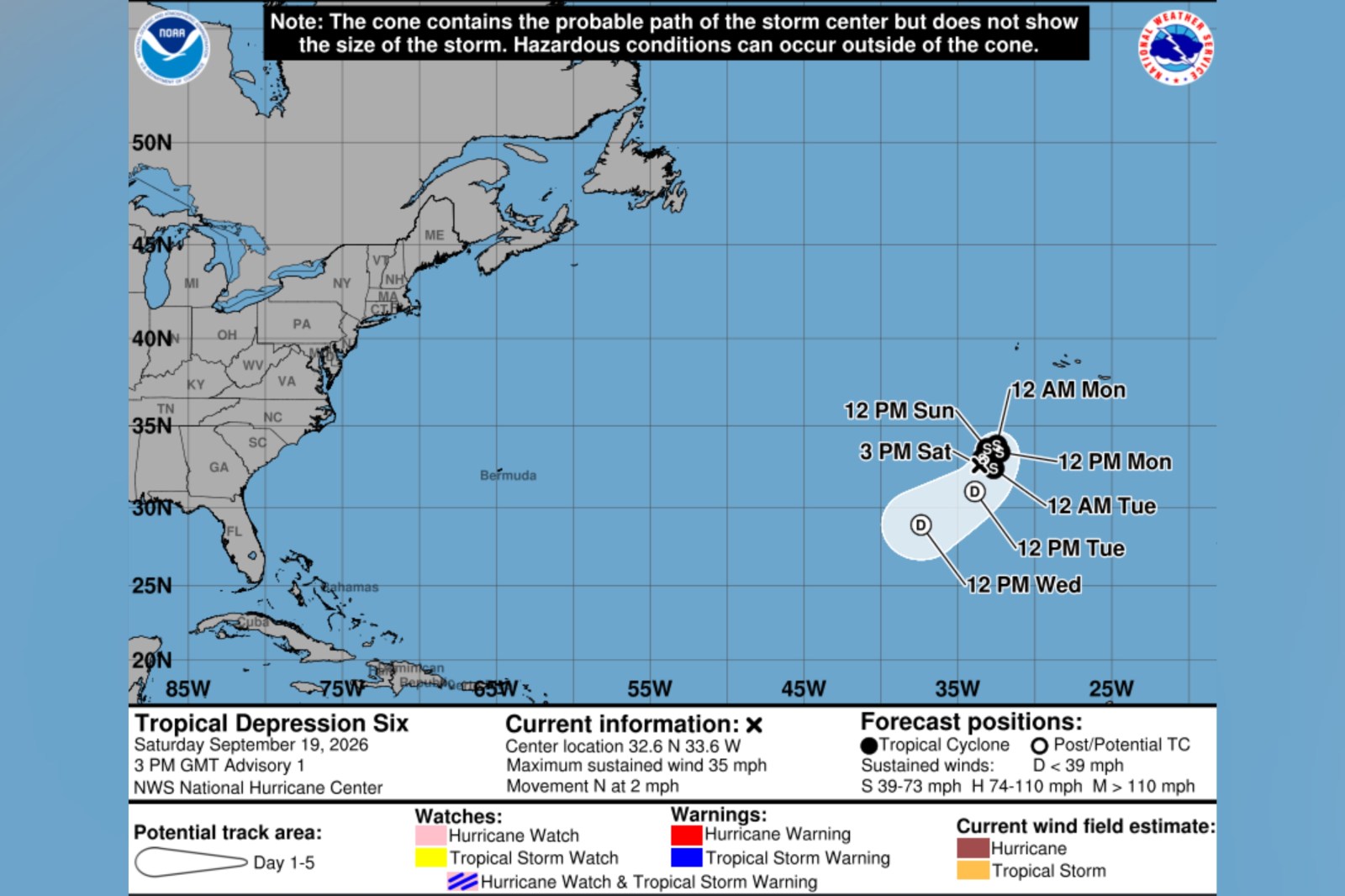
A new tropical depression has formed in the Atlantic Ocean, the National Hurricane Center (NHC) reported. Identified as Tropical Depression Six, the system organized on Saturday in the eastern subtropical Atlantic, an area previously monitored by the NHC for development potential. This formation follows a notably quiet Atlantic hurricane season, largely attributed to El Niño, where no hurricanes have yet occurred.
AccuWeather meteorologist Alexander Duffus mentioned on Saturday morning that wind shear and dry air would limit the system’s development. He predicted that it would likely only reach tropical storm strength before it begins losing wind intensity around the middle of next week.
The NHC’s initial advisory placed the system roughly 525 miles southwest of the Azores archipelago, mid-Atlantic. It was moving slowly northward at about two miles per hour. The system is expected to shift generally northeast over the next 24 to 36 hours, then turn southwest in a couple of days. While slight strengthening might occur in the next 24 hours, gradual weakening is anticipated afterward. Maximum sustained winds were reported near 35 miles per hour, with higher gusts. No coastal watches or warnings were issued, and no land hazards were noted.
Before Saturday, the Atlantic had generated five named storms: Tropical Storms Arthur, Bertha, Cristobal, Dolly, and Edouard, according to NHC records. If Tropical Depression Six strengthens into a tropical storm, it will be named Fay. Meanwhile, the Eastern Pacific has experienced over a dozen named systems.
What Is a Tropical Depression?
According to the NHC, a tropical depression is a tropical cyclone with maximum sustained winds of 38 mph or less. If winds increase to between 39 and 73 mph, the system becomes a tropical storm and receives a name. A hurricane classification is given once winds reach 74 mph or higher.
What Is El Niño and Its Impact on the Hurricane Season?
El Niño is the warm phase of the El Niño-Southern Oscillation (ENSO), a Pacific climate pattern affecting global weather. Its opposite phase, La Niña, is cooler. Forecasters earlier indicated that El Niño conditions might result in a quieter Atlantic hurricane season while increasing activity in the Pacific.
Matthew Rosencrans from NOAA’s seasonal hurricane outlook team explained that El Niño conditions typically lead to fewer tropical storms and hurricanes in the Western Atlantic Ocean Basin. Conversely, these conditions are associated with more activity during the eastern and central Pacific hurricane seasons.
Leave a Reply