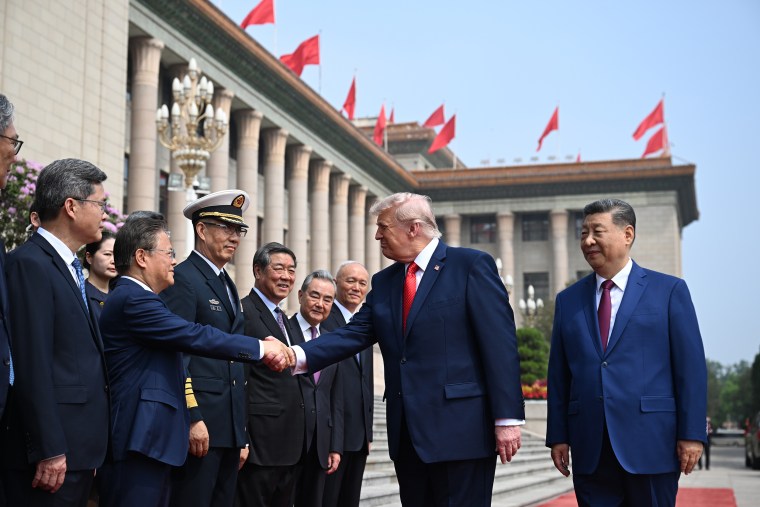
During a critical visit to China, President Donald Trump held discussions with Chinese President Xi Jinping. The talks focused on existing and new bilateral agreements, though some issues remain unresolved. The White House disclosed several agreements were made, including:
- China’s pledge to purchase at least $17 billion annually in U.S. agricultural products through 2028.
- An order of airplanes from Boeing, but fewer than market expectations.
- Restoration of market access for U.S. beef and poultry previously restricted due to health concerns.
The U.S. and China plan to create frameworks for discussion on trade and investment matters. Yet, uncertainties remain, especially concerning China’s control over rare earth mineral exports.
Key geopolitical concerns, specifically regarding Taiwan and Iran, linger without clear resolutions.
Trade and Investment Details
China’s commitments highlighted a strategic approach. While agreeing to purchase 200 Boeing planes, fewer than anticipated, China also secured its access to U.S. aircraft parts. This reflects current geopolitical tensions, particularly the U.S. use of jet engine sales as leverage.
The agreement’s foundation includes establishing a board of trade and a board of investment. The trade board might reduce tariffs on $30 billion of non-sensitive goods. The investment board would offer a platform for bilateral discussions.
Despite these steps, concerns remain regarding Chinese investments in the U.S., as highlighted by hesitation surrounding a New Hampshire Nongfu Spring factory.
Geopolitical Issues: Taiwan and Iran
The summit barely addressed Taiwan and the Iran conflict. Beijing regards Taiwan as a critical point of contention. Despite U.S. assertions of unchanged policy, Trump hinted Taiwan’s arms package could serve as a negotiation tool.
On Iran, both nations oppose Iran’s control over the Strait of Hormuz. However, they diverge in their approach; China maintains significant ties with Tehran.
Future Engagements and Challenges
Further discussions will occur during Xi’s planned visit to Washington, which both countries have confirmed. This is expected to stabilize relations but could expose more challenges like technology disputes and Western Hemisphere politics.
Professor Ja Ian Chong noted the shift in dynamics, observing that President Xi showcased China’s prominence on the global stage, contrasting with Trump’s more deferential approach.
Leave a Reply