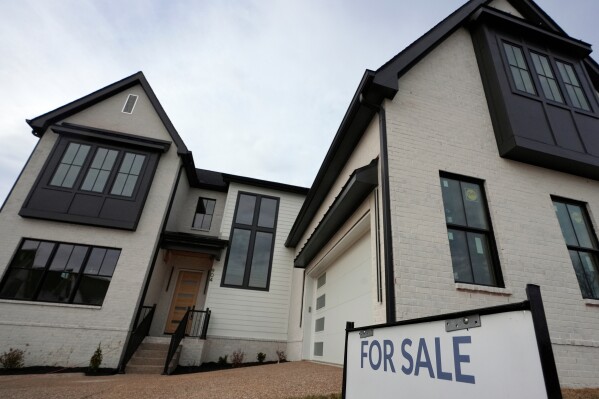
Sales of previously owned homes in the United States saw a notable increase last month, achieving the highest sales pace since December. This marks a significant change in demand following a slow start to the spring home buying season.
The National Association of Realtors (NAR) reported that existing home sales climbed by 3.2% in May compared to the previous month, reaching a seasonally adjusted annual rate of 4.17 million units. On an annual basis, sales also increased by 3.2% from May of the previous year.
Regionally, home sales recorded growth in the Midwest, South, and West, yet saw a decrease in the Northeast. The sales figures surpassed the anticipated pace of approximately 4.07 million units that economists had expected according to FactSet data.
Despite the rise in sales, the numbers are still hovering around a 4-million unit annual pace. This is considerably lower than the historical average of 5.2 million units.
Interestingly, the increase in sales came despite mortgage rates generally trending higher this spring, although they remain under last year’s levels. Nationally, home prices continued to rise, with the U.S. median sales price reaching $429,300 in May, marking a new record for any May since data collection began in 1999. Home prices have increased annually for 35 consecutive months.
However, the growth in home prices now trails income growth in many areas. Combined with mortgage rates stabilizing below the previous year’s levels, this has improved affordability, injecting momentum into the housing market. Lawrence Yun, NAR’s chief economist, noted the potential continued recovery of home sales from a multi-year downturn, contingent upon a reduction in the average 30-year mortgage rate back to around 6%.
The U.S. housing market has faced a slump since 2022, following an increase in mortgage rates from the lows seen during the pandemic. The market saw a stagnation last year, hitting a 30-year low in sales activity, and continuing to show sluggishness this year. Sales remained flat in April after prior declines earlier in the year.
Years of escalating home prices, particularly during the early 2020s, have excluded many prospective buyers from the market. Additionally, a longstanding shortage of homes for sale, partly due to years of below-average new home construction, has kept home prices high even amid sales downturns.
Homes sold in May were likely under contract during March and April, a period when the average rate on a 30-year mortgage ranged from 6% to 6.46%, as per Freddie Mac. By the end of May, the average rate was 6.48%, slightly lower than 6.85% a year earlier.
Ongoing geopolitical tensions, such as the conflict with Iran, have led to increased oil prices, impacting long-term bond yields used by lenders to set home loan rates. According to Ted Rossman, principal analyst at Bankrate, mortgage rates might have been lower if not for inflation pressures stemming from the war.
Among home purchases last month, first-time buyers made up 35%, the highest since June 2020. Historically, first-time buyers usually comprise about 40% of the market. Some buyers are benefiting from favorable trends, as the median list prices in May were down by 2.4% compared to the previous year, the steepest decline on record since 2017 reported by Realtor.com.
Although more options are available, inventory levels of homes for sale remain below historical norms. There were 1.55 million unsold homes at the close of May, an increase of 3.3% from April and 0.6% from the previous May, as stated by NAR. However, this figure is still below the pre-pandemic norm of roughly 2 million.
At the current sales pace, May ended with a 4.5-month supply of homes. Typically, a balanced market is one with a 5 to 6-month supply of available homes.
Leave a Reply