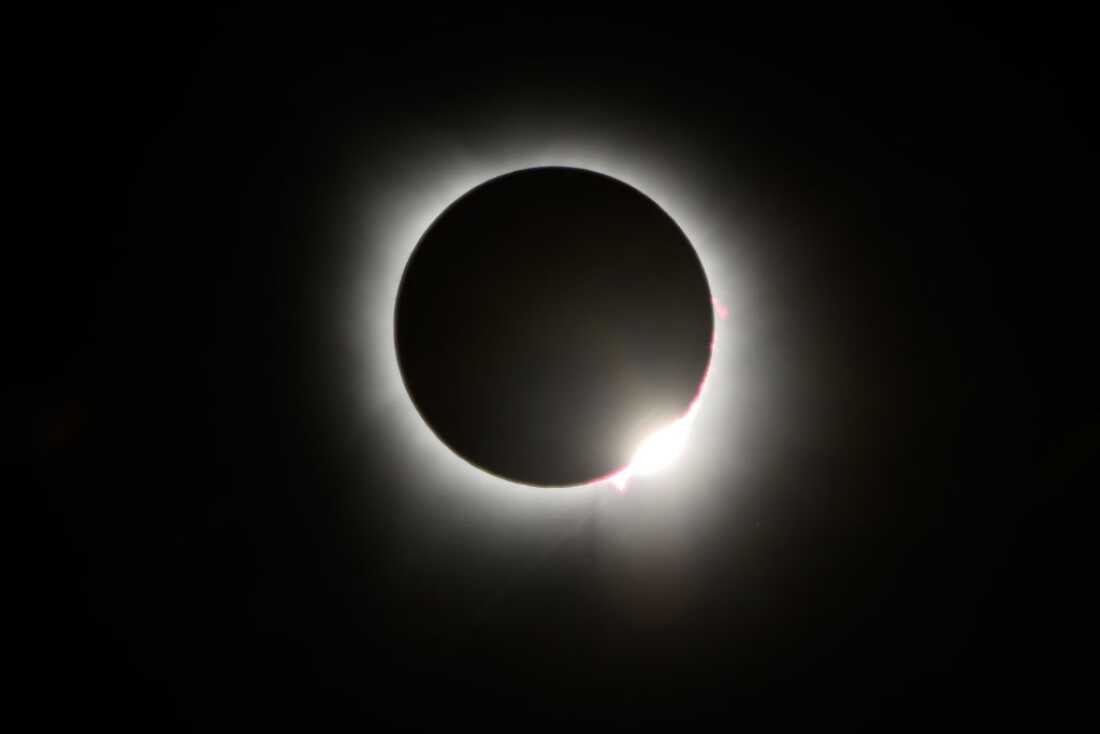
On April 8, 2024, a total solar eclipse will occur at Lake Monroe in Indiana, USA. During this phenomenon, the Moon crosses in front of the Sun, completely obscuring its face. Edward M. Pio Roda/Getty Images
Several regions, including parts of Europe and the U.S., will experience this astronomical event. Countries like Iceland, Greenland, northern Russia, Spain, and a section of Portugal will witness the total eclipse, according to astronomers. NASA reports that the northern parts of the United States, stretching from Alaska to North Carolina, will experience a partial solar eclipse.
In a partial eclipse, the Moon partially blocks the Sun, creating a crescent shape. The alignment is not perfect, resulting in only a portion of the Sun being covered. In Washington, D.C., the partial eclipse will commence at around 1:17 p.m. ET with an expected coverage of 4%. This indicates that the Moon will obscure up to 4% of the Sun’s surface.
In Reykjavík, Iceland, the total eclipse will begin at 5:48 p.m. local time. In León, Spain, the totality starts at 8:28 p.m. and will last for two minutes. Notably, this event marks the first time Spain’s mainland will witness a solar eclipse since 1905, as reported by the European Space Agency.
Individuals planning to observe either the total or partial eclipse must utilize appropriate equipment, such as eclipse glasses or handheld viewers with special filters, to safeguard their eyes. Standard sunglasses are insufficient for protection during these events. The American Academy of Ophthalmology warns that even a brief look at the Sun can result in severe eye damage, including burns and permanent vision loss.
The eclipse presents an extraordinary opportunity for skywatchers to safely admire this rare occurrence. Simultaneously, some scientists will capitalize on the event to further explore the Sun. NASA has established teams equipped with scientific balloons and a high-altitude jet to study the Eclipse’s impact on Earth’s atmosphere when the sky darkens briefly.
“From our unique perspective on Earth during a total solar eclipse, scientists can study the Sun’s corona in a way we can’t from anywhere else in the solar system,” stated Kelly Korreck, eclipse program manager for NASA.
The subsequent partial solar eclipse will be visible across parts of the U.S. on August 2, 2027, with totality observed in Spain, the Middle East, and portions of North Africa. A total solar eclipse is slated for August 23, 2044, and will be visible across segments of the contiguous U.S.
Leave a Reply