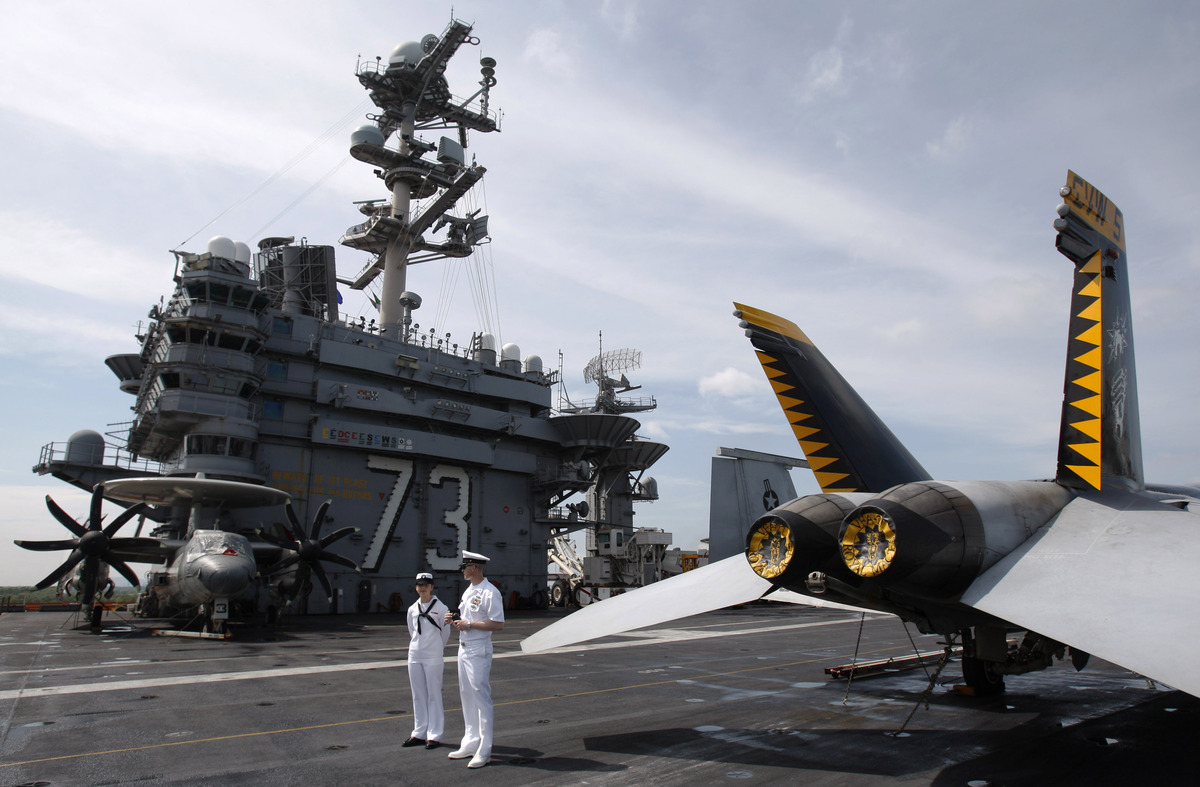
The transfer of the USS George Washington from the Pacific to the Middle East represents a potential national security risk for the United States. According to a former commander of the aircraft carrier, this move signals a concerning shift in U.S. naval focus, impacting both strategic presence and relations.
The USS George Washington will soon relieve the crew of the USS Abraham Lincoln. The Abraham Lincoln has been under scrutiny due to ongoing issues reported, including supply shortages and declining mental health among its approximately 5,000 sailors and Marines who haven’t been ashore since December. These conditions have raised questions about the well-being of the personnel on U.S. Navy ships.
Concerns have also surfaced about the U.S. Navy’s capacity. Prolonged involvement in Middle Eastern conflicts has stretched resources thin, potentially impairing readiness for any future confrontations, particularly with China. Retired Rear Admiral Mark Montgomery, a former commander of Carrier Strike Group 5 on the Washington, expressed concerns over the strategic implications. He warned that this redeployment would leave the U.S. with a limited naval presence for an extended period, affecting deterrence in the Pacific region.
“This is a national security risk as it sends a weak deterrence message to China and does not assure America’s allies and partners in the Pacific,” said Montgomery, now with the Foundation for Defense of Democracies in Washington, D.C.
The White House directed queries to the Pentagon, which refused to comment on matters affecting operational security. The U.S. Navy pointed Newsweek to the U.S. Pacific Command for further comments.
Within the U.S. administration, there has been pressure for allies to increase their defense budgets to counter the threat posed by China’s improving military capabilities. This pressure has unsettled officials in capitals like Tokyo, Taipei, and Seoul.
Additionally, President Trump recently scaled back military exercises with South Korea. Citing sensitivity toward North Korea, the president also highlighted Seoul’s reluctance to participate in actions against Iran as a reason for this decision.
In another move, President Trump seemed to use American arms sales to Taiwan as leverage in discussions with Chinese President Xi Jinping. Taiwan relies significantly on these weapons for defense, but the U.S., adhering to the “One China” policy, does not officially recognize Taipei. Beijing’s stance involves potential military reunification with Taiwan, viewing it as a breakaway region since 1949.
China’s military capabilities continue to advance, with formidable forces and an increasing naval strength exceeding that of the U.S. Navy. Their arsenal includes sophisticated missile technology, and Beijing’s progress is closely watched.
Greg Poling from the CSIS think tank remarked that China might benefit from U.S. strategic distractions, giving Beijing room to enhance its regional influence.
As of recent updates, the USS George Washington has been traversing through significant maritime pathways. By Thursday, the carrier moved through the Singapore Strait. News from the Associated Press indicated its passage through the Strait of Malacca, a critical waterway connecting the Pacific with the Indian Ocean. Previously, when the Abraham Lincoln was redirected, it followed a similar path through the Strait of Malacca.
The USS George Washington had been stationed in Guam in mid-June and was seen in the Philippine Sea by July. It made a scheduled port call in Da Nang, Vietnam, until early August.
For further details, Newsweek’s editors Ben Kelly and Sam Wilson can provide insights regarding the redeployment of the USS George Washington.
Leave a Reply