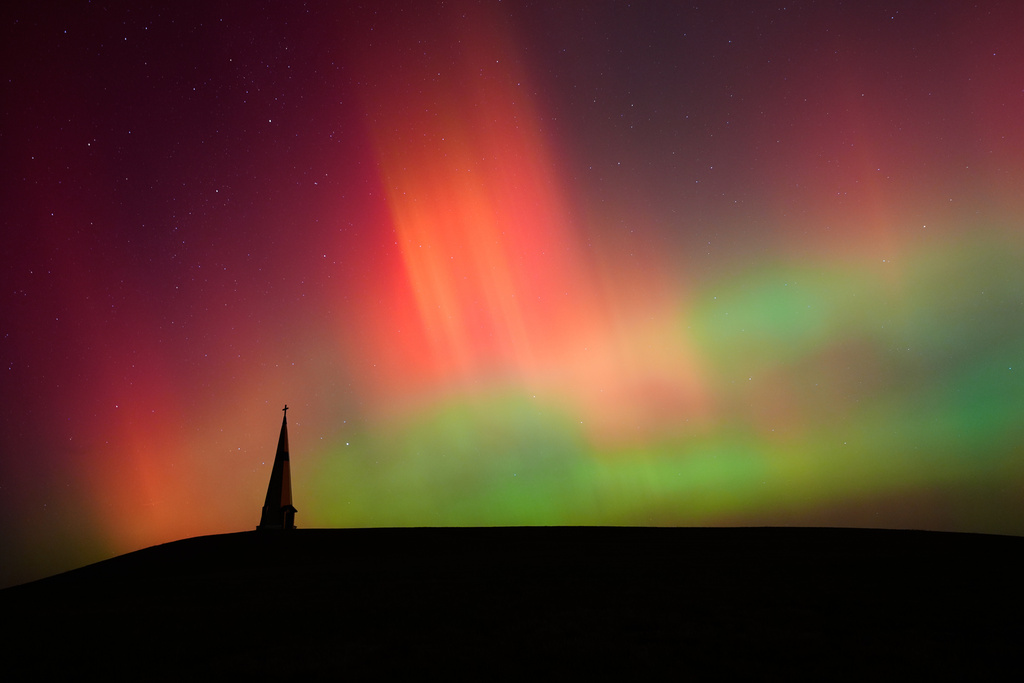
Forecasters predict that some might witness the northern lights on Friday. NOAA’s Space Weather Prediction Center (SWPC) has been observing two significant sunspot groups. One of these spots caused a solar flare of X1 strength, according to Shawn Dahl, a service coordinator with the SWPC. The ‘X’ classification is the highest for solar flares, with ‘1’ being the weakest within this category.
Dahl described the event as ‘impulsive’ because it was brief but powerful. Initially, it was not clear if the coronal mass ejection (CME) linked to this activity was heading towards Earth. On Wednesday, the SWPC confirmed the CME is likely to affect Earth and cause increased geomagnetic activity. If conditions, especially the orientation of the embedded magnetic field, are right, there may be moderate geomagnetic storm conditions.
Potential Visibility on July 3
Should the SWPC’s forecast hold true, those in the northern U.S. might catch a glimpse of the aurora. Moderate, or G2, level geomagnetic storms can bring the northern lights as far south as New York and Idaho. States such as Washington, Oregon, Idaho, Montana, and others may see the northern lights with this storm’s strength.
The University of Alaska Fairbanks adds that those in Wyoming, Nebraska, Iowa, Illinois, Indiana, Ohio, Pennsylvania, and Massachusetts might see the aurora on the northern horizon.
Whether the aurora will be visible depends on timing. If the strongest geomagnetic storming occurs before sunset, it may be outshone. Predictions indicate conditions might strengthen around 2 a.m. EDT, lasting through the day. By sunset, the activity might still sufficiently spark the northern lights for some time.
The possibility remains that the conditions necessary may not fully develop. For the latest forecasting, you can visit the SWPC’s website. To increase your chances of seeing the aurora, look north. If visually elusive, use your phone to capture the lights; modern digital cameras may be more sensitive to light than the human eye.
Leave a Reply