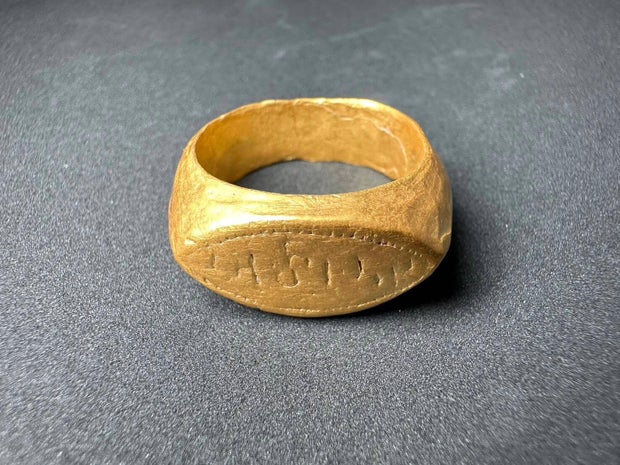
On July 7, 2026, officials in Thailand announced the discovery of two gold rings estimated to be around 2,000 years old. These were found during an excavation at a recently identified archaeological site in western Thailand. The rings were uncovered alongside human remains at the Don Yai Thong site in Phetchaburi province.
The Thai government’s Fine Arts Department reported the discovery last week. One of the rings, unearthed on Thursday, is engraved with characters likely from the Brahmi script—an ancient Indian writing system. Experts interpreted the script as ‘pusarakhitasa,’ which translates to ‘the one protected by Pushya.’ Pushya is considered one of the most auspicious zodiac signs in Indian astronomy. The other, discovered with the same remains, is a simple gold ring devoid of any pattern.
Experts speculate that the rings might have belonged to a merchant from the Vaishya caste, notable in the ancient Indian social hierarchy. This insight adds a fascinating layer to our understanding of historical interactions between cultures.
The Fine Arts Department released an image showing a gold ring at the site, located approximately 80 miles southwest of Bangkok. Don Yai Thong came to light earlier this year when local residents discovered fragments of ancient bronze drums in a nearby rice field. Subsequent excavation linked the site to Thailand’s late prehistoric era, which dates back roughly 1,500 to 2,500 years, known as the Iron Age.
In an eight-minute video shared on social media, archaeologists are seen examining artifacts and skeletal remains at the site. Since February, they have found eight human skeletons, along with bronze and gold jewelry, pottery, and other items indicating a ceremonial burial likely associated with the affluent or upper classes of the community.
Local media highlighted that one skeleton might belong to a young child, identified by a bronze object placed on its torso. Charcoal samples collected from the site have been sent to the United States for precise dating.
Although the excavation is expected to conclude within a month, the Fine Arts Department plans to publicly exhibit the discoveries, offering a glimpse into ancient societal structures and practices. The department also highlighted the role of new technology in aiding the archaeological exploration of the past.
Leave a Reply