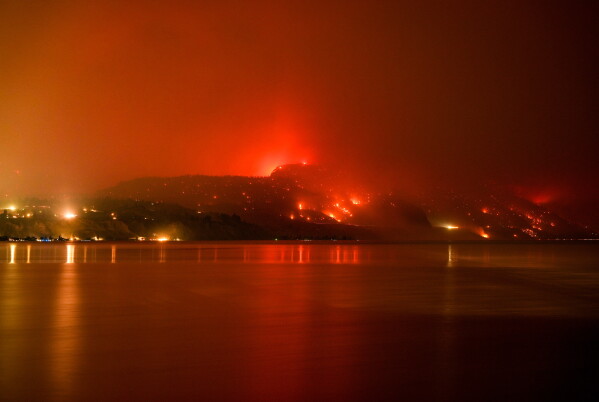
Canada is preparing to deploy its military to assist in combating severe wildfires in British Columbia as the situation grows dire. A local official reported substantial damage to one community, and a woman has died during the chaos. Approximately 20,000 residents have evacuated their homes.
Hundreds of wildfires have been raging throughout the province, with nearly half of them out of control. Elevated temperatures, strong winds, and an extended drought have exacerbated the crisis. People are evacuating via heavily congested roads, and more communities could potentially be in peril.
Impact on Communities
The Mayor of Summerland, a town with around 12,000 residents, expressed concern over the extent of destruction, stating that conditions remain too perilous to assess the damage. An evacuation was ordered for Summerland and the surrounding areas. The Bald Range wildfire is advancing over the region and remains uncontrolled.
“We must prepare for devastating news when re-entry is allowed. Many will know someone who has lost their home,” Summerland Mayor Doug Holmes said.
Defense Minister David McGuinty confirmed that the Canadian Armed Forces are on standby and ready to act if British Columbia officially asks for support. Already, the federal government has sanctioned provincial requests for aid in housing and accommodations.
Tragic Loss and Fire Management Efforts
The Royal Canadian Mounted Police confirmed the death of an 80-year-old woman attempting to escape the fire near Summerland. Prime Minister Mark Carney lamented the tragedy, confirming continued federal support for afflicted areas. Investigations into the fire’s origin are underway.
Presently, the British Columbia Wildfire Service indicates that the blaze has expanded to 60 square miles (156 square kilometers). Officials caution that clearer skies and direct sunlight may amplify fire activity.
Hugh Murdoch, overseeing fire response efforts, stated that nearly 99 wildland firefighters, 120 personnel focused on protecting structures, and heavy equipment are all being utilized. Support from 100 additional firefighters from Mexico is anticipated shortly.
Challenges in Fire Suppression
Ravi Parmer, British Columbia’s forestry minister, highlighted the fire’s extreme intensity, which deters successful suppression even with vast resources.
“We could deploy significantly more resources, yet it might still be ineffective,” Parmer noted.
Natalie Bonnett, representing the British Columbia Wildfire Service, identified poor visibility due to dense smoke, limiting the effectiveness of air-based operations.
The blaze has largely been fueled by notably arid conditions, growing from 19 square miles (50 square kilometers) in just three hours during the recent surge.
Uncertain Future for Evacuees
Graham Statt, chief administrative officer of Summerland, explained that residents would return in phases, though no timeline is specified. Mayor Holmes asserted it would likely be a lengthy wait before residents can safely return.
Kyla Gaudiuso from Faulder voiced her loss, receiving images of her residence surrounded by flames. She recounted the frantic evacuation experience and is currently residing in Penticton.
“It seems unreal. I need to witness it to accept it,” Gaudiuso shared.
Canada consistently experiences escalating wildfire seasons, prompting massive evacuations and consequential smoke effects across the nation and into the United States.
West Coast Fires Across the U.S.
In the United States, evacuations have been initiated in California’s Big Sur coastal region due to an adjacent wildfire. The Timber Fire has spread across Monterey County, totaling about 2 square miles (5 square kilometers).
North of Reno, Nevada, a blaze has compelled the evacuation of about 5,500 individuals, driven by similar hot, dry, and windy conditions. Meanwhile, authorities in Spokane, Washington, managed to secure containment lines around three major fires, allowing some evacuees to return home.
Governor Bob Ferguson of Washington described his visit to affected neighborhoods, emphasizing the loss of community as a severe consequence.
“Rebuilding that community is essential,” Ferguson remarked.
Oregon has marked its most destructive fire season to date, burning 3,671 square miles (9,508 square kilometers), announced Jean Nelson-Dean from the Northwest Interagency Coordination Center.
Leave a Reply