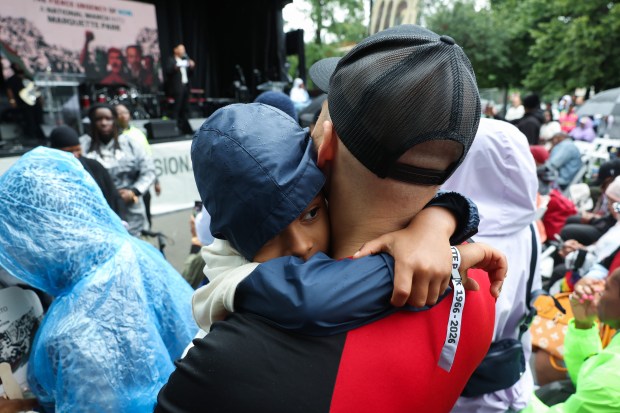
The heavy rains that disrupted the start of the third morning of Lollapalooza did not deter the crowds headed to Marquette Park on Saturday, following the path Rev. Martin Luther King Jr. walked 60 years earlier. Although the violent crowds from 1966 are no longer present, civil rights advocates assert that their demands remain significant and the threat to democracy persists.
Amir Hamid, aged 6, was held by his father Samir as they attended a rally at Marquette Park on August 1, 2026, in Chicago. The event marked the 60th anniversary of Rev. Martin Luther King Jr.’s civil rights demonstrations in Chicago.
“We’re living in a time when human dignity is being dismissed,”said Rev. Bernice King, the youngest child of the civil rights leader.“And in the midst of this trembling, we stand on the ground where my father once stood.”
She joined faith leaders and civil rights advocates nationwide to honor those who fought against housing segregation, racial injustice, and systemic inequality in the past. The anniversary served as a reminder that while past victories should be celebrated, there remains much work to be done.
The gathering began around 9 a.m. at the intersection of 63rd Street and South Kedzie Avenue, two hours before the march started. Participants, sheltered under colorful umbrellas, cheered community leaders and sang songs advocating liberation.
Many attendees expressed their opposition to the intensified immigration enforcement operations under the Trump administration, which heightened fears in communities. Alejandra Villa-Moges, a resident of McKinley Park, spoke about the repeated immigration raids in her neighborhood.
“It’s hard not to think about all that’s going wrong,”said Villa-Moges, 36.“But I want to be hopeful, so I’m going to keep coming to things and getting inspired by the energy that other people bring.”
Beth Wallace shared similar frustrations, noting her growing disappointment with the nation’s leadership. She remains determined to participate in demonstrations to combat ongoing racism.
“Racism is alive and well in Chicago,”said Wallace, 72, of Western Springs.“God bless Dr. Martin Luther King, but I’m so sorry that we have to be marching in his footsteps still.”
As participants moved through the streets, business owners and residents showed support from the sidewalks and their homes. The crowd, unfazed by the weather, continued their march, encouraged by the sound of bagpipes and a sousaphone.
Joy Reid, a political commentator and television host, emphasized the importance of demonstrating strength despite discomfort. Reid, who traveled from Washington, D.C., joined the march to honor King’s legacy and support a growing movement.
“He didn’t have the privilege of feeling as comfortable as you will feel today, even in the rain,”said Reid, recognizing the determination required to fight for justice.“What we are trying to regrow in this country is a movement, so we are thankful to have a little water.”
Speakers criticized President Donald Trump’s administration for actions perceived as threats to democracy. Mayor Brandon Johnson assured attendees that Chicago would resist authoritarianism and commit to investing in marginalized communities.
Musicians entertained the crowd as the rain subsided. Chicago native and award-winning artist Common energized attendees, encouraging them to stand and celebrate.
Titus Bryant, a 29-year-old from Washington Heights, found the celebration a testament to the power of collective action. Standing where King once marched, he felt a connection to King’s enduring legacy.
“It feels like his presence is still here,”said Bryant.“I’m literally stepping in his footsteps, and because of that, I’m standing tall.”
Leave a Reply