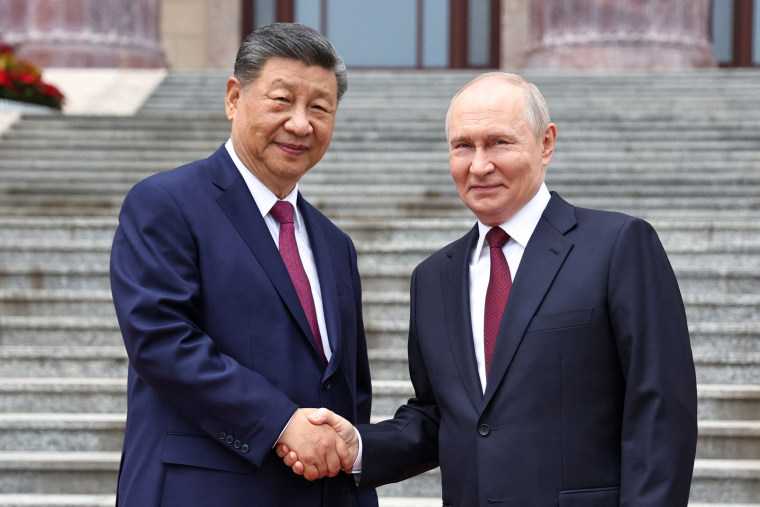
Chinese President Xi Jinping stated on Wednesday that China-Russia relations are at a “historic high.” He made these remarks during a meeting with Russian President Vladimir Putin in Beijing, held shortly after a visit by U.S. President Donald Trump. Xi noted that the international landscape is experiencing significant changes and that the world risks reverting to power struggles. He described the cooperation between China and Russia as a stabilizing force globally.
Earlier, Xi welcomed Putin outside the Great Hall of the People with a ceremony mirroring the one for President Trump the previous week. The event included the Chinese and Russian national anthems and a 21-gun salute in Tiananmen Square. For China, Putin’s visit serves to reassure a reliable ally following Trump’s visit, which sought to reset Beijing’s complex relations with Washington.
Despite neither leader directly mentioning the U.S. in their public comments, Xi criticized the global situation as being marked by turbulence and transformation, noting the rise of unilateral tendencies. Both leaders have voiced criticism of the U.S.-Iran conflict, deeming it a breach of international law, and Xi reaffirmed his call to end the conflict to minimize disruptions to global energy supplies.
Putin asserted that China-Russia relations have reached an “unprecedented level” and emphasized that Russia remains a reliable energy partner amid tensions in the Middle East. Calling Xi his “dear friend,” Putin extended an invitation for Xi to visit Russia next year, quoting a Chinese idiom to emphasize the significance of their relationship.
The two leaders signed nearly two dozen agreements on topics such as the economy, trade, education, science, and technology. They also agreed on principles for a second gas pipeline from Russia to China, the Power of Siberia 2, although no timeline was provided. Xi and Putin expressed their commitment to a “comprehensive strategic partnership” and championed the idea of a multipolar world. Additionally, they extended the Sino-Russian Treaty of Friendship and criticized the U.S. for allowing a key arms control treaty to expire and for its missile defense project, which they see as a threat to global stability.
Putin highlighted the strengthened trade relationship between Russia and China, which has grown after Russia’s conflict with Ukraine. Although a frequent visitor to China, Putin felt increased pressure due to ongoing uncertainties in Ukraine, with military setbacks and heightened tensions in Moscow. China positions itself as a neutral party in this conflict while continuing its diplomatic and economic support for Russia. The Chinese Foreign Affairs Ministry dismissed reports that Xi had questioned Putin’s decision on Ukraine during talks with Trump.
On Wednesday, the Chinese Commerce Ministry confirmed details of agreements made with the U.S., which include China’s purchase of 200 planes from Boeing. This marks the first significant Chinese purchase from the American firm in nearly a decade. In return, the U.S. agreed to ensure a stable supply of aircraft components. The ministry also mentioned the renewal of U.S. market access for American beef and poultry, creation of a board to facilitate tariff reductions, and discussions on a high-value trade deal.
Despite these agreements, both ministries have not verified China’s commitment to acquiring $17 billion in U.S. agricultural products annually until 2028, as announced by the White House. The U.S. Treasury Secretary Scott Bessent expressed comfort in the current trade conditions but noted no urgency to extend a critical minerals trade truce with China.
UN Secretary-General António Guterres commented from Tokyo that while the Trump-Xi summit demonstrated some cordiality, the absence of major agreements necessitates careful attention to Xi’s upcoming visit to Washington in September. Further meetings are anticipated between Xi and Trump when they attend summits in Miami and potentially in Shenzhen.
Russian officials have indicated a possible meeting between Trump and Putin at these events. Presidential aide Yuri Ushakov suggested that if both leaders are present in China, a meeting would be likely, though not officially planned.
Leave a Reply