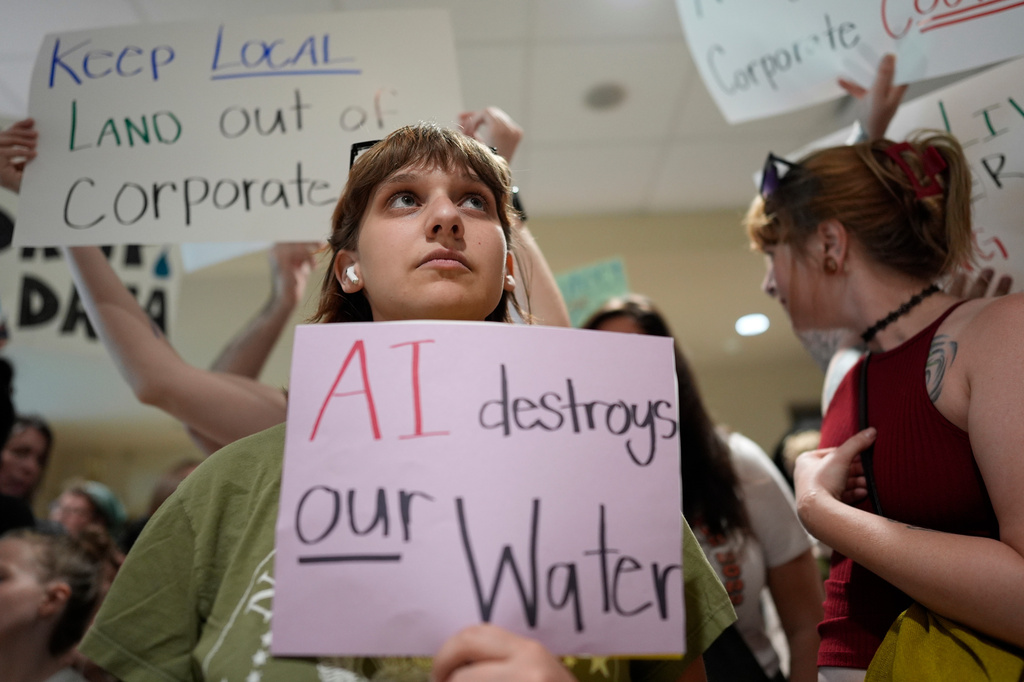
On June 11, 2026, Alexandra Crawford held a sign outside a planning commission meeting in Nashville, Tenn. The agenda focused on regulating data centers, which are crucial to artificial intelligence (AI) development. While AI often involves discussions about semiconductors, models, and talent, it is increasingly tied to electricity, transmission lines, and infrastructure.
These developments have wide-reaching implications, including how China influences public debate in the U.S. Historically, U.S. policymakers have concentrated on defending against Chinese cyber espionage and intellectual property theft. However, as U.S. institutions have strengthened defenses, Beijing’s influence operations are evolving. Evidence points to a growing focus on magnifying existing domestic disagreements regarding strategically vital industries.
Earlier this year, OpenAI released a report detailing a Chinese-linked influence operation utilizing ChatGPT to generate social media posts against American AI data centers. The campaign, known as ”Data Center Bandwagon,” created fake personas claiming data centers would increase electricity costs and damage local communities. OpenAI traced the operation to a Chinese tech company serving provincial government clients. Though modest in scope, this represents a significant shift in Chinese strategy.
The campaign illustrates how Chinese influence is shifting away from promoting overtly pro-Beijing narratives, instead inserting itself into pre-existing American policy debates. These operations amplify existing grievances rather than inventing new ones. Recent investigations highlight this trend.
For instance, Graphika analyzed “Spamouflage” networks posing as Americans during the 2024 election, while Microsoft Threat Intelligence noted Chinese operations growing more sophisticated.
OpenAI’s findings demonstrate similar techniques now target a major domestic debate: the future of America’s AI infrastructure. Data centers have become vital national infrastructure, supporting AI development, cloud computing, manufacturing, military applications, and scientific research. Both the U.S. and China view AI leadership as crucial to economic and military competitiveness.
Although Chinese state media criticizes U.S. data centers for environmental and economic impacts, the Chinese government massively subsidizes domestic AI growth. China’s electricity demand for data centers is expected to more than double by 2030. It’s essential to clarify that China did not create America’s debate over AI infrastructure. Local opposition to data centers is valid, rooted in honest concerns about energy demands, water usage, land use, and community impact.
Many local campaigns stem from genuine community concerns. Foreign influence operations often amplify existing disagreements to advance strategic goals. This dynamic is evident in information campaigns where state-linked actors insert themselves into ongoing debates. In 2022, Operation Dragonbridge included a Chinese campaign posing as Texans opposed to a Pentagon-supported rare earth processing facility. Google removed over 175,000 related accounts from YouTube and Blogger.
Current tactics could shift from rare earth processing to AI infrastructure, and soon focus on transmission lines, semiconductor fabs, quantum computing, and advanced manufacturing plants. The strategy aims to weave Beijing’s preferred outcomes into seemingly authentic U.S. discourse.
While democracies thrive on robust debate, particularly with significant industrial projects, China should not inauthentically generate anti-data center sentiment while fostering development in their own country. Their scattered efforts focus on decelerating America’s infrastructure build out and intensifying policy disagreements.
The challenge is discerning between genuine democratic discussion and coordinated foreign influence amplifying divisions over critical technologies. Nikolas Foster, a nonresident fellow at the Atlantic Council’s Global China Hub, emphasizes the importance of this distinction. Foster previously served as deputy China advisor to the USAID administrator.
Copyright 2026 Nexstar Media Inc. All rights reserved. Unauthorized use is prohibited.
Leave a Reply