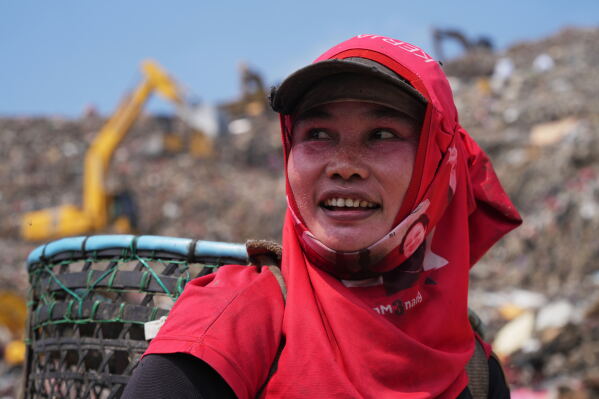
In the early hours before the sun rises, Nur Wencih, a 35-year-old widow, joins thousands of waste pickers at Bantargebang, Indonesia’s largest landfill. Situated on the eastern edge of Jakarta, she has worked there for two decades, a path she followed from her parents who still earn a living sifting through the waste. The landfill has provided for her family, helping Wencih support her two teenage daughters who live with relatives in a village. She deeply wishes her daughters won’t have to pursue the same harsh livelihood.
Wencih lives alone in a rented room nearby, earning about 200,000 rupiah, which is approximately $12, on a good day. This involves gathering discarded toys, cardboard, and plastic bottles before they are buried by bulldozers. Occasionally, she stumbles upon gold jewelry, an experience she likens to hitting the jackpot in the sweltering heat of July. However, these fortunate finds may soon become scarce.
Starting August 1, Indonesia aims to shift its landfill operations from open dumping to more controlled systems as part of a national initiative. This move will affect 343 out of the 550 disposal sites, transitioning them to controlled or sanitary landfill systems. The focus will be on accepting only waste that cannot be recycled or composted, such as diapers and dirty paper towels.
Waste pickers look for recyclable items in a pile of garbage at the Bantargebang landfill on the outskirts of Jakarta, Indonesia.
Residents are encouraged to separate organic waste and recyclables, a practice many are not accustomed to on a large scale. Dudi Gardesi Asikin, head of Jakarta’s Environment Agency, has highlighted the policy’s goals of improving environmental health, reducing pollution, and curbing methane emissions from decomposing waste.
Methane Emissions and Climate Impact
Methane accounts for about one-third of global warming effects. It traps more heat than carbon dioxide, making it a crucial focus of global climate initiatives. The U.N. Secretary-General António Guterres continues to urge governments to cut methane emissions as a fast approach to slowing global warming. Bantargebang is at the center of this climate debate because it emits a significant amount of methane compared to other landfills.
Asikin has explained that Bantargebang, which opened in 1989, was meant to function as a sanitary landfill equipped to collect methane. However, since a private-sector contract lapsed in 2016, the site has drifted towards open dumping practices.
Garbage trucks line up before unloading waste at the Bantargebang landfill on the outskirts of Jakarta, Indonesia.
Currently, only two of the original twelve methane extraction wells at the landfill remain functional. Officials are now working to cover parts of Bantargebang with tarps, a process estimated to cost up to 200 billion rupiah ($12 million).
The Dilemma of Waste Pickers
Indonesia faces a significant challenge as it reforms waste management while safeguarding the livelihoods of around 600,000 waste pickers, including over 4,000 registered workers at Bantargebang alone. These pickers retrieve and sell materials through a network of traders and recycling businesses.
Wencih expressed concern about how she will provide for her family amidst these changes. While the government seeks to offer safer job opportunities in recycling and composting, the transition poses concerns for many who rely on current practices.
“Today they are practically racing against our excavators to grab recyclable materials. It is extremely dangerous,” Asikin noted.
The Growing Landfill at Bantargebang
Bantargebang covers about 110 hectares (272 acres) and has grown to a height of 60 meters (196 feet), equivalent to a 20-story building. Daily, roughly 7,500 tons of waste are deposited from Jakarta. In March, a rain-triggered collapse at the site claimed seven lives, emphasizing the urgency of its condition. Agung Pujo Winarko, the facility head, has pointed out that the landfill’s capacity is nearing, or possibly exceeding, its limits.
Workers operate heavy machines at the Bantargebang landfill.
According to satellite data analyzed by UCLA’s STOP Methane initiative in 2025, Bantargebang was ranked the world’s second-largest landfill methane emitter, following a site in Argentina. Reducing organic waste at landfills could lower emissions, though monitoring and gas collection are needed for years to come.
Jakarta’s Recycling and Waste Separation Efforts
The new policy requires Jakarta residents to segregate organic waste, recyclables, and residual trash as the city develops refuse-derived fuel plants. Asikin describes this initiative as revolutionary, given the absence of previous attempts to educate the public on waste separation.
However, there is uncertainty about whether enough public education has been conducted to facilitate these changes. Central Jakarta resident Rukasih Wanti voiced her confusion, citing the inconvenience of the new rules.
Collaboration among various government ministries and the implementation of new recycling and composting infrastructures are required for effective change. Currently, formal systems handle only about a quarter of Indonesia’s daily waste volume. The remainder is unmanaged.
David Sutasurya of the environmental organization YPBB has noted that half of Jakarta’s waste is compostable and about 30% recyclable. This indicates that up to 80% of waste could avoid landfills.
In West Jakarta, Monica T. Anggriani has been successful in encouraging her neighbors to separate household waste. Her community waste bank processes organic waste through methods like composting, maggot cultivation, and urban farming.
Workers spray water to cool garbage piles at the landfill during hot weather, addressing immediate conditions as Indonesia continues to tackle long-term waste management issues.
Leave a Reply