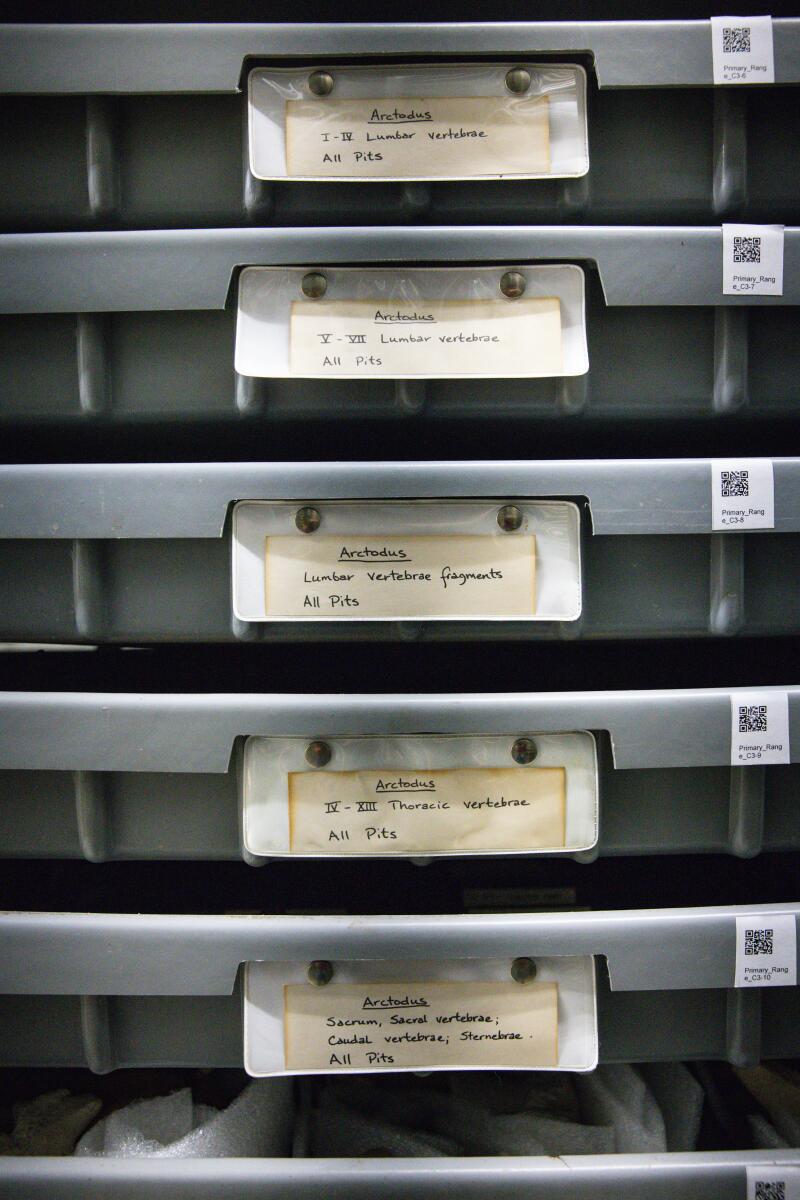
The back rooms of the La Brea Tar Pits resemble a maze filled with packing crates. Each crate is labeled with handwritten sticky notes stating contents like “bison skulls” or “camel hip.” Every bone, from the dire wolf ribs to sabertooth fangs, will be protected in custom foam shells. The museum will be closing for a major renovation starting July 6, lasting until summer 2028. During this period, the museum aims to highlight the extensive collection and the ecosystem preserved by the pits.
Upon reopening, the La Brea Tar Pits will serve as a central part of the Samuel Oschin Global Center for Ice Age Research. This scientific hub will focus on an era of natural history exceptionally preserved in the pits. Nature selected this location 60,000 years ago when crude petroleum began surfacing, leading to the capture of everything that encountered these sticky pits. This creates a near-complete record of life in what is now Los Angeles during the late Pleistocene.
Fossilized remains, including dire wolf skulls, reflect an era with parallels to today — climate change, extinction, and human impact on the environment. In 2023, curators Regan Dunn and Emily Lindsey used the collection to study biodiversity collapse coinciding with human arrival and associated fires. This story of extinction and resilience is critical for understanding current global challenges, as noted by Lori Bettison-Varga, president of the Natural History Museums of Los Angeles County.
The current museum lacks the capacity to effectively tell this story, as its exhibits stem from an era when both the collection and scientific understanding were smaller. Notable misconceptions include the outdoor Lake Pit’s submerged mammoth sculpture, suggesting inaccurately that tar worked like quicksand. Actual exhibits about bugs and plants are limited, despite their importance in the Ice Age ecosystem.
The planned renovation will address these issues. Community members and visitors have suggested retaining popular features, such as the grassy hills for children and the tar pull exhibit. Outdoor mammoth family sculptures will also remain, with modifications for scientific accuracy. The new museum layout will enhance space for exhibits, research, and educational programs. The inner courtyard will feature plants from the late Pleistocene like cypress and toyon.
All current mounted mammal skeletons will return, joined by new displays like a giant ground sloth constructed from real fossils and Zed, the most complete Columbian mammoth discovered. The collection, including some 3.5 million fossils, will temporarily move to other Natural History Museum properties during the renovation process.
Volunteers and employees are actively working to relocate these fossils. Visitors can view activities within the Fish Bowl, a glass-walled lab where preparators clean fossils. Volunteers, such as Ricky Whitman, contribute to restoring parts like the Columbian mammoth neck vertebrae. Excavations and conservation efforts continue during the closure but in altered conditions.
The museum plans mobile programming for the 34,000 schoolchildren who visit annually. Although the Fish Bowl-type lab will be expanded, volunteer preparators will adjust to working without an audience. They reflect fondly on interactions with visiting children, an aspect that will resume with the renovated museum.
Leave a Reply