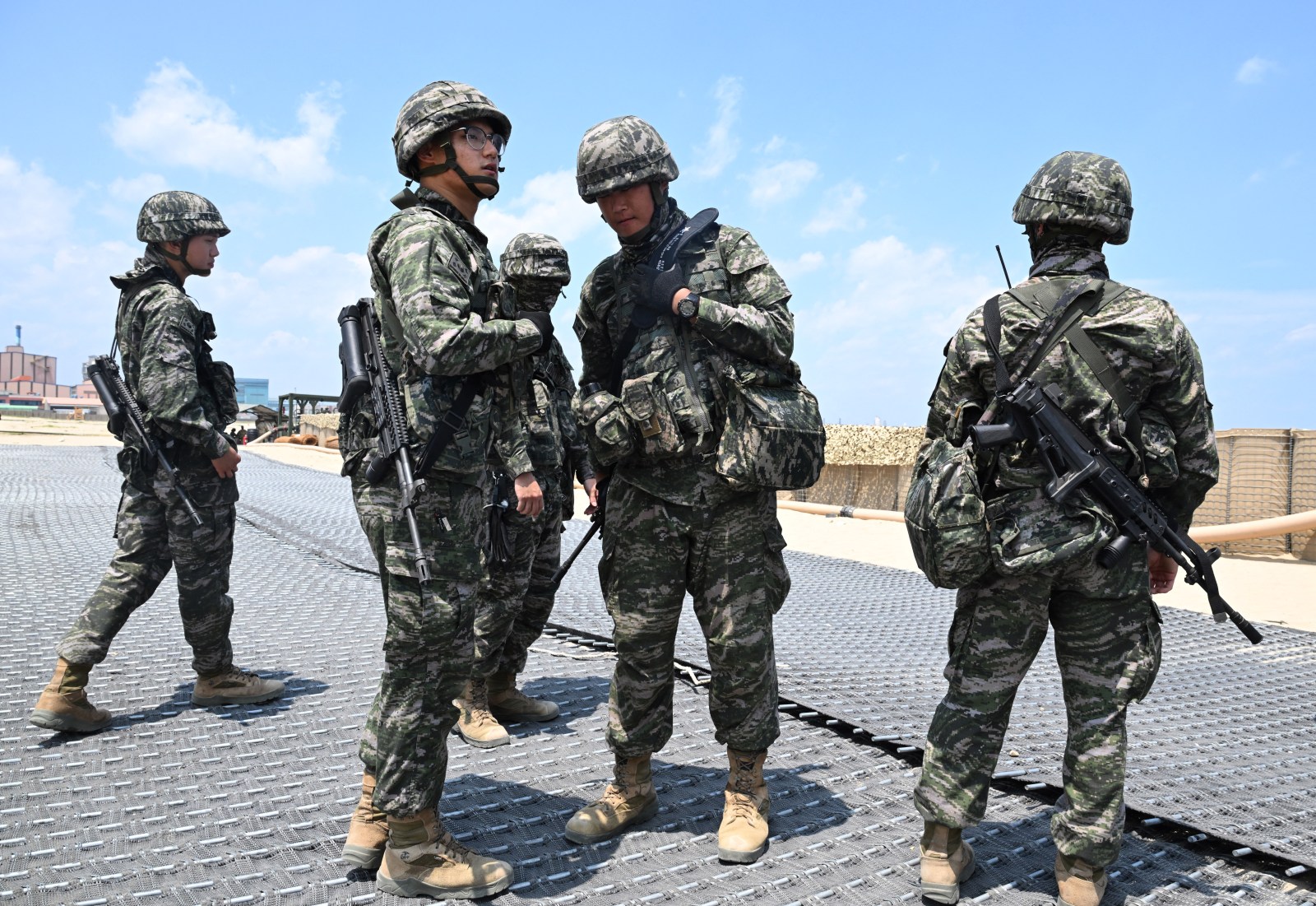
Donald Trump’s decision to scale back military exercises with South Korea has generated significant discussion among analysts and policymakers. This move might pave the way for renewed negotiations with North Korea, potentially allowing Washington to address constraints on Pyongyang’s expanding nuclear capabilities, according to experts.
Reasons Behind the Decision
Trump announced on Sunday that he directed Defense Secretary Pete Hegseth to reduce the annual military drills in response to his positive relationship with North Korean leader Kim Jong Un and Seoul’s insufficient support for the conflict in Iran. Despite the announcement, exercises commenced on Monday as originally planned.
During his initial term, Trump met Kim three times for denuclearization talks that did not yield results. Since then, North Korea has enlarged its nuclear arsenal, reportedly holding around 60 assembled weapons and possessing enough fissile material for at least 30 more, based on a report from the Stockholm-based think tank in June 2026. Pyongyang has also conducted banned ballistic missile tests this month.
Reactions and Concerns
Trump’s announcement on Truth Social has raised concerns among Democrats, Republicans, and South Korean officials. Some fear the decision might strengthen Pyongyang and question Washington’s reliability as an ally during a challenging geopolitical period.
Evan Sankey, a policy analyst at the Cato Institute, speculated on the possibility that this step might lead to a renewed push for U.S.-North Korea talks. He noted that while convincing Kim to relinquish nuclear weapons seems unlikely, discussions might lead to restrictions on missile arsenals and fissile material.
Jennifer Kavanagh, director of military analysis at Defense Priorities, described Trump’s announcement as a strategic decision aligning with U.S. interests. Newsweek reached out to both the White House and South Korean foreign ministry for comment.
The U.S.-South Korea Military Relationship
South Korea houses the largest American military base abroad, Camp Humphreys, and both nations regularly conduct joint military drills. The Ulchi Freedom Shield exercises began Monday, focusing on countering North Korea’s evolving threats including drones, GPS disruptions, and cyberattacks. Local authorities reported the participation of at least 18,000 South Korean troops.
North Korea has consistently criticized these drills, labeling them as preparations for warfare. Trump commented on Truth Social that the exercises convey a “hostile” message to North Korea, which he describes as “unthreatening and respectful.”
Sen. Jack Reed, a leading Democrat on the Senate Armed Services Committee, accused Trump of cutting military exercises to flatter a dictator. Republican Sen. Thom Tillis also criticized Trump’s decision, suggesting it frees North Korean forces to support Russia’s military efforts.
In an op-ed, the South Korean newspaper Hankook Ilbo stated that Trump’s announcement exposes the fragile Korea-U.S. alliance. Sankey from CATO remarked that Trump’s decision mirrors past cancellations during his 2018 and 2019 negotiations with Kim, which may indicate a future U.S. initiative.
Comments on Regional Stability
Kavanagh expressed doubt on the effectiveness of drills with South Korea, claiming they may provoke further military buildups from North Korea and China. She stated such drills accelerate regional military engagements such as weapons tests.
South Korea’s Security Control Efforts
Kavanagh argued that exercises with South Korea drain U.S. resources and readiness, already limited due to the conflict in Iran. She suggested Washington should transfer the responsibility of South Korea’s security entirely to Seoul.
South Korea’s President Lee Jae Myung emphasized the need to expedite the transfer of wartime operational control from the U.S. to Seoul and advocated for acquiring nuclear-powered submarines. The matter dates back to the Korean War, which concluded in an armistice in 1953 without a peace treaty.
Sankey proposed that talks between Washington and Pyongyang might result in a Korean War resolution, emphasizing the diplomatic value of such efforts to serve U.S. interests.
Contact Newsweek editors concerning this story: Matthew Robinson and Cristina Diciu.
Leave a Reply