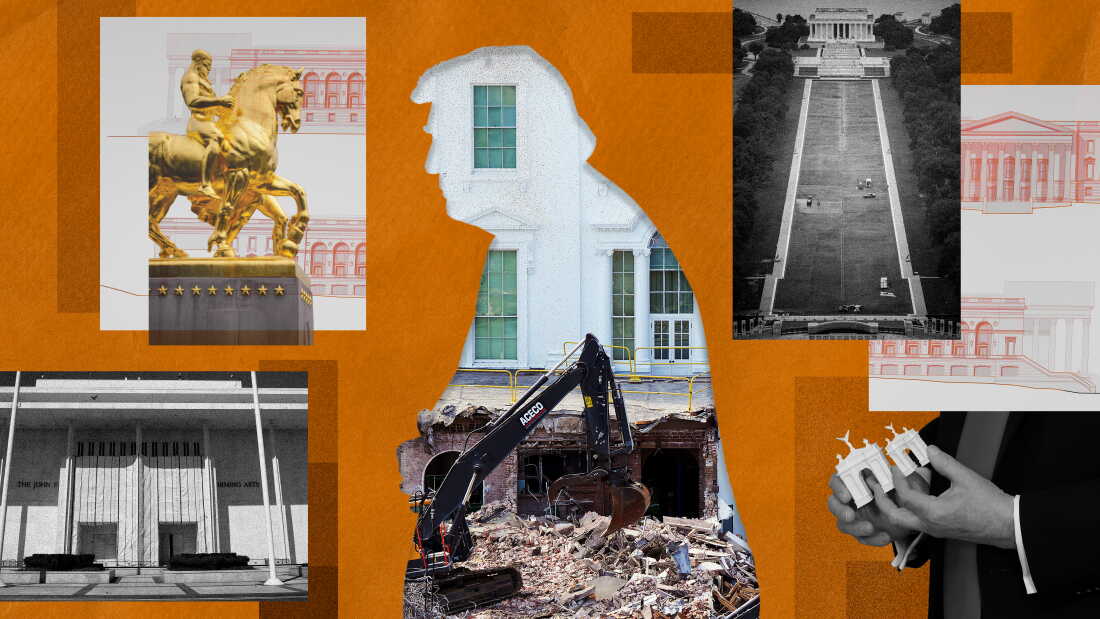
President Donald Trump has spent a significant portion of his second term focused on construction projects in Washington, D.C. With ambitions to reshape the nation’s capital, Trump has attempted numerous changes to the White House and D.C.’s iconic sites. He seeks to earn the title ‘builder-in-chief.’ Trump has torn down the East Wing to construct a larger ballroom and military complex underneath. A helipad was placed on the South Lawn, and the Rose Garden paved over. His plans for the Lincoln Memorial Reflecting Pool to be in ‘American flag blue’ remain incomplete due to installation issues and arrests. Furthermore, Trump envisions a sculpture garden celebrating ‘national heroes’ in West Potomac Park and desires to transform East Potomac Golf Links into a championship venue.
Trump also aims to attach his name to the Kennedy Center or demolish it. He seeks to expedite the construction of a 250-foot arch near Arlington National Cemetery, describing it as a military complex rather than an honor for himself. White House spokesperson Davis Ingle stated that Trump simultaneously fulfills policy promises while ‘glorifying’ the capital for future generations. Despite these efforts, Trump’s projects have incited protests and legal battles. Critics accuse him of rushing memorialization to ensure personal recognition. In a piece by New York Magazine, Trump admitted concerns that his efforts would cease once he is out of office at the age of 80.
Greg Werkheiser, involved in numerous lawsuits against Trump’s projects, commented that Trump’s self-worth stems from his identity as a builder. A White House statement claimed Trump’s renovations benefit both the People’s House and the nation’s capital, asserting no other president has contributed more to its interior beauty. Trump’s boastful emphasis on construction skills raises questions. Critics note controversies in his early career projects, amplified with perceived disregard for historic preservation.
Barbara Res, former head of construction for the Trump Organization, emphasized Trump’s tendency to cut corners, affecting the capital and sparking protests. Res shared insight into Trump’s past and challenged the notion that these skills translate well to his presidential role.
Res distinguished between builders and developers, noting Trump’s involvement in broader strategic decisions rather than technical construction know-how. His name-building tendencies ignore legal precedents and norms. Historically, Trump’s experiences in construction have primarily aimed at self-promotion rather than preservation.
Reflecting on Trump’s earlier years, Tim Naftali, a historian, asserts Trump operates as though he owns the White House, contrary to historical precedent where presidents acted as custodians. Construction has historically required Congressional authorization, a precedent Trump dismisses, setting the stage for potential future White House occupants to follow suit.
Now, several developments in D.C. echo Trump’s personal ambitions. Monuments to national heroes have traditionally resulted from collaboration between presidential vision and Congressional action. Naftali references President Franklin Delano Roosevelt’s humble request for a modest memorial, contrasting it to Trump’s grandiose initiatives.
Charles Birnbaum of The Cultural Landscape Foundation notes Trump’s disregard for preservation, appointing non-experts to oversight panels, and potentially exporting this mindset nationwide.
Trump plows forward with construction despite broader economic and international issues. Historically, presidents have pursued legacy through work and presidential libraries. Trump’s unconventional path sees him leaving a personal imprint on historic sites and establishing new dubious records, including currency and airport naming, during his presidency. He aims to secure his legacy firmly, fearing loss after leaving office.
Amid rapid change, experts warn against potential erosion of power separation. Trump revealed intentions to solidify the White House ballroom with ‘nuclear concrete,’ thwarting demolition attempts by Democrats. These actions threaten broader constitutional norms and separation of powers doctrines.
Leave a Reply